
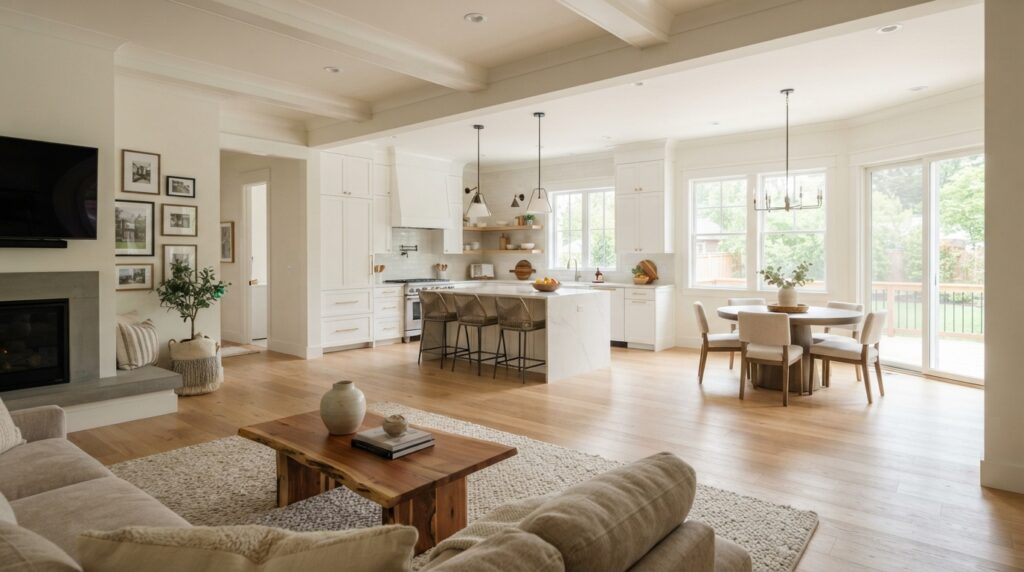
As we embrace the evolving landscape of home design, the allure of open concept house plans continues to captivate the hearts of prospective homeowners. With their airy, light-filled interiors and effortless flow from room to room, open concept home designs offer a refreshing departure from the traditional boxy layouts of the past. If you’re weighing open concept floor plans for a new home, here are the benefits, the trade-offs, and what to decide before building.
Key Takeaways
- An open concept floor plan combines two or more rooms with related uses into one space, such as the kitchen, dining room, and living room.
- The five main benefits are flexibility, easier time together, more natural light, a home that feels larger, and potential resale appeal.
- The trade-offs are real: sound carries, privacy drops, and one large space is harder to keep at an even temperature than separate rooms.
- A semi-open (hybrid) plan keeps the kitchen and living area connected while closing off rooms such as an office or play area.
- Most trade-offs are simplest to solve at the floor plan stage, and Reinbrecht Homes builds open, semi-open, and traditional layouts across 30+ customizable floor plans.
What Is an Open Concept Floor Plan?
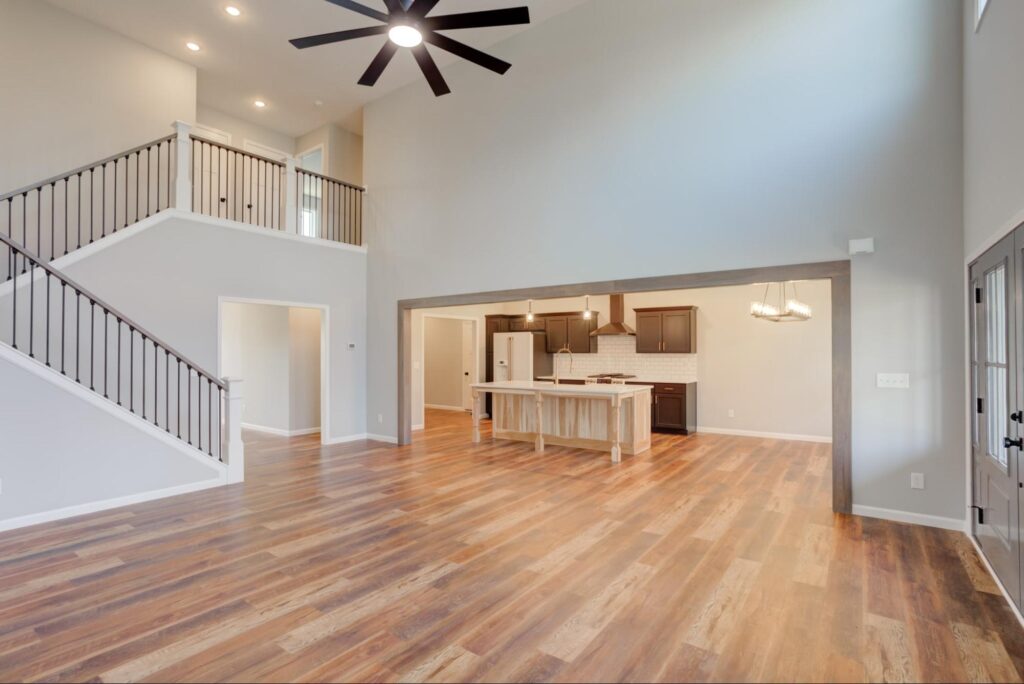
An open concept floor plan combines two or more rooms with related uses into one space, such as the kitchen, dining room, and living room. Instead of walls and doorways, the rooms flow into each other. You’ll often hear the combined living space called a great room.
It works in both types of new homes Reinbrecht builds:
- Semi-custom: you personalize an existing floor plan.
- Custom: the layout is designed from scratch.
Whether you’re a growing family, a social butterfly, or simply someone who appreciates the blend of functionality and style, open concept home plans are a smart choice that caters to a diverse range of preferences and needs.
5 Reasons to Consider Open Concept Floor Plans
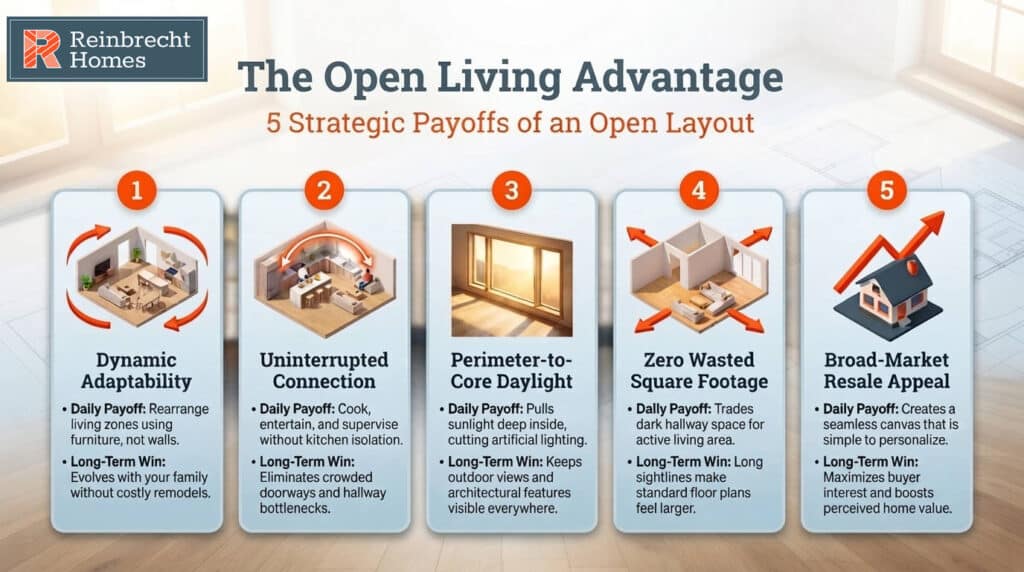
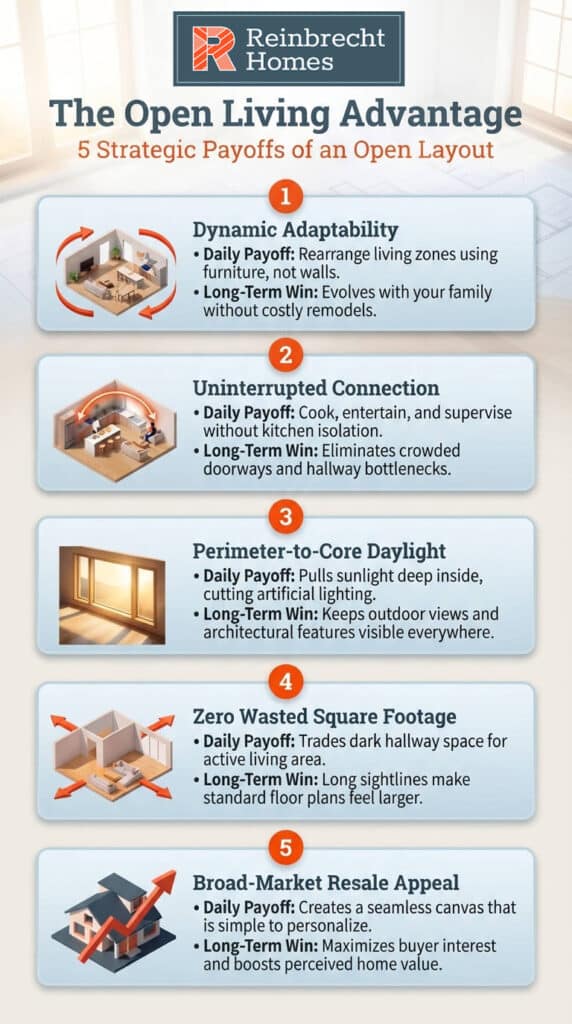
Open concept floor plans grew in popularity after World War II and had become the norm in new construction by the 1990s, and for a good reason. In this blog post, we will delve into the top five reasons why opting for an open floor concept house plan is not just a trend but a strategic decision for your future home. With Reinbrecht Homes’ expertise, we’ll explore how these designs:
- Add flexibility: they provide the flexibility to adapt to your evolving lifestyle.
- Bring people together: they foster enhanced social interaction.
- Share the light: they bathe your living spaces in natural light.
- Live larger: they make homes feel larger.
- Support resale appeal: they can potentially increase your home’s resale value.
Below we will explore each one, and why open concept living might just be the perfect fit for your dream home.
1) More Flexibility and Versatility
An open layout gives you more ways to use the same space. Open floor house plans are celebrated for their inherent flexibility and versatility: furniture or movable pieces divide the space, and its uses can change as needed. Likewise, an open layout helps new homebuyers avoid the common mistake of not choosing a floor plan with future changes in mind.
The spacious nature of an open concept floor plan provides a canvas that can be customized to suit various functions, and the adaptability of open concept home plans caters to the evolving needs of families:
- Everyday living: an expansive living room for family gatherings, a cozy nook for quiet reading, or an extra dining space for frequent entertainers.
- Growing families: a toddler’s play zone that later becomes a teenager’s study spot or a home office nook.
- Aging in place: with fewer walls creating barriers between living spaces, homeowners can incorporate aging-in-place elements while maintaining a seamless flow.
For those contemplating future renovations or updates, an open floor plan can make remodeling easier, allowing for simpler reconfigurations without the hassle and expense of moving walls.
2) Enhanced Social Interaction and Cohesiveness
Open concept floor plans foster an environment of social cohesion, encouraging interaction and connectivity between family members and guests. By removing the barriers of traditional compartmentalized rooms, everyone can interact more freely and seamlessly. That shared living experience shows up in three everyday ways:
- Family time: open sightlines make it easier to keep an eye on children or older family members, from homework at the dining table to a parent living with you in a multigenerational home.
- Hosting: a cohesive flow between the kitchen, dining area, and living space lets hosts engage with guests while attending to meal preparation or refreshments.
- Fewer bottlenecks: guests can move between the island, the table, and the living area without crowding into hallways and doorways.
3) Improved Natural Light and Expansive Views
Open floor concept floor plans excel in maximizing natural light throughout the home, and they put that light and the views to work in three ways:
- Daylight travels farther. With fewer interior walls to obstruct sunlight, daylight reaches more of the connected space, which can reduce reliance on artificial lighting.
- Views carry across rooms. The strategic placement of windows can offer panoramic views that extend across multiple living areas, so occupants enjoy their surroundings from more of the home.
- Architectural features stand out. A vaulted ceiling, a fireplace, or a wall of windows can be seen from more vantage points when walls aren’t in the way.
Natural light and indoor-outdoor flow were among the trends highlighted in NAHB’s 2025 Best in American Living Awards. Getting the most from daylight also takes careful window placement that lets sunlight in while controlling glare and heat, one more reason to settle window placement at the floor plan stage.
4) Making Homes Feel Larger and More Open
An open layout can feel bigger than the same area divided into rooms, so it can work well with less square footage. That matters now that the median home size has leveled off at 2,155 square feet in 2025, about the same as 2,150 in 2024. Two things create the effect:
- Less dead space: minimizing unused or “dead” space is another significant benefit of open floor house plans. Traditional layouts often have hallways and small, enclosed rooms that are infrequently used, effectively wasting valuable square footage.
- Longer sightlines: by eliminating physical barriers that interrupt sightlines, open concept layouts promote smooth transitions between living spaces and contribute to a home’s visual continuity.
In contrast to a traditional layout, an open concept home plan is designed to utilize every inch of space efficiently, promoting a minimalistic environment that feels more open and airy. This can make homes feel more connected and cohesive while creating an illusion of added square footage.
5) Better Resale Value and Market Appeal
An open layout may help your home’s appeal when it’s time to sell, but treat that as potential: higher property value is a possible benefit of an open plan, not a guaranteed one. Open floor house plans can also influence a property’s marketability in two ways:
- Wider interest: open concept designs have the potential to attract a wider audience when it’s time to sell.
- Perceived space: as discussed earlier, open concept layouts can increase a home’s perceived square footage, which may add to its appeal.
That appeal supports the potential for a higher resale value, though no floor plan guarantees a return. Reinbrecht Homes thoughtfully incorporates open floor concept floor plans and open concept elements into its designs, offering homeowners both immediate enjoyment and potential future advantages.
What Are the Trade-Offs of an Open Concept Floor Plan?
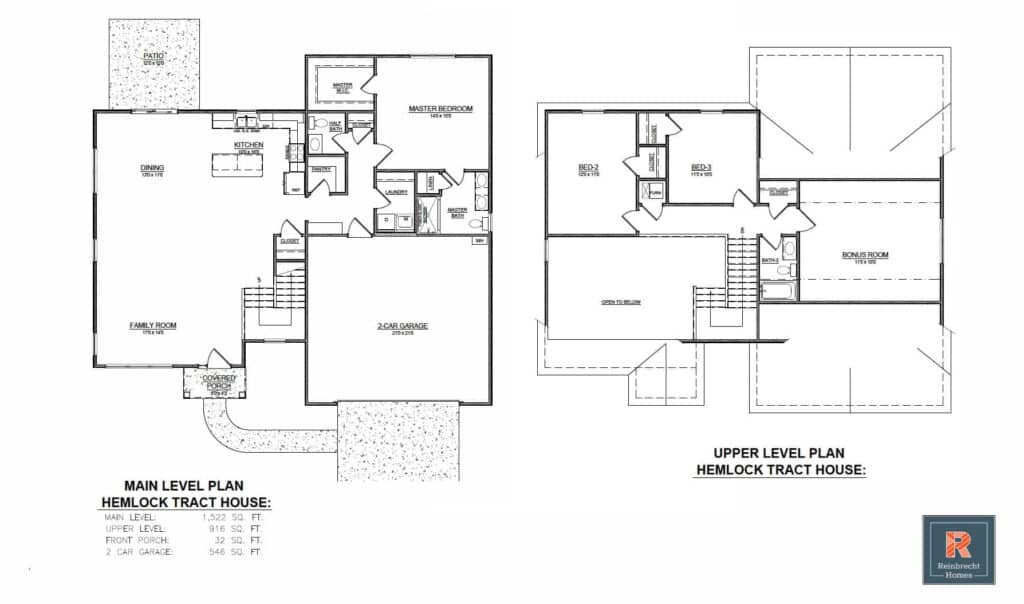
The main trade-offs of an open concept floor plan are noise that carries, less privacy, a space that can feel undefined, uneven heating and cooling, and added structure. Most are simplest to address at the floor plan stage, before framing, which is where a new-construction buyer has the advantage.
The table pairs each trade-off with its cause and the decision that addresses it:
| Trade-off | What causes it | What to decide at the floor plan stage |
|---|---|---|
| Noise carries | Appliance noise and conversation carry through an open space, with fewer walls to dampen them. Echo can be an issue. | Consider a semi-open plan: keep the kitchen and living area connected, and close off the office, play area, or utility rooms. |
| Less visual privacy, more visible clutter | Fewer places to retreat, less ability to run different activities side by side, and everyday clutter stays in view. | Plan partial dividers that separate without fully blocking sight lines: half walls, French, pocket, or barn doors, and oversized doorways. |
| The space can feel undefined | A single large room has to work as one design and leaves less wall space for art and decor. | Define zones with a kitchen island or peninsula, a change in flooring or ceiling height, ceiling beams, and furniture placement. |
| Harder to heat and cool evenly | One large space is harder to keep at an even temperature than separate rooms, which can be heated and cooled as their own zones. More glass also leaves less insulated wall. | Ask about the wall and window package early. Every Reinbrecht home includes Spider Plus sprayed-in fiberglass insulation in the exterior walls, spray foam sealing the band boards (where each floor meets the exterior walls), and caulk sealant on the inside of all exterior walls. |
| Structure and upfront cost | Without interior load-bearing walls, open spans are carried by steel or laminated beams, which can add to the upfront build cost. | Decide it in the plan. This can be simpler in new construction than in a remodel. Reinbrecht prices each home upfront, so the cost is known before signing. |
Three smaller points are worth raising early too: cooking odors, fewer kitchen walls for cabinets, and where plumbing and wiring will run.
How Do You Define Spaces in an Open Concept Floor Plan?
You define spaces in an open concept floor plan with furniture, fixtures, and area rugs, kitchen islands or peninsulas, and changes in flooring type or ceiling height instead of walls.
Architectural Cues: Islands, Half Walls, and Ceiling Changes
These cues are built in, so decide them while your plan is still on paper:
- Island or peninsula: it marks where cooking ends and living begins, and the right kitchen island size depends on the clearances around it.
- Half wall: topped with a countertop or built-in shelving, it separates living and dining areas while light and conversation still flow.
- Ceiling: a dropped soffit (a lowered section of ceiling), a change in ceiling height, or ceiling beams can mark out a zone overhead.
Flooring Transitions and Area Rugs
A change in flooring, such as hardwood in the living area and tile in the kitchen, draws a line without building one (our new home flooring guide compares the options). If you prefer one continuous floor, a large area rug can anchor the seating area.
Furniture Placement as Soft Walls
The back of a sofa can act as a soft wall between the living area and a walkway or dining space, and a console table or folding screen can reinforce that edge. Size each zone for its furniture first, the approach in our guide to great room and living room dimensions.
Open vs. Semi-Open vs. Traditional Floor Plans: Which Fits How You Live?
An open plan combines the main living areas into one space, a traditional plan gives each room its own walls, and a semi-open plan lands in between. A semi-open, or hybrid, layout keeps the kitchen and living area connected while closing off rooms such as an office or play area.
Here is how the three compare:
- Open: the kitchen, dining, and living areas share one space.
- Semi-open (hybrid): the kitchen and living area stay connected, while half walls, French, pocket, or barn doors, and oversized doorways separate other spaces.
- Traditional: each room has its own walls and doorways.
If someone in your household needs a door that closes, look closely at a semi-open plan with a flex room that can work as an office or guest room. Builders also plan to include more flex spaces, rooms that can change jobs over time.
Reinbrecht Homes: Tailoring Open Concept Designs to Your Lifestyle
Reinbrecht Homes builds open, semi-open, and traditional layouts across 30+ customizable floor plans. The team is dedicated to crafting homes that are not only structurally sound but also tailored to the lifestyles of their clients. With a strong commitment to quality and customer satisfaction, Reinbrecht understands that each homeowner has unique needs and preferences. By offering a variety of open concept floor plans, plus move-in ready homes when they’re available, Reinbrecht Homes provides a canvas for personal expression and lifestyle-centric design.
The portfolio of completed projects showcases the versatility and beauty of open concept home plans executed by Reinbrecht Homes. We have several floor plans that offer expansive living areas, including these three homes:
- This semi-custom home in Evansville, Indiana: a 1,756 square foot Fir plan with an open concept first floor.
- This single level semi-custom in Elberfeld, Indiana: a 1,601 square foot Magnolia plan, the smallest of the three.
- This 2,995 square foot semi-custom home in Newburgh, Indiana: an open floor plan with a study and formal dining room alongside the great room.
Check out our project gallery for a look at our finished open floor concept house plans that suit the varied tastes of our clientele.
Reinbrecht Homes recognizes that an open floor concept is not the ideal fit for every client, and they welcome homeowners to explore their other design options. Whether it’s a traditional layout with defined rooms or semi-open designs that incorporate elements of both styles, Reinbrecht Homes offers semi-custom, custom, and spec home options so you can find your perfect match.
One homeowner described working with the Reinbrecht team this way:
Frequently Asked Questions About Open Concept Floor Plans
Do open concept floor plans work for small homes?
Yes. An open layout can feel bigger than the same area divided into rooms, so it can work well with less square footage.
What is a semi-open floor plan?
A semi-open floor plan, also called a hybrid layout, keeps the kitchen and living area connected while closing off rooms such as an office or play area. It uses partial dividers like half walls and French, pocket, or barn doors. Reinbrecht Homes offers semi-open designs alongside open and traditional layouts.
Is it cheaper to build a home with an open floor plan?
Not necessarily. Without interior load-bearing walls, open spans are carried by steel or laminated beams, which can add to the upfront build cost. Reinbrecht avoids cost per square foot as a way to compare builders, which it considers unreliable. Instead, each home is priced upfront so you know the cost before signing.
Are open concept floor plans going out of style?
No, they are evolving more than disappearing. Open plans had become the norm in new construction by the 1990s, and the newer direction is a hybrid layout that keeps the main living area connected and adds doors where privacy matters.
Take Advantage of Open Concept Living In Your Next Home
As we’ve explored throughout this post, open concept floor plans are more than just a design trend. They are a smart choice for a home that grows with you, celebrates your social lifestyle, and embraces the beauty of your surroundings. The best ones balance openness with cozy, functional zones.
Open concept home plans offer a unique blend of practicality and style. Embrace the modern, spacious living that an open concept house plan offers, and let Reinbrecht Homes guide you in creating a home that’s tailored to your unique lifestyle. Let’s discuss how our customizable open floor house plans can be the foundation of your dream home.
Interested in learning more? Reach out to Reinbrecht Homes for a consultation and start your journey toward a beautiful, open concept home today.
