
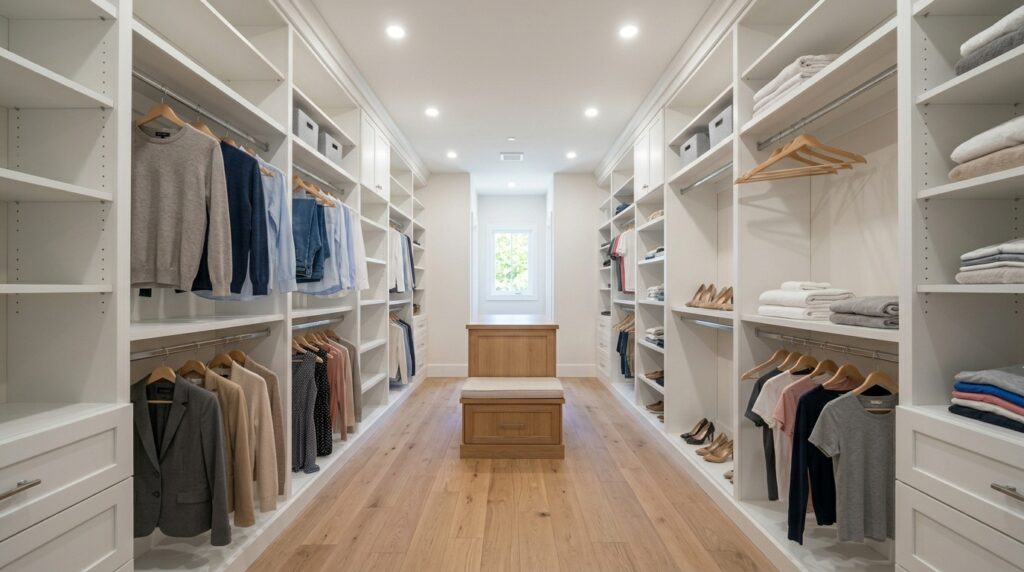
Homes keep getting smaller, but buyers refuse to shrink one space: the closet. When you build a new home, the walk-in closet dimensions you choose get locked in at framing, so sizing the space correctly before the drywall goes up matters more than almost any other storage decision. This guide covers standard sizes, minimums, layouts, and depth so you can plan a primary closet that fits how you actually live.
Key Takeaways
- A standard primary walk-in closet runs about 5 by 6 feet for one person, 7 by 10 feet for two people, and 8 by 12 feet for an island or dressing-room layout.
- The smallest practical walk-in is about 4 to 5 feet wide, built around roughly 24 inches of hanging depth on each storage side.
- Even as the typical buyer’s desired home size fell from 2,260 square feet in 2003 to 2,067 in 2023, the closet is one of the few spaces buyers won’t shrink.
- Only 22% of buyers willing to accept a smaller home would take a smaller closet, second only to the kitchen.
- Layout (single-sided, galley, L-shape, U-shape, or island) shapes how a closet works as much as its square footage does.
- The cheapest time to upsize or reconfigure a closet is during framing, before finishes go in.
What Are the Standard Walk-In Closet Dimensions?
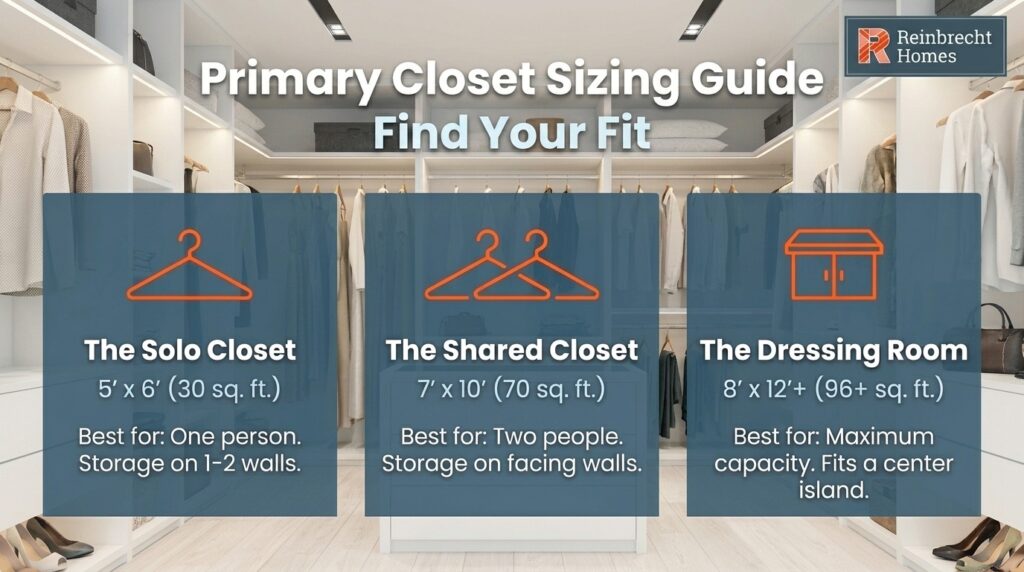
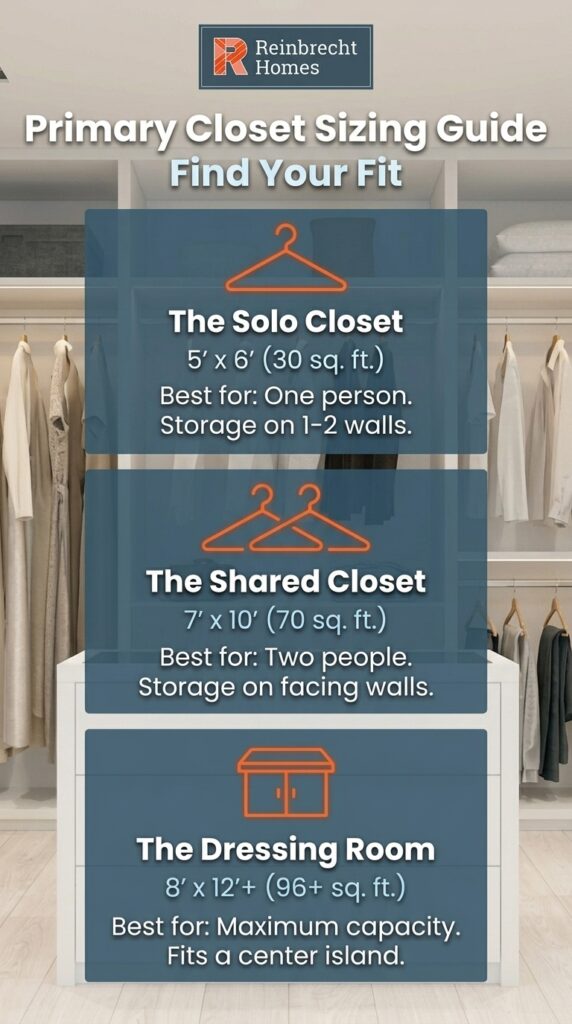
A standard primary walk-in closet is about 5 by 6 feet (30 square feet) for one person, 7 by 10 feet (70 square feet) for two, and 8 by 12 feet (96 square feet) when you want an island or a dedicated dressing zone. If you have ever wondered how big a master closet should be, those three sizes cover most new homes.
As a family-owned builder that has designed and built homes across Southern Indiana, Northwestern Kentucky, and Eastern Illinois since 1995, Reinbrecht Homes sizes the closet as part of the full primary suite, not as an afterthought. The closet shares a wall budget with the bedroom and bathroom, which makes its footprint a floor plan decision you make before the build begins.
Use these as starting points for a primary closet:
- One person: about 5 by 6 feet (30 square feet), enough for hanging and shelving on one or two walls.
- Two people: about 7 by 10 feet (70 square feet), the common shared size with storage on facing walls.
- Island or dressing room: about 8 by 12 feet (96 square feet) and up, with room for a center island and a folding surface.
What Is the Minimum Size for a Walk-In Closet?
The minimum practical walk-in closet is about 4 to 5 feet wide and 5 to 6 feet deep. That gives you one wall of storage plus enough room to step in, turn, and reach hanging clothes without the door catching the rod.
A few minimum-size questions come up in almost every planning conversation:
- Is 6 feet wide enough? Yes, for a single-sided layout. Six feet of width leaves room for about two feet of storage on one wall and a comfortable walkway in front of it.
- Is 6 by 6 big enough? It works as a compact walk-in for one person, but it gets tight once you add storage on facing walls or share the space.
- What about a double-sided closet? Plan for at least 6 to 7 feet of width so two facing storage walls still leave a clear center walkway.
Walk-In Closet Layouts Compared
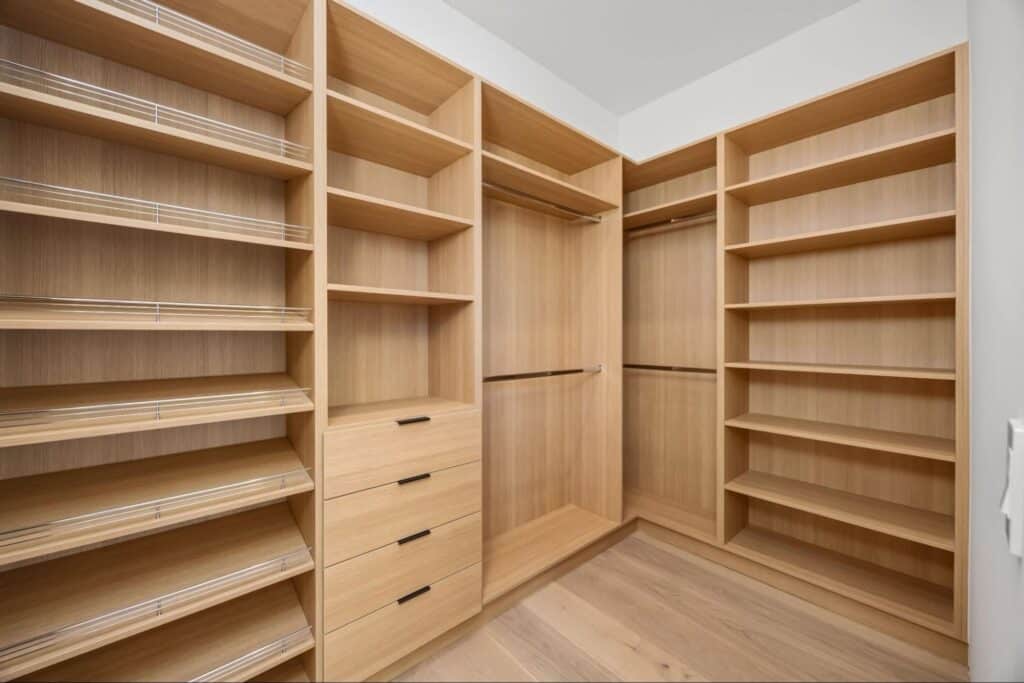
Five layouts cover almost every primary closet: single-sided, galley (double-sided), L-shape, U-shape, and island. The right walk-in closet layout depends on your floor plan, how many people share the space, and whether you want a dressing area.
Here’s how the common layouts compare on footprint and fit:
| Layout | Typical footprint | Storage configuration | Best for |
| Single-sided | About 5 by 6 feet | Hanging and shelving on one wall | One person, smaller suites, tight floor plans |
| Galley (double-sided) | About 7 by 10 feet | Two facing walls with a center walkway | Shared closets, maximum hanging in a narrow footprint |
| L-shape | About 6 by 8 feet | Two perpendicular walls | Corner placement, mixing long-hang and shelving |
| U-shape | About 8 by 8 feet and up | Storage on three walls | Two people, high capacity, room for a bench |
| Island | About 8 by 12 feet and up | Perimeter storage plus a center island | Dressing-room feel, folding space, larger primary suites |
Seeing these in finished homes helps. Reinbrecht’s completed project gallery shows real primary suites with single-sided, galley, and island closets you can use as a reference.
How Deep Should a Walk-In Closet Be?
A walk-in closet needs about 24 inches of depth on each storage wall, which is all a row of hanging clothes requires. Get that depth right and the rest of the closet falls into place.
Depth planning works outward from that hanging baseline:
- Single-sided closet: one storage wall at that depth, plus standing room to step in and reach it.
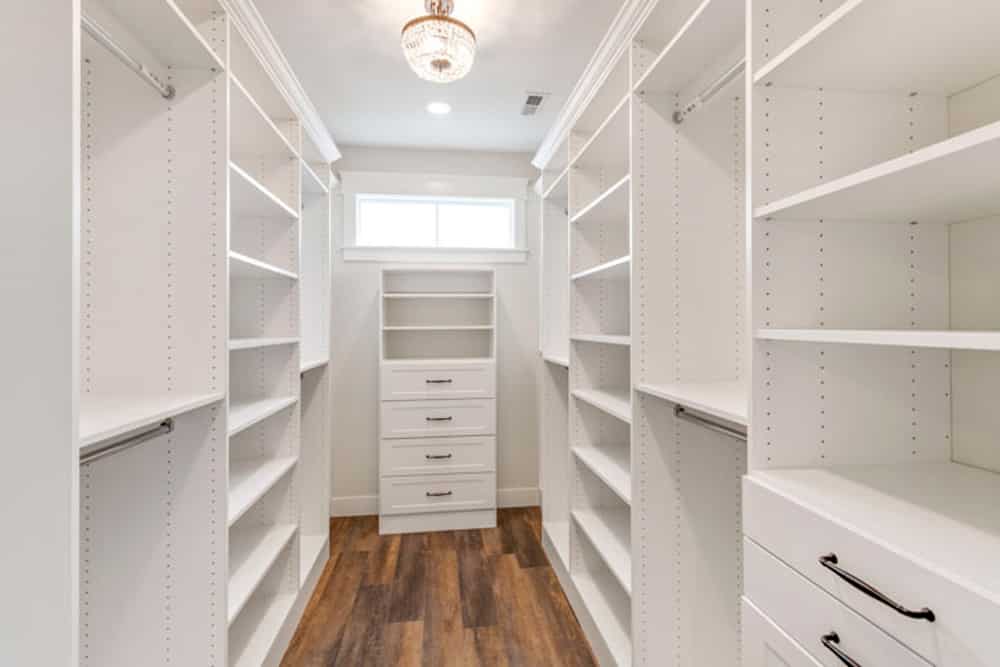
- Galley closet: storage at that depth on both facing walls, with a center walkway between them.
- Walkway clearance: plan roughly 36 inches between facing storage so two people can pass and reach the rods.
His-and-Hers Closet Dimensions for Shared Primary Suites
A shared his-and-hers walk-in works best at about 7 by 10 feet (70 square feet) or larger, divided into two zones so each person has dedicated hanging and shelving. Larger suites can step up to an 8 by 12 island layout for a true dressing room.
A few choices make a shared closet function for two:
- Split the sides: give each person a facing wall in a galley layout so neither has to cross into the other’s space.
- Mix hanging heights: double-hang rods (two rods stacked) roughly double the capacity for shirts and folded-length items.
- Add an island: in an 8 by 12 layout, a center island adds drawers and a folding surface without widening the walls.
For two fully separate closets or a dedicated dressing room built from scratch, a fully custom home gives you the most freedom to lay out each side independently.
How to Plan Your Walk-In Closet Before You Build
The best time to size a closet is during design and framing, when moving a wall costs far less than it will after drywall and finishes. Closet space is the part of the home buyers most often wish they had made bigger after moving in, and it is one of the simplest parts of the home to get right early.
A few build-phase decisions are hard to change once the home is finished:
- Door width and swing: make the closet door as wide as practical so far corners stay reachable, and consider a pocket or barn door to save swing space.
- Lighting: plan ceiling lights and an outlet for the closet during the electrical phase, not after.
- A window: a window is optional and trades wall space for natural light, so weigh it against the hanging walls you would lose.
A closet that was not planned carefully from the start is one of the floor plan regrets buyers wish they had avoided. Closet sizing is also a top personalization in Reinbrecht’s semi-custom homes, where you adjust an existing plan to fit how you store things. The same plan-it-early thinking applies to a walk-in pantry, another storage space that is far easier to size correctly before the build than to expand afterward.
That kind of hands-on guidance through the details is what buyers tend to remember. As one Reinbrecht homeowner put it: “Our home started with a good plan, then moved on to a budget that included everything from concrete and fill rock to towel bars! The Reinbrecht team helped us make decisions and even took us to the cabinet maker on an icy, winter day. The quotes were specific and based on what we said we wanted.”
Does a Bigger Walk-In Closet Add Value?
A well-sized closet is one of the few spaces buyers consistently protect, which supports both daily livability and resale appeal. It won’t carry a home on its own, but undersized storage is a common reason buyers pass on a plan.
The buyer data is striking. When buyers accept a smaller home, the closet is one of the last spaces they’re willing to cut:
- Closet: only 22% would accept a smaller one, second only to the kitchen.
- Kitchen: just 21% would take a smaller kitchen, the single most-protected space.
- Home office: 53% would shrink it to save square footage.
- Dining room: 52% would shrink it, close behind the home office.
The message builders hear, in the words of NAHB survey lead Rose Quint, is to “leave the kitchen […] and closet space […] alone”.
That protection stands out because homes overall are shrinking. The typical buyer’s desired home size fell from 2,260 square feet in 2003 to 2,067 in 2023, and the median new home reached 2,179 square feet in 2023. Smaller footprints make deliberate closet sizing more important, not less.
Frequently Asked Questions About Walk-In Closet Dimensions
How much square footage do you need for a walk-in closet?
Plan for at least 25 to 30 square feet for a single-person walk-in, which is the roughly 5 by 6 foot standard. A shared closet needs about 70 square feet (7 by 10), and an island or dressing-room layout runs about 90 square feet and up (8 by 12). Usable wall space for hanging and shelving matters more than the raw square footage.
What is the standard depth of a reach-in closet?
A standard reach-in closet is about 24 inches deep, which is all the depth a row of hanging clothes needs. Going deeper than two feet usually wastes space, since items pushed to the back become hard to reach. For a walk-in, apply that same depth to each storage wall and add a walkway.
Does a walk-in closet need a window?
No, a walk-in closet does not need a window, and many primary closets do not have one. A window adds natural light but trades away a section of wall you could use for hanging or shelving. If you want light without losing storage, plan layered ceiling and task lighting during the electrical phase instead.
How much hanging space do you need per person?
Hanging needs vary by wardrobe, so a useful planning rule is to give each person their own wall or zone rather than a fixed number of feet. Double-hang sections (two rods stacked) roughly double capacity for shirts and folded-length items. Reserve one section of long-hang for dresses and coats, which need the full height.
Plan Your Primary Closet Before the Drywall Goes Up
Your closet is one of the simplest spaces to get right, as long as you size it during design instead of discovering the problem after move-in. Reinbrecht builds primary closets into its floor plans from the start, so you can plan the layout, depth, and door before framing.
Reinbrecht homeowners tend to describe the process the same way: “The Reinbrecht team and their sub contractors did a wonderful job bringing our dream home to reality. They delivered a home of exceptional quality on time and on budget. They were present for us every step of the way, delivering a personal and professional home building experience.”
To see what comes standard, browse the semi-custom standards guide, or contact the Reinbrecht team to start planning a home that fits how you live.
