
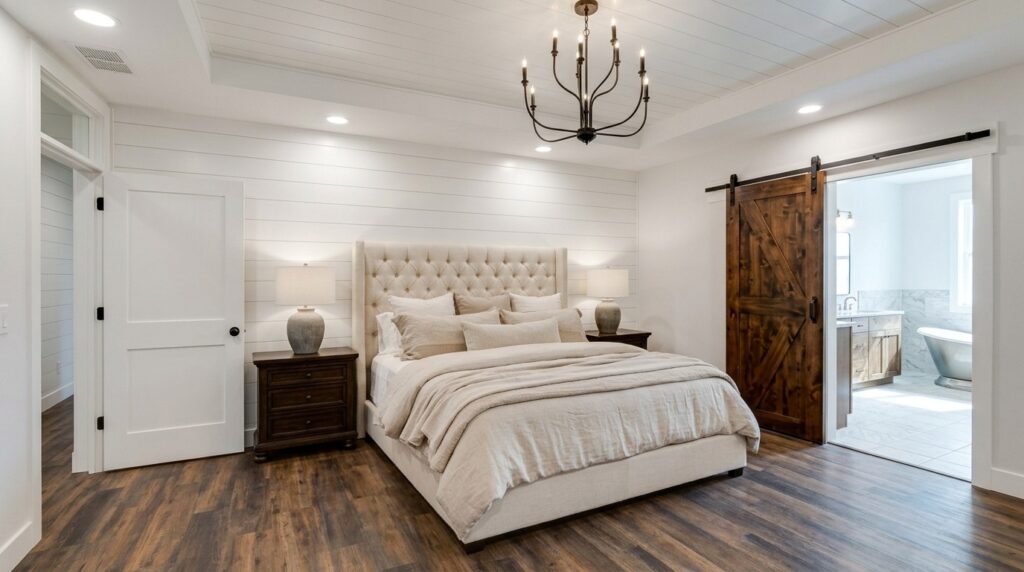
Master bedroom dimensions are one of the most consequential layout decisions in a new home, and one of the easiest to get wrong on paper. A few feet in either direction changes what furniture fits, how the closet and ensuite work, and how the rest of the floor plan flows. This guide breaks down the common sizes, what each one actually fits, and where the building code sets the floor.
Key Takeaways
- The average master bedroom in a new single-family home is roughly 14 by 16 feet, around 224 square feet, large enough for a king bed and walk-around clearance.
- The 2021 International Residential Code requires a habitable room to be at least 70 square feet with no horizontal dimension less than 7 feet.
- A 12 by 12 room fits a king mattress but leaves only about 24 inches of side clearance. Most buyers want 30 to 36.
- A 12 by 20 is the most flexible small-format primary suite, supporting a king bed, dresser, and small seating zone.
- A 15 by 15 room (225 square feet) is close to the new-build average and balances furniture clearance with ensuite integration.
- A 20 by 20 suite (400 square feet) supports a king bed, seating, and attached ensuite and walk-in closet without crowding.
What Counts as a Standard Master Bedroom Size?
A standard master bedroom in a new single-family home runs about 14 by 16 feet, or roughly 224 square feet. That fits a king mattress, two nightstands, a dresser, and walk-around clearance on three sides. Anything below 12 by 12 starts to feel tight with king-bed furniture.
For context, median single-family floor area was 2,176 square feet in third-quarter 2025. A primary suite at 225 to 400 square feet typically consumes 10 to 18 percent of that footprint, which is why dimensional decisions ripple into the rest of the plan.
A note on terminology: the industry now uses primary bedroom or primary suite in place of “master.” Both refer to the same room, and search behavior still favors “master bedroom,” which is what this guide uses.
New construction is also right-sizing overall bedroom counts. The three-bedroom share of new single-family homes rose to 47.0 percent in 2024, the highest level since 2011. Four-bedroom homes held 32.4 percent. The takeaway: more buyers are choosing fewer, better-sized bedrooms over more, smaller ones, which puts the primary suite at the center of the floor plan decision.
What Are the Minimum Master Bedroom Dimensions Required by Code?
The 2021 International Residential Code Section R304 sets the legal minimums for any habitable room. A bedroom must be at least 70 square feet of floor area, no horizontal dimension under 7 feet, and the dwelling’s largest habitable room must measure at least 120 square feet (usually satisfied by the great room, not the bedroom).
The bedroom-specific minimums that matter at the design stage:
- Minimum floor area: 70 square feet (IRC R304.2).
- Minimum horizontal dimension: 7 feet in any direction (IRC R304.3). Often more limiting than the square-footage minimum, since a 7-by-10 room hits 70 square feet but feels like a closet.
- Ceiling height: IRC R305.1 requires at least 7 feet across the room.
Code is the floor, not the goal. A bedroom that just meets R304 is legal, but it won’t hold the furniture most buyers expect. Use the code as a hard constraint, then size the room around the bed and clearance you actually want.
How to Match a King Bed and Walk-Around Clearance to the Room
Start sizing from the bed out, not the walls in. A standard king mattress measures 76 by 80 inches (roughly 6.3 by 6.7 feet). Plan around the 3-foot walk-around rule: 30 to 36 inches of clear space on the sides and foot of the bed.
A worked example for a king-bed wall:
- Bed with frame: about 6.5 by 7 feet (the frame adds 1 to 3 inches per side).
- Two nightstands: roughly 22 inches deep and 24 inches wide, alongside the bed.
- Side clearance: 30 to 36 inches each side.
- Foot clearance: 30 to 36 inches, more if you want a bench.
A comfortable king-bed wall needs about 11 to 12 feet of width and 12 to 13 feet of depth before adding a dresser. That math is why 12 by 12 is the lower boundary of livable and most primary suites land between 12 by 14 and 14 by 16.
Master Bedroom Layouts by Common Dimension
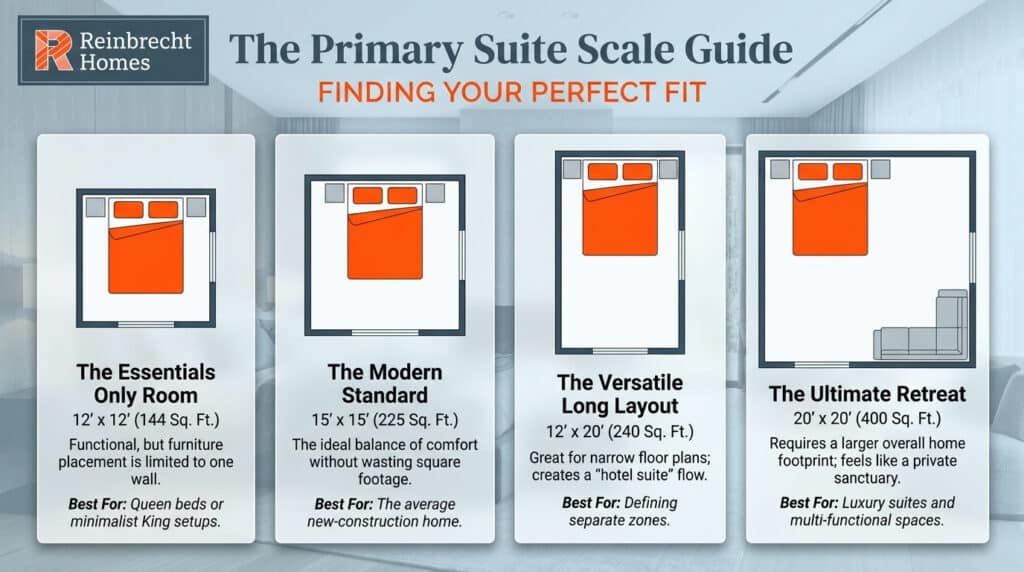
The same square footage can feel different depending on the room’s proportions. A 12 by 20 and a 15 by 16 layout both hit 240 square feet but hold furniture and traffic very differently. The sections below walk through the most-searched dimensions and what each one realistically supports.
Is 12×12 Too Small for a Master Bedroom?
A 12 by 12 room (144 square feet) is above the IRC minimum but at the low end for a primary suite. It fits a king mattress (76 by 80 inches) with about 24 inches of side clearance and 30 inches at the foot. Functional but tight, with no room for a seating area and a dresser usually relegated to the wall opposite the bed. A 12 by 12 works better with a queen, which opens up about 36 inches of clearance per side.
The 12×20 Master Bedroom Layout
A 12 by 20 room (240 square feet) is the most flexible small-format primary suite. The 12-foot width holds a king bed with nightstands, and the 20-foot length leaves room for a dresser wall, seating, and a clear path to the ensuite or closet.
Common 12 by 20 arrangements:
- Bed centered on the short wall: king and nightstands along one 12-foot wall, dresser opposite, and a 6- to 8-foot zone at the far end for seating.
- Bed on the long wall: works when the ensuite and closet open from one of the short walls, freeing the opposite long wall for a dresser-and-TV setup.
- Split-zone layout: sleeping zone at the back, with the front of the room serving as a closet-and-ensuite corridor.
The 15×15 Master Bedroom Layout
A 15 by 15 room (225 square feet) sits at the new-build average and is the safest default for a primary suite in a 2,000- to 2,400-square-foot home. The square footprint accommodates a king bed on any wall, two nightstands, a dresser, and a small chair without forcing tradeoffs. The drawback: no length for a separated seating zone, so most 15 by 15 layouts pair with an ensuite and closet rather than absorbing them.
The 20×20 Master Bedroom Layout
A 20 by 20 primary suite (400 square feet) supports a king bed, a full seating area, a dresser wall, and easy circulation, with the ensuite and walk-in closet typically attached rather than absorbed. At this size, the conversation shifts from “what fits” to “how to zone the space.”
- Sleeping and lounge zones: bed on one half, two chairs and a small table on the other.
- Ceiling detail: a vaulted or tray ceiling adds proportion without changing the floor plan.
- Entry corridor to ensuite and closet: a pass-through separates the sleeping zone from the bathroom door so the ensuite doesn’t open directly onto the bed.
A 20 by 20 suite consumes around 18 percent of a 2,200-square-foot home’s footprint. From any of our 30-plus customizable floor plans, this size typically calls for a larger overall plan, not just a larger bedroom.
How the Closet and Ensuite Change the Master Bedroom Footprint
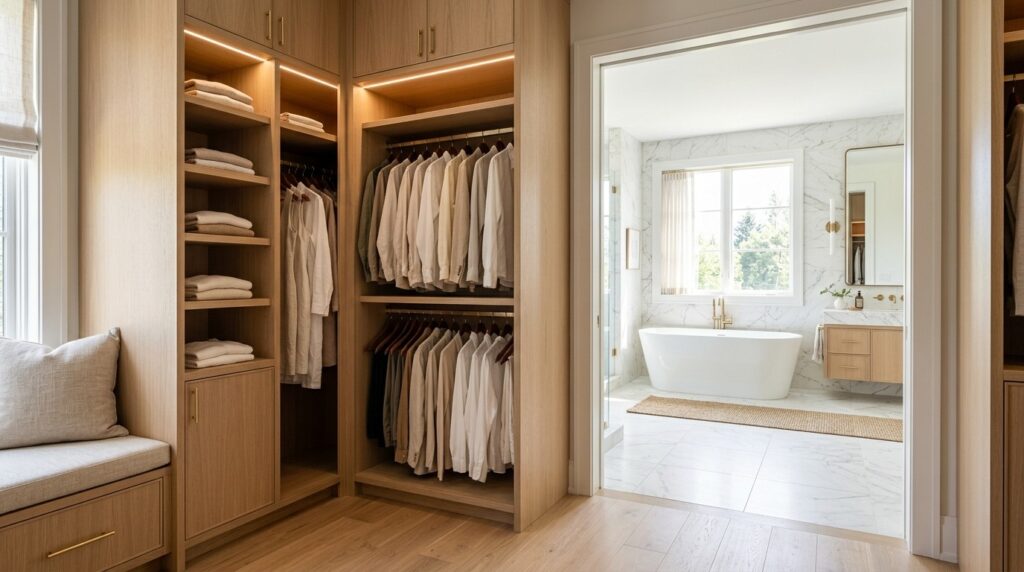
A primary suite is rarely just the bedroom. The closet and ensuite are part of the same footprint and need to be planned together. A 14 by 16 bedroom with a 6 by 10 ensuite and a 6 by 8 walk-in adds up to roughly 332 square feet of suite, not 224.
Typical sizes by room:
- Walk-in closet: 5 by 6 feet (30 sq ft) for a single user; 7 by 10 (70 sq ft) for a true two-person layout; 8 by 12 (96 sq ft) for an island closet with a dressing zone.
- Ensuite bathroom: 5 by 8 (40 sq ft) for a basic three-piece; 8 by 10 (80 sq ft) for a separate shower and tub; 10 by 14 (140 sq ft) for a spa layout with a freestanding tub and double vanity.
- Transition zone: add 15 to 25 square feet if there’s a hallway connecting the bedroom to the closet and ensuite.
Decisions inside the ensuite also shape total square footage. Choosing between a garden tub and a walk-in shower affects both the room’s size and how the suite zones around it. A separate tub and shower needs about 8 by 10 feet; a walk-in-only layout can work in 6 by 8.
Two sequencing tips: place the closet between the bedroom and the ensuite when possible (it buffers sound and shortens the morning routine), and avoid placing the ensuite door directly across from the bed.
Where the Primary Suite Should Sit in the Floor Plan
Bedroom size is only half the layout decision. Where the suite sits in the home shapes the daily routine and long-term flexibility. Primary-on-main floor plans have become the default request for buyers who want the home to work at every stage of life.
The case for primary-on-main is strongest when:
- You plan to stay in the home long-term and want to build aging-in-place flexibility into the original design.
- You want noise separation between the primary suite and the secondary bedrooms.
- The lot supports a wider, shallower footprint with a separated wing.
A second-floor primary works on narrow lots or when the buyer prefers separation from the main living level. The tradeoff is stairs. We see common floor plan regrets cluster around bedroom placement more than any other layout decision, so the call is worth pressure-testing before the plan is finalized.
How Reinbrecht Approaches Master Bedroom Dimensions in New Construction
Reinbrecht builds primary suites at every size from 12 by 14 up through 20 by 20-plus. In a semi-custom home, the suite dimensions come from the plan you choose, but the layout inside is yours: bed wall, ensuite fixtures, closet configuration, and finishes. A fully custom home designs the suite from scratch around your furniture and circulation.
A few patterns from the suites that work best in our project gallery:
- Buyers consistently underestimate walk-around clearance and overestimate the value of a bigger bed. A 14 by 16 room with a king and 36 inches of clearance feels larger than a 12 by 20 room with the same bed pushed into a corner.
- Closet square footage is where buyers most often wish they’d added space after move-in, and it’s the cheapest part of the suite to upsize at framing.
- Ensuite door placement is the most-overlooked detail. A door positioned to avoid sightlines from the bed makes the room feel more like a retreat without changing dimensions.
Frequently Asked Questions About Master Bedroom Dimensions
What is the minimum size for a master bedroom?
The 2021 IRC minimum for any habitable room is 70 square feet, with no horizontal dimension less than 7 feet. The practical floor for a primary suite holding a king bed and basic furniture is closer to 12 by 12 (144 square feet). Below that, a queen and minimal furniture is more realistic.
Can you fit a king bed in a 12×12 room?
Yes, but with limited clearance. A king mattress is 76 by 80 inches, which leaves about 24 inches per side and 30 inches at the foot in a 12 by 12 room. That meets the minimum for walking and changing sheets but leaves no room for normal-depth nightstands or seating. Most buyers planning around a king prefer at least 12 by 14.
What is the average size of a master bedroom in a new home?
Roughly 14 by 16 feet, or about 224 square feet, is the most commonly cited average. That sits inside the typical new-home footprint: median single-family home size is 2,176 square feet. Primary suites in larger homes tend to scale up to 15 by 15 or 16 by 18, but the 14 by 16 baseline is durable.
Does a master bedroom need an ensuite bathroom?
Code doesn’t require it, but buyer expectations effectively do. A primary suite without an ensuite is unusual in new construction and tends to hurt resale value. Plan for at least a 5 by 8 ensuite as the minimum, and budget 80 to 140 square feet for a separate shower and tub or a double vanity.
How big should a master bedroom closet be?
A functional walk-in closet starts at around 5 by 6 feet (30 square feet) for a single user. A 7 by 10 closet supports a two-person layout with hanging on both walls. An 8 by 12 closet adds room for an island or dressing zone. Closet sizing is one of the easier upgrades to plan upfront and one of the most common regrets buyers cite after move-in.
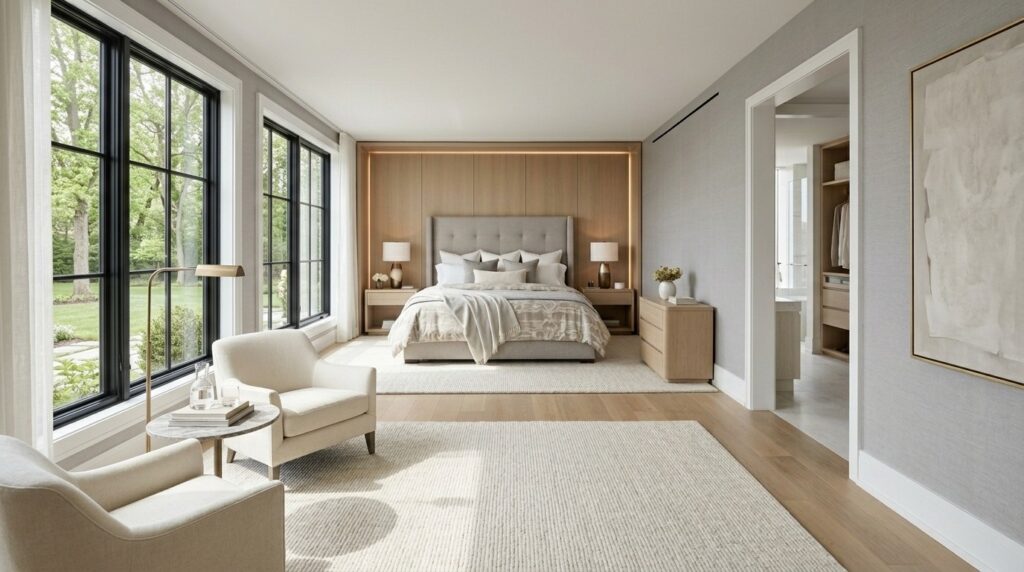
Planning Your Primary Suite
The right master bedroom dimensions depend on the bed and furniture you actually use, the closet and ensuite connected to it, and how the suite sits inside the larger floor plan. The math isn’t complicated once you start from the bed and work out. Contact the Reinbrecht team to schedule your first meeting and walk through how dimensions translate into a plan that works for the way you live.
