

If you want to build a new home while selling your current home, timing is the hard part. What happens if your old home hasn’t sold by the time the new one is finished? Reinbrecht Homes designed its No Stress Trade-Up Program to answer that question directly, and it’s worth comparing against the bridge loans, HELOCs, and home sale contingencies most buyers consider first.
Key Takeaways
- If your current home hasn’t sold by the time construction finishes, Reinbrecht’s No Stress Trade-Up Program guarantees a buyout at 80-85% of your home’s determined value, so you’re not stuck carrying two mortgage payments indefinitely.
- Bridge loans and HELOCs put the timing risk on you. You borrow against your current home, typically up to about 80% of its value, and you’re responsible for paying it off once your home sells.
- A home sale contingency shifts the risk to your new-home purchase instead, since a seller in a competitive market may pass over a contingent offer for a non-contingent one.
- New single-family homes now take about 9.1 months to build on average nationally (2024 data, the most recent available), while home-sale timing has grown less predictable as housing inventory rises.
- If you use a bridge or swing loan to cover the gap, Fannie Mae allows lenders to exclude that loan’s own payment from your debt-to-income ratio once you have a fully executed sales contract on your current home with financing contingencies cleared.
- Reinbrecht’s apartment rent-back option, available if your home sells before construction finishes, lets you move out with no early move-out penalty, subject to availability.
What Does It Mean to Bridge the Gap Between Selling and Building?
Bridge financing is a short-term way to tap the equity in the home you’re currently living in so you can afford your new home before your old one sells. Most buyers reach for it when their current home is taking longer to sell than their new home is taking to build, or when they want to make a stronger, non-contingent offer.
The three options buyers usually consider are a home sale contingency, a bridge loan, and a HELOC on the current home. Reinbrecht Homes adds a fourth option through its own No Stress Trade-Up Program, which works differently from the other three because it’s a guarantee from the builder, not a loan.
Four Ways to Bridge the Gap Between Selling and Building
Here’s how the four most common paths compare, including who ends up carrying the risk if your current home takes longer to sell than expected.
| Option | Who Bears the Timing Risk | What It Typically Involves |
|---|---|---|
| Home Sale Contingency | The seller of your new home. Your purchase depends on your current home selling first, so in a competitive market a seller may choose a non-contingent offer over yours. | No direct financing cost, but often means accepting a lower price or a weaker offer position to get a seller to accept the contingency. |
| Bridge Loan | You. You carry a new loan until your current home sells, and you’re responsible for the balance if it takes longer than planned. | A short-term loan typically secured by up to 80% of your current home’s value, plus origination, appraisal, and title fees, and interest or a lump-sum payoff when the loan comes due. |
| HELOC (Home Equity Line of Credit) | You. Same exposure as a bridge loan: you’re borrowing against your current home while hoping it sells before the bill comes due. | Interest-only payments are common during the draw period. Qualification depends on your equity and credit, similar to a bridge loan. |
| Reinbrecht’s No Stress Trade-Up Program | Reinbrecht. If your current home hasn’t sold by the time your new one is complete, Reinbrecht buys it from you at a pre-set discount off its determined value. | No bridge loan or HELOC needed. The trade-off is a buyout price of 80-85% of determined value if it comes to that, plus standard realtor commission. |
None of the three financing-based options come with a fixed, published cost, since bridge loan and HELOC terms vary by lender, your credit, and your home’s equity. As a general guide, bridge loans are typically secured by up to about 80% of your current home’s value, with repayment terms that vary by lender.
It also helps to know what borrowing costs look like right now. The average 30-year fixed mortgage rate was 7.18% as of November 5, 2026, and bridge loan and HELOC rates are typically priced above that baseline. Confirm the current rate and your own quote with a lender before you decide, since financing costs change weekly.
Reinbrecht works with local banks across several loan types, including conforming, FHA, USDA, VA, and jumbo loans. See Home Financing for a full rundown of what’s available for your build. Reinbrecht also offers free construction financing on all loan types, which is worth factoring in alongside whatever path you choose for your current home. Want to see how a given rate plays out in a monthly payment? Run the numbers with Reinbrecht’s mortgage calculator before you talk to a lender.
How Carrying Two Mortgages Affects Your Construction Loan Approval
Carrying a mortgage on a home you haven’t sold yet doesn’t automatically disqualify you from financing a new one, but it depends on how you cover the gap. If you take out a bridge or swing loan to bridge the two, lenders generally have to count that loan’s own payment as a contingent liability against your debt-to-income ratio, unless specific conditions are met.
Fannie Mae’s underwriting guidelines allow lenders to exclude that bridge or swing loan payment from your debt-to-income ratio once you have a fully executed sales contract on your current home and your buyer’s financing contingencies have already cleared.
In practice, where you are in selling your current home affects how a bridge or swing loan gets evaluated:
- No bridge or swing loan, or no contract yet: if you use a bridge or swing loan without a signed sales contract on your current home, its payment usually counts against your debt-to-income ratio, which can limit how much you qualify for on the new loan.
- Signed contract, contingencies still open: lenders may still count the bridge or swing loan payment, since the sale isn’t locked in yet.
- Signed contract, contingencies cleared: this is typically when the bridge or swing loan payment can be excluded from the debt-to-income calculation.
For a deeper look at how construction loans work in general, see Considering Your Financing Options: The Differences Between a Mortgage Loan and Construction Loan. Once you’re ready to move forward, Construction Loan Application walks through how to strengthen your application.
How Long Should You Expect the Process to Take?
Most new homes take months to build, and most home sales take months to close, so the real question is whether those two timelines line up for you.
Nationally, the average new single-family home now takes about 9.1 months to build, from permit authorization to completion, based on 2024 data, the most recent figure available. That figure covers construction time only, not how long the home then takes to sell.
On the selling side, timing has gotten less predictable. Rising housing inventory and lengthening time on market are giving buyers more negotiating leverage, according to the National Association of Realtors’ most recent report, which covers September 2026 sales data.
For Reinbrecht’s own semi-custom homes, construction typically takes 6 to 8 months once pre-construction planning, about a month, wraps up. Custom homes typically take 8 to 10 months to build, following 2 to 3 months of pre-construction design. Treat all of these as general ranges, not guarantees. Your actual timeline depends on your floor plan, selections, and local permitting.
What Happens If My Home Doesn’t Sell Before My New Home Is Finished?
If your current home hasn’t sold by the time your new Reinbrecht home is complete, Reinbrecht buys it from you. That’s the core promise behind the No Stress Trade-Up Program, and it’s the one piece of this process you don’t have to gamble on.
Here’s how the buyout path works if it comes to that:
- You sign a contract with Reinbrecht and list your current home with Reinbrecht’s designated realtor.
- Reinbrecht starts building once you’ve agreed to the program.
- If your home sells before construction is done, you keep the normal sale proceeds, minus realtor commission, like any typical sale.
- If it hasn’t sold by the time construction is complete, Reinbrecht buys it from you directly at 80-85% of its determined value, plus standard realtor commission.
A few conditions apply. Reinbrecht may order an independent inspection on your current home, only single-family homes qualify, and you’ll need to stay current on your mortgage, taxes, and home maintenance through closing.
There’s also a safety net in the other direction. If your current home sells and your buyer needs to move in before your new home is finished, you can rent one of Reinbrecht’s apartments month-to-month with no early move-out penalty, subject to availability.
This guarantee applies on the building path, triggered when construction is complete rather than by a fixed day count. A separate 90-day window applies only if you’re buying an already-built Reinbrecht home instead of building one, which is a different path with its own terms.

Building With Reinbrecht in Southern Indiana While You Sell
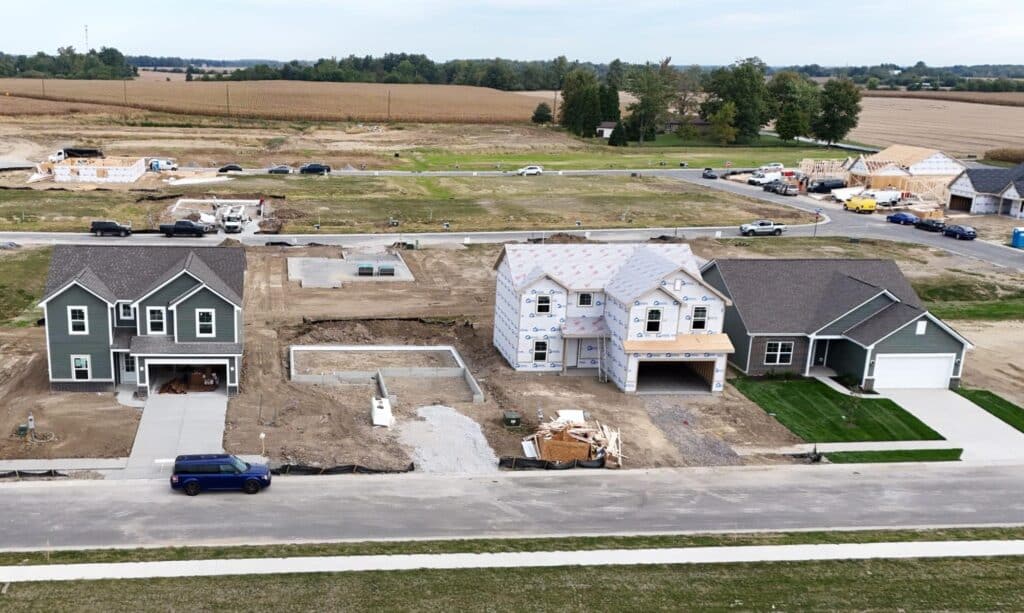
The No Stress Trade-Up Program is available to Reinbrecht buyers throughout its service area in Southern Indiana, Northern Kentucky, and Eastern Illinois. That removes the sale-timing risk no matter which of Reinbrecht’s active neighborhoods you choose.
Reinbrecht currently has ten active neighborhoods across that area, from Willow Crossing in Evansville to Waterfront Villas in Vincennes. See Lots for Sale for the full list and current lot availability.
If you already own land instead, Reinbrecht also builds semi-custom and custom homes on your own lot elsewhere in its service area, using the same transparent, upfront pricing.
Frequently Asked Questions About Building a New Home While Selling Your Current Home
Is a Bridge Loan a Good Idea When Building a New Home?
It depends on how confident you are in your sale timeline. A bridge loan can work if you’re reasonably sure your current home will sell within the loan’s term, but you’re the one covering the loan if the sale takes longer than expected. If you’d rather not take on that risk yourself, Reinbrecht’s No Stress Trade-Up Program shifts it to the builder instead.
What’s the Difference Between a Bridge Loan and a HELOC?
Both let you borrow against the equity in your current home before it sells, and the risk works the same way in each case: you’re responsible for paying it off once your home sells. The main practical difference is structure. A bridge loan is typically a short-term loan with a set payoff date, while a HELOC is a revolving line of credit with interest-only payments common during the draw period.
Does Reinbrecht’s No Stress Trade-Up Program Cost Extra?
There’s no separate loan or upfront fee for the guarantee itself. The trade-off only applies if Reinbrecht ends up buying your home: in that case, the buyout price is 80-85% of your home’s determined value, plus standard realtor commission. If your home sells on its own before that point, you keep the normal sale proceeds.
Can I Still Get Approved for a Construction Loan While I Still Own My Current Home?
Yes, in many cases, though it depends on how you finance the gap. If you take out a bridge or swing loan to cover the overlap, Fannie Mae’s guidelines allow lenders to exclude that loan’s own payment from your debt-to-income ratio once you have a fully executed sales contract on your current home with financing contingencies cleared. A loan officer can confirm exactly how your situation gets evaluated.
How Do I Get Started With Reinbrecht’s No Stress Trade-Up Program?
Start by talking with the Reinbrecht team about your floor plan or lot, and let them know you’re still selling your current home. They’ll walk you through whether the Trade-Up Program fits your timeline and what the buyout terms would look like for your specific home.
Talk to Reinbrecht About Your Trade-Up Timeline
You shouldn’t have to choose between building the home you want and carrying two mortgages while you wait for your old one to sell. Contact the Reinbrecht team to talk through your timeline and find out whether the No Stress Trade-Up Program is the right fit for your move.
