
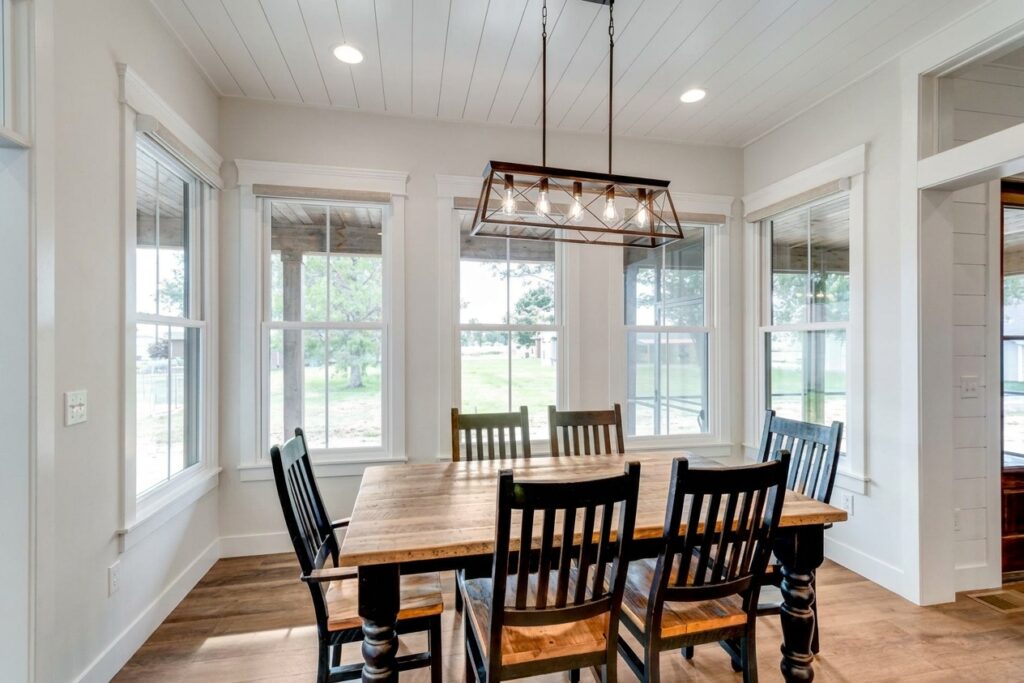
Choosing windows for new construction comes down to more than how they look from the curb. The frame material, the glass package, and the energy ratings shape how comfortable your home feels and what you pay to heat and cool it for decades. This guide decodes the window types, explains the energy ratings, and gives the U-factor and SHGC targets to spec for a new home in Southern Indiana.
Key Takeaways
- Windows are responsible for 25% to 30% of a home’s heating and cooling energy use, which makes glass and frame selection one of the highest-impact decisions in a new build.
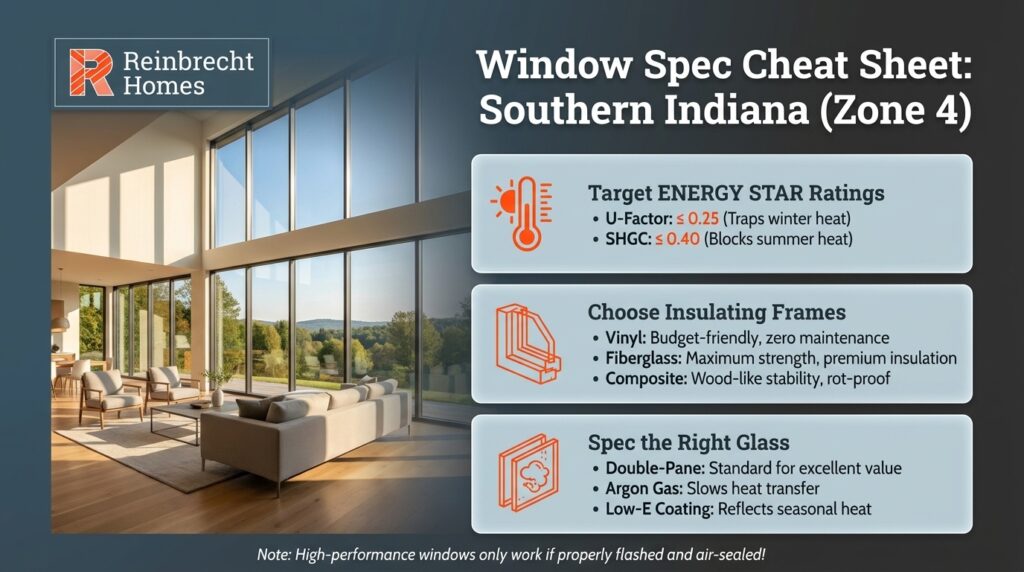
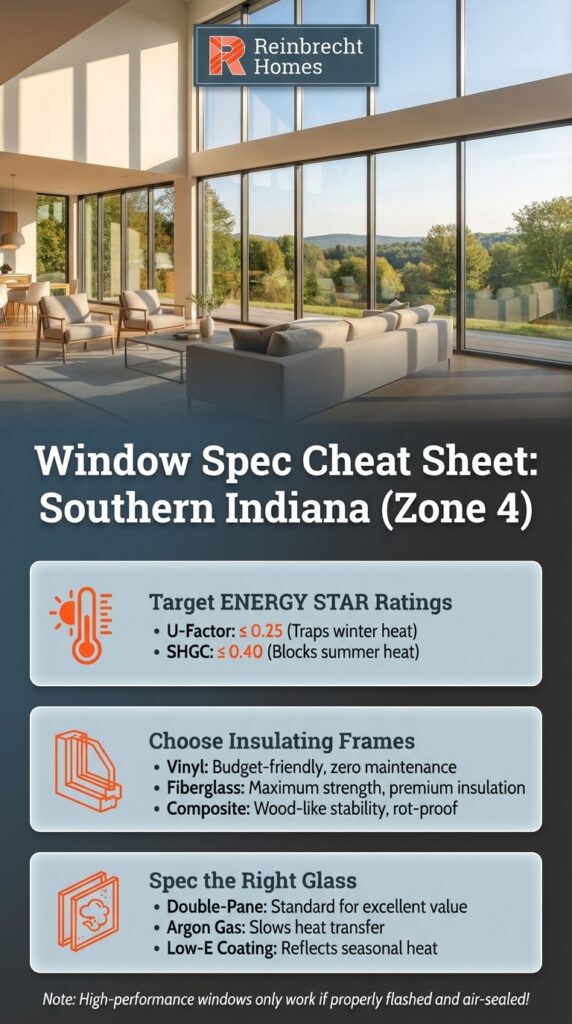
- For a new home in Southern Indiana (IECC climate zone 4, the ENERGY STAR North-Central zone), target a whole-unit U-factor of 0.25 or lower and an SHGC of 0.40 or lower.
- Vinyl, fiberglass, and composite frames insulate better than bare aluminum, which needs a thermal break to limit heat loss.
- ENERGY STAR windows save roughly 6% to 13% on utility bills compared with non-certified windows, and the highest tier drops the U-factor to 0.20 or lower.
- Every Reinbrecht home includes Spider Plus sprayed-in fiberglass insulation and is built to be 35% more energy efficient than the industry standard.
New Construction Windows vs. Replacement Windows: What’s the Difference?
New construction windows and replacement windows describe two different installation types, not two quality levels. The nailing fin is the giveaway: new construction windows have one, and replacement windows do not.
- New construction windows: have a nailing fin that attaches to the framing before siding and trim are installed. They suit a home built from the ground up, because open walls let the crew flash and seal each window correctly.
- Replacement windows: fit inside an existing frame without removing siding or trim. They are meant for renovations, not new construction.
That distinction matters online, because “new construction windows” can mean this install type or the broader task of choosing windows for a new home construction project. This guide covers the second meaning: selecting the right frame, glass, and ratings, which is where the long-term value is won or lost.
For many buyers, that decision starts earlier. As one family from Mt. Carmel, IL shared: “We originally planned to remodel a family farm house, but after talking with friends whose homes were built by Reinbrecht Homes, we decided we would be happier with new construction. We were met with within a week of our call, started construction within four months, and finished well within the projected completion date!”
How to Read a Window’s Energy Ratings (the NFRC Label)
Every certified window carries a National Fenestration Rating Council (NFRC) label with five ratings that show how it will perform. The two that matter most for energy are U-factor (how well the window insulates) and SHGC (how much solar heat it lets in). Lower numbers are better for both in a mixed climate like Southern Indiana.
Here is what each rating measures:
- U-factor: the rate of heat transfer, or how well the window insulates. It typically ranges from 0.15 to 1.1, and lower is better. A U-factor of 0.20 or lower usually indicates a triple-pane window.
- Solar Heat Gain Coefficient (SHGC): the fraction of the sun’s heat that passes through, on a scale of 0 to 1 (commonly 0.15 to 0.80). Lower blocks more solar heat.
- Visible Transmittance (VT): how much daylight comes through, from 0 to 1 (commonly 0.20 to 0.80). Higher means a brighter room.
- Air Leakage (AL): how much air passes through the assembly, in cubic feet per minute per square foot. Most codes require 0.3 or lower, and lower is tighter.
- Condensation Resistance: how well the window resists interior condensation, rated 0 to 100. Higher resists condensation better.
Window Ratings and Southern Indiana Spec Targets
| NFRC rating | What it measures | IECC 2021 zone 4 baseline | ENERGY STAR North-Central (Evansville) | ENERGY STAR Most Efficient |
|---|---|---|---|---|
| U-factor | Heat loss / insulation. Lower is better. | ≤ 0.30 | ≤ 0.25 | ≤ 0.20 (triple pane) |
| SHGC | Solar heat let in. Lower blocks more. | ≤ 0.40 | ≤ 0.40 | ≤ 0.40 |
| Visible Transmittance | Daylight let in. Higher is brighter. | Not regulated | No ENERGY STAR minimum | n/a |
| Air Leakage | Drafts through the assembly. Lower is tighter. | ≤ 0.3 cfm/ft² (common) | Verified under certification | n/a |
| Condensation Resistance | Resists interior condensation. Higher is better. | Not rated by code | Not an ENERGY STAR criterion | n/a |
Evansville and Southern Indiana are IECC climate zone 4, the ENERGY STAR North-Central zone. Indiana adopts and amends its own energy code, so the builder confirms the exact current requirement at permitting. ENERGY STAR Most Efficient is the top recognition tier for this zone, not a code or program requirement. Sources: DOE/PNNL, ENERGY STAR Version 7.0, 2021 IECC, and NFRC.
What U-Factor and SHGC to Target in Southern Indiana
In Southern Indiana, spec windows with a U-factor of 0.25 or lower and an SHGC of 0.40 or lower. Evansville and the surrounding counties sit in IECC climate zone 4, which is the ENERGY STAR North-Central zone. Those two numbers put you at the ENERGY STAR level, which beats the local code minimum.
Three benchmarks define your options:
- Code minimum (2021 IECC, zone 4): a maximum U-factor of 0.30 and a maximum SHGC of 0.40. Code is required and ENERGY STAR is voluntary, so this is the legal floor, not the goal. Indiana adopts and amends its own energy code, so your builder confirms the exact current requirement at permitting.
- ENERGY STAR (North-Central): a U-factor of 0.25 or lower and an SHGC of 0.40 or lower. ENERGY STAR is more demanding than code on insulation and is the practical target for a comfortable, efficient home here.
- ENERGY STAR Most Efficient: a U-factor of 0.20 or lower with the same SHGC of 0.40 or lower for this zone, which generally means triple-pane glass. This is the top tier rather than a requirement.
Because Southern Indiana has both cold winters and hot, humid summers, the Department of Energy advises choosing windows with both a low U-factor and a low SHGC, and comparing whole-unit ratings rather than center-of-glass numbers.
How much glass a home has, and which way it faces, changes how those SHGC numbers play out. South- and west-facing glass collects the most summer heat, so review glass area and orientation with your builder at the plan stage.
New Construction Window Frame Types Compared
The frame material sets a window’s baseline for insulation, maintenance, and durability. Vinyl, fiberglass, wood, and composite frames all insulate better than bare aluminum, which conducts heat quickly and needs a thermal break to perform. For most new homes here, vinyl and fiberglass offer the best balance of efficiency, low maintenance, and value.
How the common frame materials compare:
- Vinyl (PVC): a strong insulator, especially when the hollow cavities are foam-filled. It resists moisture and never needs painting, which makes it the most common frame in new homes.
- Fiberglass: dimensionally stable and low maintenance, with cavities that can be insulation-filled for superior thermal performance. It outperforms wood and uninsulated vinyl.
- Composite: very stable, with the same or better thermal performance as wood and better moisture and decay resistance.
- Wood: insulates relatively well and offers a classic look, but needs regular maintenance unless clad in aluminum or vinyl.
- Aluminum: strong and low maintenance, but a poor insulator on its own. It should have a thermal break to limit heat loss.
Vinyl vs. Fiberglass Windows: Which Is Better for a New Home?
Both vinyl and fiberglass are excellent choices for a new home in Southern Indiana, and the right pick depends on budget and priorities. Vinyl delivers strong energy performance at a lower price and needs no painting. Fiberglass costs more but is stronger and more dimensionally stable, and it can be filled with insulation for the best thermal performance of the two.
Window Styles and Glazing Options for a New Home
Beyond the frame, two choices shape a window’s look and efficiency: operation style (how it opens) and glazing (how many panes and what goes between them).
Common operation styles for new homes include:
- Double-hung: two sashes that slide vertically. The most familiar style, easy to clean, and a fit for most rooms.
- Casement: hinged on the side and cranked open. Casements seal tightly against the frame, one of the most airtight styles.
- Awning: hinged at the top to open outward, so they shed rain and stay open in light weather.
- Slider: sashes that glide horizontally. A budget-friendly option for wide openings.
- Picture: fixed glass that does not open, maximizing light and views with excellent air-tightness.
Double-Pane vs. Triple-Pane Windows: Is Triple Worth It in Indiana?
For most new homes in Southern Indiana, a quality double-pane window with a low-E coating and argon gas fill meets the ENERGY STAR target and is the practical choice. Triple-pane windows add a third layer of glass and push the U-factor to 0.20 or lower and improves comfort and sound control, but the added cost pays back more slowly here than in the far north.
Insulating glass units combine several components that do the real work:
- Panes: double-pane is standard, while triple-pane is increasingly common for the highest performance.
- Gas fill: an inert gas between the panes, usually argon (common and inexpensive) or krypton (better in narrow gaps).
- Low-E coating: a near-invisible metallic layer that reflects heat back toward its source, keeping warmth in during winter and out during summer.
- Warm-edge spacers: low-conductivity material separating the panes at the edge, reducing heat loss and condensation.
How Windows Affect Your Energy Bills
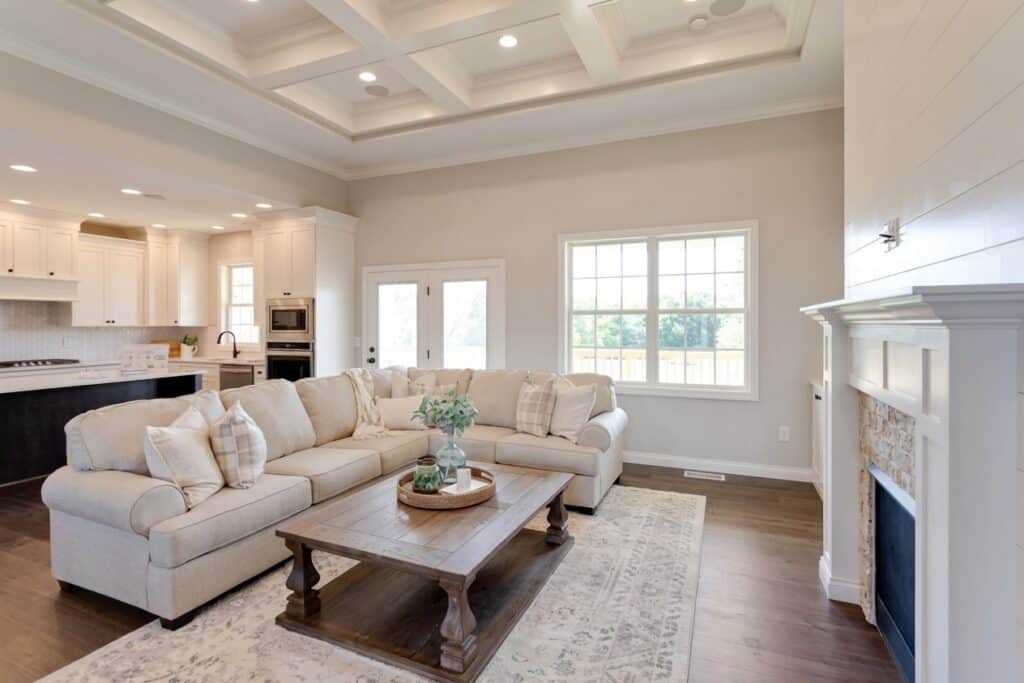
Windows are responsible for 25% to 30% of the energy a home spends on heating and cooling, so the glass you choose directly affects your bills. Efficient windows pay back in two ways:
- Lower utility bills: ENERGY STAR windows save roughly 6% to 13% on utility costs compared with non-certified windows.
- Lower demand year-round: because most of a home’s energy goes to heating and cooling, efficient glass works with insulation and air sealing to cut load in every season.
Common Window Mistakes to Avoid in a New Build
The most expensive window mistakes are not about the glass itself but about specifying the wrong ratings or installing good windows poorly. A high-performance window still underperforms if it is flashed and sealed incorrectly.
Watch for these common errors:
- Speccing the wrong SHGC or U-factor for the climate: a window tuned for a hot southern climate or a far-northern one will not perform its best in zone 4. Match the ratings to Southern Indiana’s mixed climate.
- Weak flashing and air sealing: the best window fails if air and water leak around it. Proper flashing and sealing at the rough opening protect the wall and preserve the window’s rating.
- Aluminum frames without a thermal break: bare metal conducts heat and cold straight through the frame, undercutting the glass package.
- Ignoring condensation resistance: windows that resist interior condensation help protect finishes and air quality. For the full picture on why moisture forms on glass and when to worry, see our guide to condensation on windows.
How Reinbrecht Builds Energy-Efficient Homes Around the Right Windows
At Reinbrecht Homes, energy efficiency is built into every home from the studs out, not sold as an upgrade. Every home starts from the same standards, no matter the budget:
- Insulation: Spider Plus sprayed-in fiberglass on all exterior walls, plus spray foam on the band boards where each floor meets the exterior wall.
- Verified efficiency: homes built to be 35% more energy efficient than the industry standard, with HERS Index scoring.
- ENERGY STAR options: ENERGY STAR certified home upgrades are available on top of that standard package.
Efficient windows fit into this approach alongside air sealing and insulation. In the semi-custom selection process, you personalize layouts, finishes, and fixtures, while every home starts from the same high standard. You can see what comes standard in our Semi-Custom Standards Guide.
As one recent buyer put it: “The Reinbrecht team and their sub contractors did a wonderful job bringing our dream home to reality. They delivered a home of exceptional quality on time and on budget. They were present for us every step of the way, delivering a personal and professional home building experience.”
Frequently Asked Questions About Windows for New Construction
What windows are best for a new construction home?
The best windows for a new construction home combine the right energy ratings for your climate, a well-insulating frame, and a quality glass package. In Southern Indiana, that usually means a vinyl or fiberglass frame with a low-E, argon-filled double pane rated for the ENERGY STAR North-Central zone. Match the ratings to the local climate, not to a hotter or colder one.
What is the difference between new construction and replacement windows?
New construction windows have a nailing fin that attaches to the wall framing and are installed before siding, which suits a new build. Replacement windows are designed to fit into an existing opening during a renovation without removing siding or trim. For a new home, you will use new construction windows.
What U-factor and SHGC should windows have in Indiana?
For Southern Indiana (IECC climate zone 4, the ENERGY STAR North-Central zone), target a whole-unit U-factor of 0.25 or lower and an SHGC of 0.40 or lower. That level meets ENERGY STAR and beats the 2021 IECC code minimum of 0.30 U-factor. Because Indiana amends its own energy code, your builder confirms the exact requirement at permitting.
Are triple-pane windows worth it in Indiana?
For most homes in zone 4, a low-E, argon-filled double-pane window already meets ENERGY STAR, so triple-pane is optional rather than necessary. Triple-pane lowers the U-factor to 0.20 or below and improves sound control, but the added cost pays back more slowly here than in colder northern climates. It is a comfort-and-efficiency upgrade, not a requirement.
Do new windows qualify for a federal tax credit?
Not for a newly built home. The federal Energy Efficient Home Improvement Credit that covered windows applied only to an existing home you improve, not a new home, and it ended for property placed in service after December 31, 2025. Treat efficient windows as a utility-bill and comfort decision rather than a tax play, and confirm any current state or utility incentive with your tax advisor.
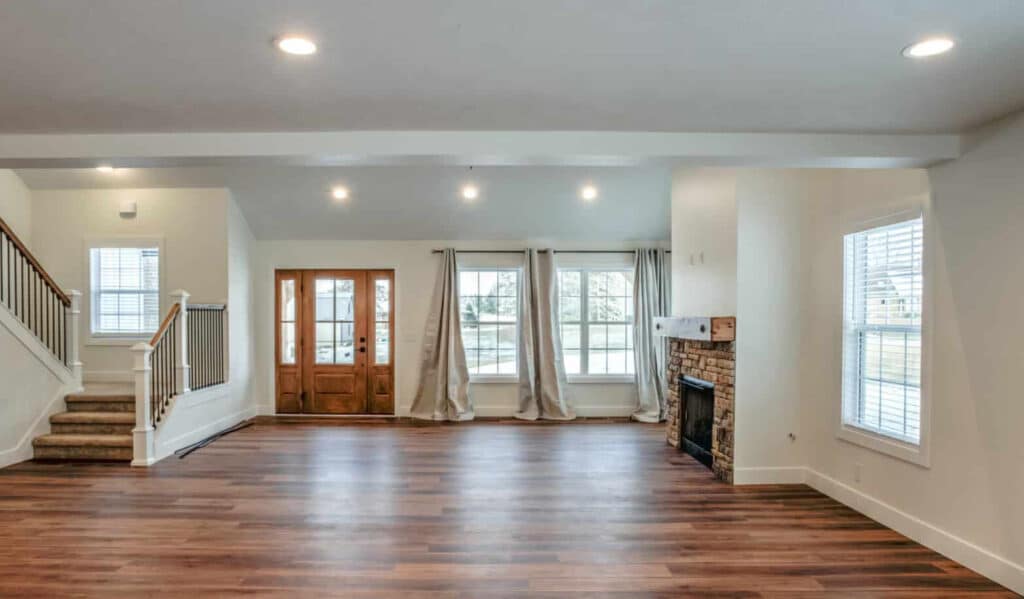
Building a New Home Around the Right Windows
Windows are one of many decisions that add up to a comfortable, efficient home, and the specs are easier to lock in when efficiency is standard. When you are ready to plan a new home built to a high energy standard, contact the Reinbrecht team to schedule your first meeting, or explore our 30+ customizable floor plans to find the right fit.
