
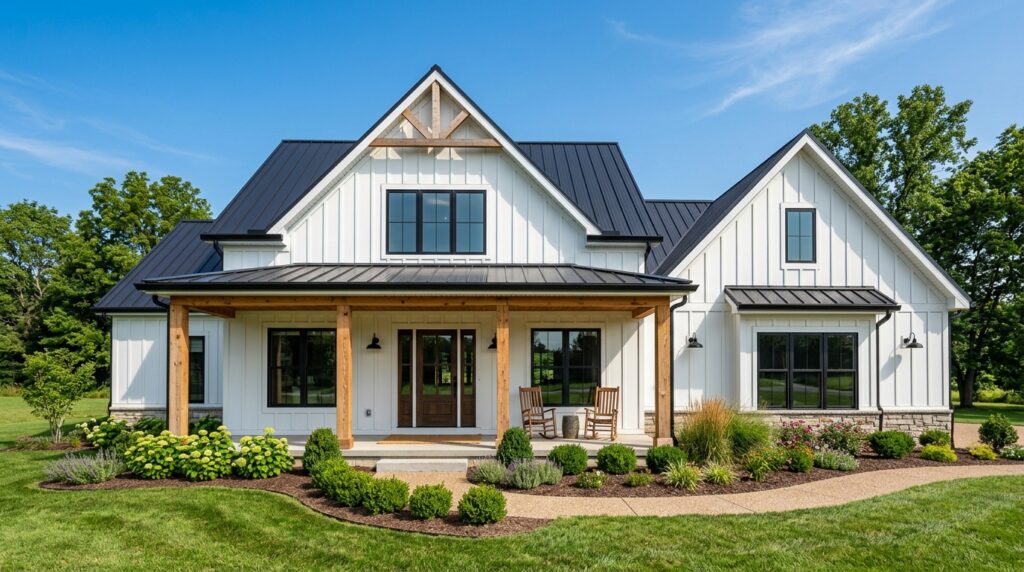
Search for “barndominium vs traditional home” and you’ll find a flood of national kit sellers, Texas builders, and forum debates, but almost nothing written for buyers in Southern Indiana, Northwestern Kentucky, or Eastern Illinois. The local realities (appraisal comps, lender comfort, code, and what the land you’re building on can support) change the math. Before you commit to a metal shell, it’s worth understanding what you’re really comparing.
Key Takeaways
- A barndominium is a metal or post-frame structure with an open interior. A traditional home uses stick-built wood framing on a poured foundation, which is what most Southern Indiana lenders, appraisers, and code officials are set up for.
- In the Midwest, median custom homes cost $186 per square foot in 2024, per NAHB regional data for the five-state East North Central group (Illinois, Indiana, Michigan, Ohio, Wisconsin).
- Barndominium financing is harder to secure than a conventional mortgage. Many lenders require higher down payments, and limited comparable sales make appraisals unpredictable in rural Indiana markets.
- The Midwest is now the geographic destination for affordable new-home construction, with median new home pricing down nearly 15% since late 2022, per NAHB.
- You can get the barn-style look (board-and-batten, metal roof, wraparound porch, open great room) with a stick-built semi-custom home and skip the financing and resale headaches of a true barndo.
- Reinbrecht builds semi-custom and fully custom homes across Southern Indiana, Northwestern Kentucky, and Eastern Illinois, with free construction financing on builds up to $250,000 and as little as $1,000 down to start.
What a Barndominium Actually Is, and Why Southern Indiana Buyers Are Searching for One
A barndominium is a residential structure built using post-frame or metal-shell construction, with a large open interior that gets divided into living spaces. The look is borrowed from a working barn: a long, gabled metal-clad shell, big windows, a covered porch, and an open great-room layout.
The modern-farmhouse style is everywhere on Pinterest and Instagram, and the price tags being thrown around online look much lower than what people are quoted for traditional builds. That’s the headline. Here’s the structural comparison most kit sellers lead with:
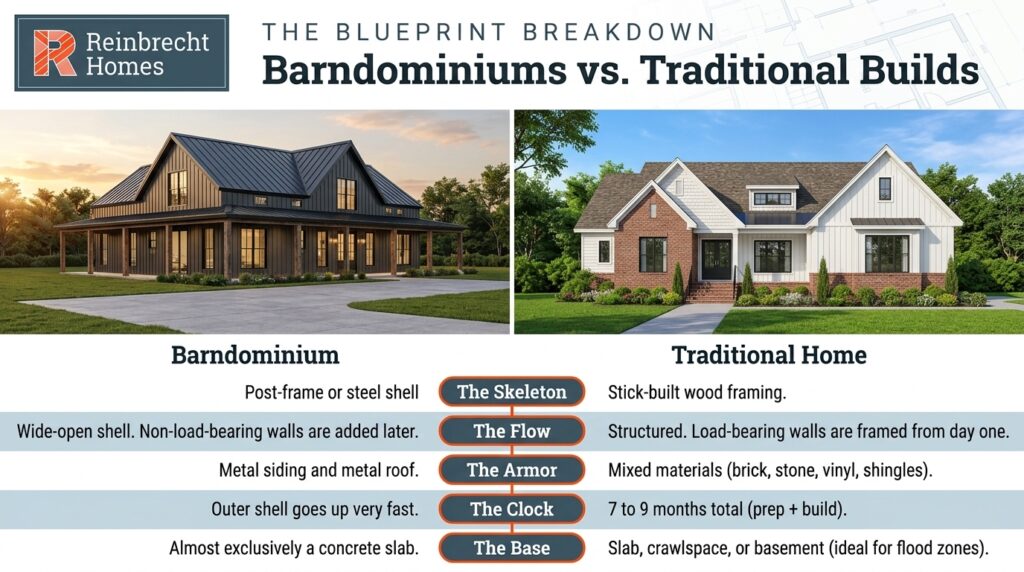
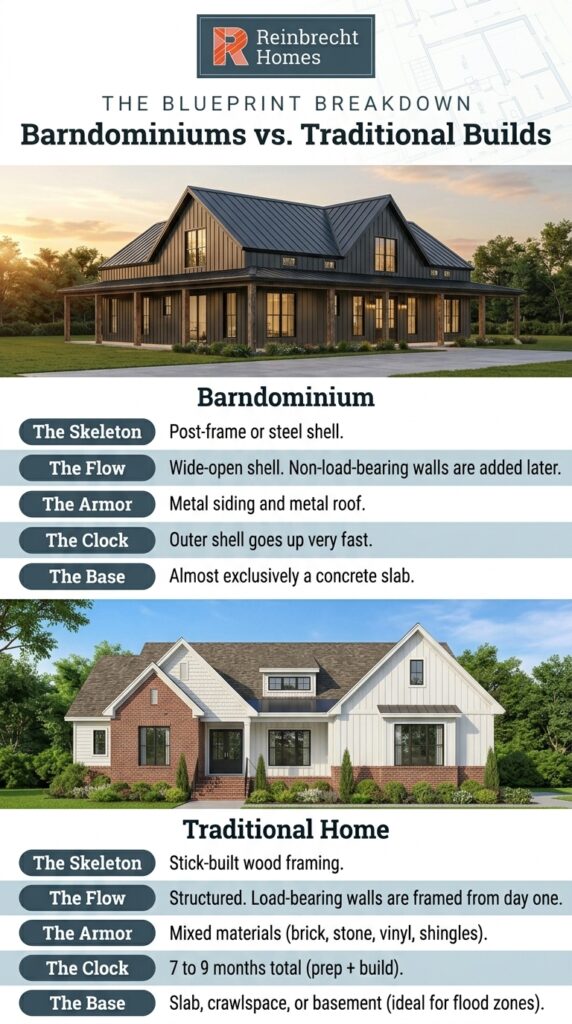
- Construction method: metal or post-frame shell versus stick-built wood framing on a poured foundation.
- Interior layout: open shell with non-load-bearing walls added later versus interior walls framed in place from the start.
- Exterior cladding: metal siding and metal roof versus a mix of vinyl, fiber cement, brick, stone, or board-and-batten with architectural shingles.
- Build timeline: barndo shells go up quickly. A semi-custom Reinbrecht home typically takes about a month of pre-construction plus six to eight months to build.
- Foundation: barndos are usually built on a slab. Traditional homes can sit on a slab, crawl space, or basement, which matters in floodplain-adjacent areas of Southern Indiana.
The Real Cost Comparison: Barndominium vs Traditional Home in the Midwest
Most barndominium content compares national kit prices against national traditional-build averages. In the Midwest, the gap looks different than it does in Texas or the Plains. Here are the figures kit-seller pages tend to cite, alongside the regional benchmarks that actually apply to Southern Indiana:
- 2,000-square-foot barndominium: around $200,000, or about $100 per square foot, per Today’s Homeowner.
- 2,000-square-foot traditional home: $220,000 to $340,000 ($110 to $170 per square foot) in the same source.
- Midwest median custom home, 2024: $186 per square foot of floor space, per NAHB regional analysis for the five-state East North Central group (Illinois, Indiana, Michigan, Ohio, Wisconsin).
- National median custom home, 2024: $166 per square foot, up slightly from $162 in 2023, per NAHB.
- National average single-family home cost, 2024: $428,215, or about $162 per square foot, per the NAHB Cost of Constructing a Home survey.
NAHB Chief Economist Robert Dietz put the regional shift this way: “Median new home pricing has declined nearly 15% since late 2022 due to builder-enacted price cuts, a small decline in typical new home size and a geographic shift for construction to lower cost areas such as the Midwest.” Southern Indiana is part of that affordability story.
On the headline per-square-foot number, a barndominium is usually cheaper than a traditional home. The gap is just smaller than the national content suggests, especially once you factor in foundation upgrades, interior build-out, and the financing realities covered below. For a closer regional view, our cost to build a house in Evansville guide breaks down materials, labor, permits, and land prep for Southern Indiana.
One note on how Reinbrecht prices builds: we don’t quote cost per square foot. Same square footage can vary tens of thousands of dollars based on finishes, mechanicals, site work, and lot conditions. You see the full cost before signing anything, with no hidden fees. One past homeowner put it this way: “Our home started with a good plan, then moved on to a budget that included everything from concrete and fill rock to towel bars! The quotes were specific and based on what we said we wanted.”
Financing and Appraisal: Where Most Barndominium Plans Hit a Wall in Indiana
This is the section the kit-seller pages skim past, and it determines whether a barndominium project actually gets built in Southern Indiana. Most of the friction is financial, not structural.
Lender comfort with barndominiums is uneven
A conventional mortgage assumes the property is a stick-built single-family home that can be resold to a comparable buyer. Barndominiums break that assumption:
- Fewer lenders are familiar with barndo construction, so financing options narrow.
- Lenders that do finance them often require 20% to 30% down, with shorter terms or higher rates.
- Construction-to-permanent financing is harder to structure for a metal-shell build.
- USDA loans (a common path for Southern Indiana land buyers) aren’t always available for non-traditional construction.
Compare that to a stick-built home through Reinbrecht. We offer free construction financing on builds up to $250,000 with as little as $1,000 down, zero interest-only payments, and zero out-of-pocket costs from down payment until closing. The program supports Conforming, FHA, USDA, VA, Jumbo, and Single Loan Close Construction Program loans.
Appraisal comps are thin for barndominiums in Southern Indiana
An appraisal is the lender’s independent estimate of what a property is worth, based on recent sales of comparable homes. In most Southern Indiana, Northwestern Kentucky, and Eastern Illinois markets, barndominium sales are still rare enough that there aren’t many true comps. That means a low appraisal at closing can force you to bring more cash or renegotiate, and the same thin-comps problem works against you at resale. Traditional homes generally hold value more predictably here because the appraisal math is anchored to a much larger pool of sales.
If your land sits in or near an Ohio River floodplain, the appraisal and zoning picture gets one more layer, and the foundation choice matters more than the exterior finish. The foundation, the layout, and the level of personalization all shape what your build actually costs, which is why it helps to understand how custom, semi-custom, and spec homes compare before settling on a path.
What About a Pole Barn Home? The Close-Cousin Question
A pole barn home is built with post-frame construction: vertical posts set into or on a slab, with the roof and walls hung from those posts. Many barndominiums use the same method, but some use steel framing instead. The terms get used interchangeably online, but they’re not identical.
Our pole barn house guide covers the construction-side considerations in more depth, including post-frame mechanics, basement compatibility, code compliance, and the financing realities specific to post-frame. The lender, appraisal, and resale concerns above apply to pole barn homes too.
Getting the Barn-Style Look with Traditional Construction in Southern Indiana
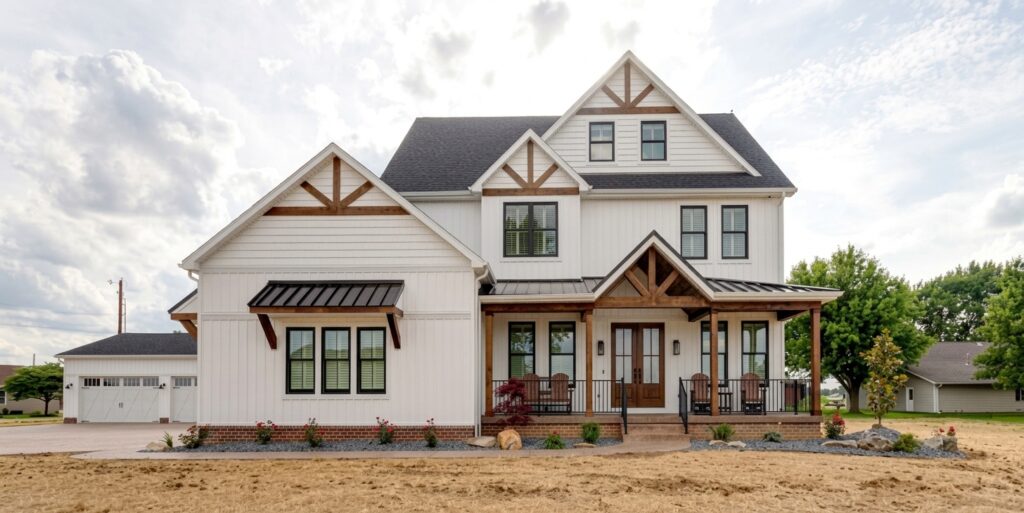
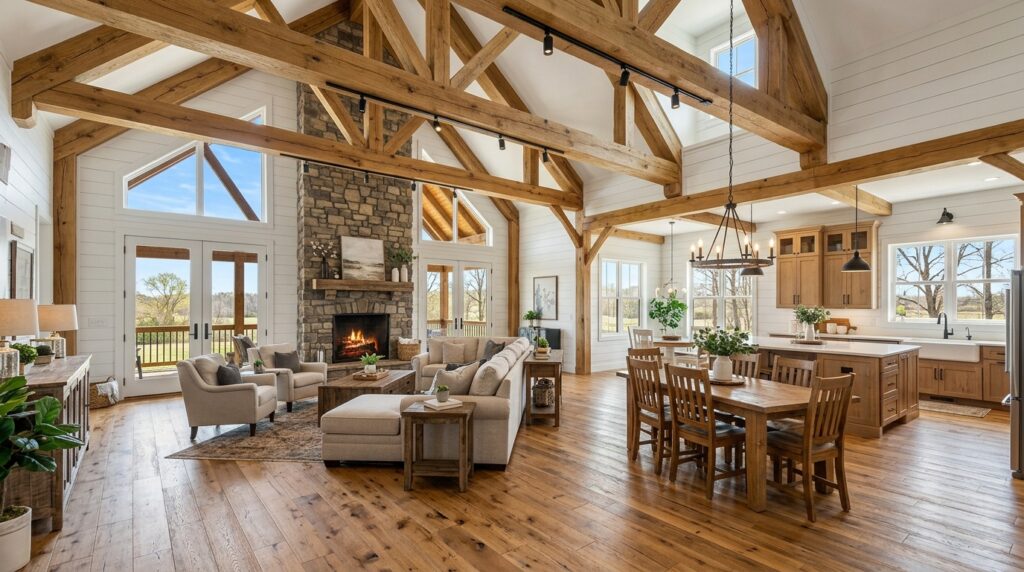
Here’s what most buyers searching “barndominium” actually want: the look and the feel. Vertical board-and-batten siding, a standing-seam metal roof, a wraparound porch, an open great room with vaulted ceilings, a mudroom, an oversized garage. You can build all of that with stick-built construction. Reinbrecht delivers it in two formats:
- Semi-custom: Start with one of our 30+ semi-custom floor plans and personalize the layout, finishes, fixtures, and exterior treatments. This is the best of both worlds for many buyers: more personalization than move-in ready, simpler and faster than fully custom. Pre-construction typically runs about a month, and the build itself runs six to eight months.
- Fully custom: Design the home from scratch with a custom home build. The right path if you want a one-of-a-kind footprint, an unusual lot, or a layout no existing plan supports. Pre-construction is typically two to three months, with a build period of eight to ten months.
If you already own land, we can build a semi-custom or fully custom home on it through our build on your lot program. If you don’t have land, we have lots available in active neighborhoods across Evansville, Newburgh, Boonville, Princeton, Owensville, Poseyville, and Vincennes.
What you gain in the trade-off:
- Mortgage path: conventional financing with the same lender comfort as any other home in the region.
- Appraisal: anchored to established comparable sales, not a thin pool of barndominium comps.
- Foundation: slab, crawl space, or basement depending on the lot.
- Insulation: Spider Plus sprayed-in fiberglass on every exterior wall as a standard, designed for the Midwest climate.
- Warranty: a Home Buyers Warranty that includes 10 years on structural defects, 2 years on systems, and 1 year on workmanship and materials.
Our project gallery shows what this looks like in practice across completed Southern Indiana builds. One past homeowner summed up their experience this way: “They delivered a home of exceptional quality on time and on budget. They were present for us every step of the way, delivering a personal and professional home building experience.”
Frequently Asked Questions About Barndominium vs Traditional Home Builds
Are barndominiums actually cheaper than traditional homes in Southern Indiana?
On a per-square-foot basis, usually yes. Today’s Homeowner estimates roughly $100 per square foot for a barndominium versus $110 to $170 for a traditional home of the same size. Midwest traditional custom homes ran $186 per square foot in 2024, per NAHB. The headline gap shrinks once you factor in foundation upgrades, interior build-out, financing limits, and resale risk.
Can you get a conventional mortgage for a barndominium in Indiana?
Sometimes, but rarely on the same terms as a traditional home. Many lenders decline barndominium loans or require 20% to 30% down. USDA, FHA, and VA programs are more restrictive for non-traditional construction. A stick-built Reinbrecht home can be financed through our free construction loan program with as little as $1,000 down on Conforming, FHA, USDA, VA, Jumbo, and Single Loan Close Construction loans.
Do barndominiums hold their value as well as traditional houses?
Generally, no. Resale value depends on comparable sales nearby, and barndominium sales are still rare in most of Southern Indiana, Northwestern Kentucky, and Eastern Illinois. That makes appraisals unpredictable at closing and at resale. Traditional homes hold value more predictably here because the appraisal math is anchored to a much larger pool of sales.
Can you build a barndominium in Indiana at all?
Yes, depending on the county, the lot, and local code. Rural counties tend to be more permissive than incorporated towns and cities. Floodplain rules, septic and well requirements, and minimum dwelling size standards vary by jurisdiction, so any project starts with a serious conversation about your specific lot.
Can you get the barndominium look without building a true barndominium?
Yes. Board-and-batten siding, metal roof accents, wraparound porches, open great rooms, vaulted ceilings, and oversized garages are all fully achievable with stick-built construction. A semi-custom build lets you personalize an existing floor plan to land that look without the financing, appraisal, and resale trade-offs of a true barndominium.
Planning Your Build in Southern Indiana
If the barndominium idea grabbed you because of the look, the lifestyle, or the land you already own, you have more options than the search results suggest. A traditional semi-custom or custom home can deliver the same aesthetic, run smoothly through standard financing, and hold its value the way Southern Indiana lenders and appraisers expect.
Ready to talk through what would actually work on your lot and in your budget? Contact the Reinbrecht team to schedule your first meeting, or browse our 30+ customizable floor plans to start finding the right starting point.
