
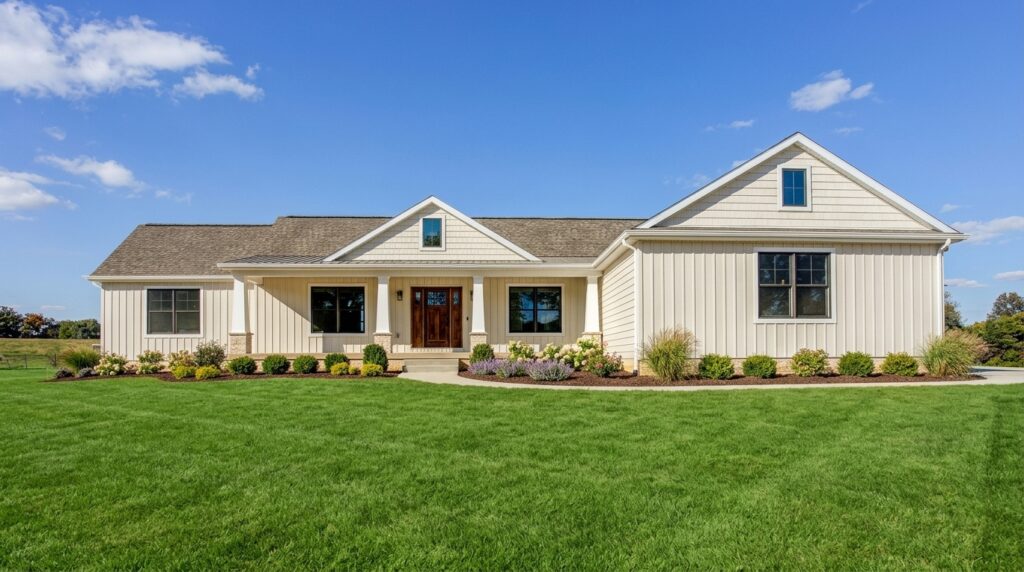
If you’ve earned your VA home loan benefit, you may have heard it only applies to buying an existing property. That’s one of the most common misconceptions veterans in Indiana run into. A VA loan for new construction works on the same core terms as a standard purchase loan: zero down payment required, no private mortgage insurance, and potential exemptions from the VA funding fee (a one-time charge the VA uses to fund the program) for veterans with qualifying disability ratings. Here’s what veterans and active-duty service members need to know about using that benefit to build in Southern Indiana.
Key Takeaways
- VA construction loans carry the same core benefits as standard VA purchase loans: no down payment required, no PMI, and potential funding fee exemptions for veterans with qualifying disability ratings.
- Indiana has approximately 363,906 veterans, with roughly 12,757 in the Evansville metro area, many of whom don’t know their VA benefit extends to building a new home.
- The biggest obstacle isn’t eligibility. It’s finding a participating lender and a builder who understands the VA draw and inspection process.
- A one-time close VA construction loan combines the construction financing and the permanent mortgage into a single loan with one set of closing costs.
- Reinbrecht Homes supports VA loans alongside FHA, USDA, and conventional financing, and offers free construction financing with as little as $1,000 down to start the build.
- Veterans who own land can build on their lot; those who don’t can choose from lots in active Reinbrecht neighborhoods across Southern Indiana.
Can You Use a VA Loan for New Construction in Indiana?
Yes. The VA loan guaranty program explicitly supports new construction. Veterans and active-duty service members can use their benefit to finance building a home from the ground up, provided they work with a lender who offers VA construction loans and a builder registered with the VA.
The misconception is widespread. Most VA loan marketing focuses on the purchase side because that’s where the volume is. VA construction loans are a smaller, more complex product that fewer lenders originate, so many veterans simply never hear about the option unless they go looking.
Indiana is home to approximately 363,906 veterans as of July 2025. In the Evansville metro area alone, an estimated 12,757 veterans call the region home. For many of them, building a home to their own specifications instead of compromising on a resale is exactly what they’re after. The VA benefit makes that financially possible.
How VA Construction Loans Work
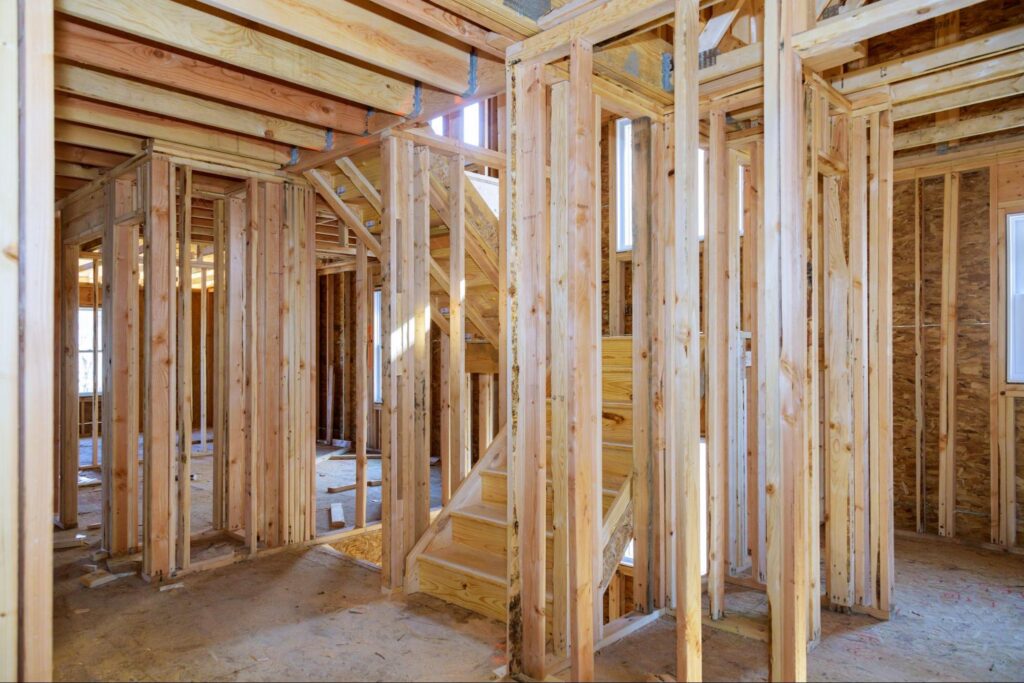
A VA construction loan is a short-term product that covers the cost of building a new home. Unlike a standard purchase loan, where funds are disbursed at closing, a construction loan releases money in stages as building milestones are reached. The VA requires that funds be held in an escrow draw account and that written approval from the veteran be obtained before each draw payment is released, a consumer protection built directly into the process.
The VA loan guaranty isn’t issued at the start of construction, either. It’s only issued after the VA receives a clear final compliance inspection report. That distinction matters: you’re not fully backed by the VA guaranty until the build is complete and inspected.
For a broader look at how draw schedules and lender requirements work, the Reinbrecht post on construction loan fundamentals covers the mechanics clearly. If you want to understand how construction financing compares to a standard mortgage in terms of repayment and term structure, see the post on the differences between a mortgage loan and a construction loan.
One-Time Close vs. Two-Close VA Loans
Most veterans will encounter two structures when shopping for VA construction financing:
- One-time close (construction-to-permanent): Construction financing and the permanent mortgage are wrapped into a single loan at one closing. You lock your rate at the start, the loan converts automatically to a standard mortgage when construction is complete, and you pay closing costs once. This is the option most VA borrowers prefer.
- Two-close: Separate loans for the construction phase and the permanent financing, each with its own closing and qualification process. More flexibility in some situations, but two rounds of closing costs and two qualification processes.
For most Indiana veterans building a primary residence, the one-time close structure is simpler and more cost-effective.
The Real Challenge: Finding the Right Lender and Builder
VA construction loans are available, but they aren’t widely offered. Many national lenders don’t originate them at all. Finding a participating lender in your area who does VA construction lending is often the first obstacle veterans hit.
The second is the builder. The VA construction process involves draw schedules, compliance inspections, and documentation requirements that not every builder is set up to handle. A builder who isn’t familiar with the process can cause delays, documentation gaps, and friction between the lender and the construction site.
Why Your Builder Choice Matters More Than Usual
The VA’s own guidance advises veterans to research their contractor carefully: checking references, reading reviews, examining past work, and consulting local home builders’ associations when selecting a builder. That advice matters here more than in a typical purchase transaction because the builder’s familiarity with the VA draw process directly affects how smoothly construction goes.
Reinbrecht Homes has experience working with VA loan buyers in Southern Indiana and understands the documentation and process requirements. The builder supports VA loans alongside FHA, USDA, Jumbo, and Conforming products.
What to Bring to Your First Builder Meeting
Arriving prepared makes your first meeting with a builder significantly more productive. Here’s what to have ready:
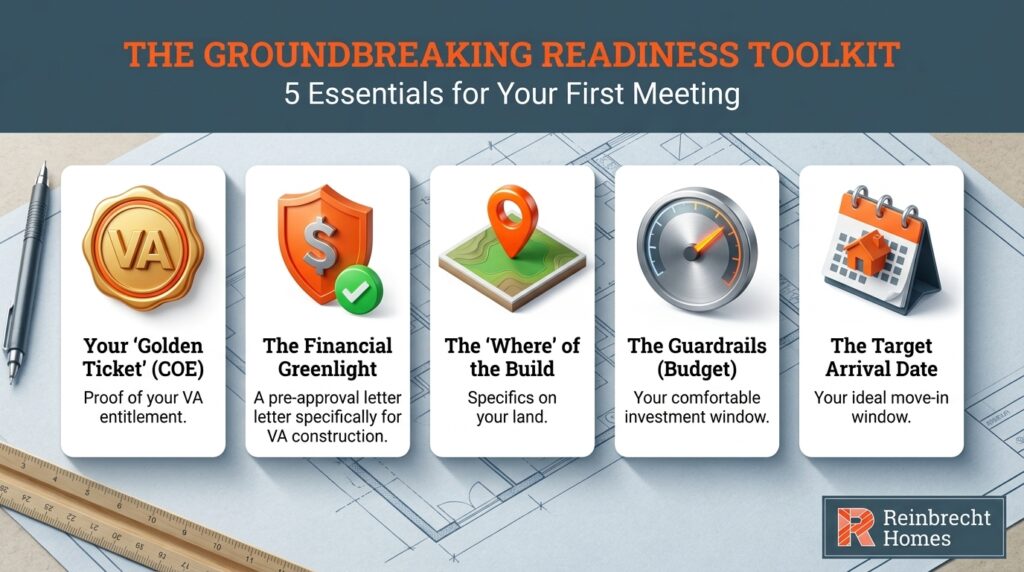
- Certificate of Eligibility (COE): This VA document confirms your entitlement. You can request it through the VA’s eBenefits portal or through your lender. Not every builder will ask for it at a first meeting, but having it confirms you’re eligible to proceed with VA financing.
- Lender pre-approval or pre-qualification: Because VA construction loans are a specialized product, identifying a participating lender before selecting a builder is worth doing early. If you haven’t started yet, your builder may be able to point you toward lenders they’ve worked with.
- Lot status: Know whether you own land, are open to purchasing a lot, or want to build in an established neighborhood. This shapes the entire conversation about floor plans, timelines, and infrastructure.
- Budget range: You don’t need a final number. A general range helps the builder recommend floor plans and options that fit without overshooting early in the process.
- Timeline: If you have a target move-in date, a deployment schedule, or a lease that ends at a specific time, mention it early. It affects how the builder plans your start date.
Building with Reinbrecht Homes on a VA Loan
Reinbrecht Homes is a family-owned builder with more than 30 years and 500+ homes across Southern Indiana, Northwestern Kentucky, and Eastern Illinois. VA loan buyers are supported alongside every other loan type Reinbrecht works with, and pricing is transparent from the start. You know the full cost before signing.
Reinbrecht’s free construction financing program covers up to $250,000 of the build cost with zero interest during construction, and you can start with as little as $1,000 down. That program is available across all supported loan types, including VA. There are no hidden fees, and the cost is fixed before you commit.
Veterans who own land can use Reinbrecht’s build on your lot program. Those who don’t have a lot yet can choose from lots in active Reinbrecht neighborhoods across the region, including communities in Evansville, Newburgh, Boonville, Vincennes, and Gibson County. With 30+ customizable floor plans, the process starts with a plan that’s close to what you want and then you personalize from there.
Every Reinbrecht home is backed by a 10-year structural warranty, 2-year systems coverage for electrical, plumbing, and mechanical, and 1-year workmanship and materials protection.
“The Reinbrecht team and their subcontractors did a wonderful job bringing our dream home to reality. They delivered a home of exceptional quality on time and on budget. They were present for us every step of the way, delivering a personal and professional home building experience.”
Frequently Asked Questions About VA Loans for New Construction
Can I use a VA loan to build a new home if I don’t own land yet?
Yes. You can pursue a VA construction loan without owning land. In some cases, the cost of purchasing a lot can be rolled into the construction loan, though this depends on the lender and the specifics of the transaction. Reinbrecht also has lots available in active neighborhoods across Southern Indiana if you’re still looking for the right location.
Do VA construction loans require a down payment?
No, not for eligible veterans. VA construction loans carry the same zero-down benefit as standard VA purchase loans, provided the veteran has sufficient entitlement and the application is approved by the lender. Veterans with qualifying disability ratings may also be exempt from the VA funding fee, which can represent meaningful savings.
What is a one-time close VA construction loan?
A one-time close loan (also called a construction-to-permanent loan) combines the construction financing and the long-term mortgage into a single loan closed once, with one set of closing costs. When construction is complete, the loan converts automatically to a standard mortgage. You qualify once and close once, which is simpler and less expensive than the two-close alternative.
Do I need a VA-registered builder for a VA construction loan?
Yes. The VA requires that the builder be registered and approved to work on VA construction loans. The builder must meet specific requirements related to licensing, insurance, and willingness to comply with VA inspections and draw documentation. Before committing to a builder, confirm they are registered with the VA or are prepared to complete the registration process.
Is it hard to get a VA construction loan?
More complex than a standard VA purchase loan, primarily because fewer lenders offer the product and because the construction process adds documentation and inspection steps. The credit and income underwriting requirements are similar to a standard VA loan, but both your lender and your builder need to be familiar with the VA’s process for the transaction to go smoothly. Working with an experienced builder reduces a significant portion of that friction.
Start Building with Reinbrecht Homes
Ready to explore what building on your VA benefit looks like in Southern Indiana? The Reinbrecht team works with veterans across the region and can walk you through floor plans, lot options, and financing from the first conversation. Contact Reinbrecht Homes to schedule your first meeting.
