
If you’re building a new home instead of buying one that already exists, you’ll run into a question most first-time builders don’t expect: do you need a construction loan or a mortgage? The short answer is that you may need both, and understanding the construction loan vs mortgage difference up front makes the whole build feel less intimidating. This guide walks through how each one works, what it costs, and how building a new home with a builder can change the math.
Key Takeaways
- A construction loan funds building a home from the ground up and is paid out in stages called draws, tied to build milestones. A traditional mortgage is a single lump sum that buys a home that already exists.
- During the build, a construction loan is typically interest-only on the amount drawn, and the balance comes due (or converts to a mortgage) when the home is finished.
- Construction loans usually require a larger down payment, often close to 20%, versus as little as 3% on a conventional mortgage.
- Lenders often look for a credit score around 680 (some allow 620), a licensed builder, and detailed plans and a budget.
- A construction-to-permanent (single-close) loan converts automatically to a standard mortgage at completion, so you close once.
- Building with Reinbrecht Homes includes free construction financing up to $250,000 of the build price, as little as $1,000 down to start, and zero interest-only payments during the build.
Construction Loan vs. Traditional Mortgage: The Core Difference
A construction loan pays for building a home from the ground up, released in stages as the work gets done. A traditional mortgage is a single lump sum that buys a home that already exists. The biggest practical difference is collateral: a mortgage is secured by a finished home, while a construction loan has no finished home behind it yet, which is why lenders treat it as higher risk.
The table below lays out the differences side by side, including how the picture changes when construction financing is handled as part of building with a builder.
| Factor | Construction loan | Traditional mortgage | Building with Reinbrecht |
|---|---|---|---|
| Purpose | Funds building a new home from the ground up | Buys a home that already exists | Funds your build, with financing handled as part of the process |
| Loan term | Short-term, generally a year or less | Long-term, commonly 15 or 30 years | Construction period, then your permanent mortgage |
| How funds are released | In stages (“draws”) tied to build milestones | Single lump sum to the seller | Same draw structure, managed with your builder |
| Payments during build | Interest-only on the amount drawn | Principal and interest from payment one | Zero interest-only payments during the build |
| Typical down payment | Close to 20% on a conventional construction loan | As little as 3% on a conventional mortgage | As little as $1,000 down to start the build |
| Credit score | Often around 680+ (some lenders 620) | Can qualify with lower scores by program | Qualify through a partner-bank loan; free financing on all types |
| Collateral | No finished home yet, so higher risk to lenders | The finished home secures the loan | Standard construction-loan structure via partner banks |
| At completion | Balance due, or converts to a mortgage (construction-to-permanent) | Already permanent financing | Converts to your permanent mortgage at closing |
Many buyers end up using both types of financing: a construction loan during the build, then a mortgage once the home is complete. A construction-to-permanent loan combines the two, which we cover below.
How Construction Loans Work
A construction loan works in stages instead of all at once. Rather than handing you a lump sum, the lender releases money in scheduled payments called draws, each tied to a milestone in the build (foundation, framing, and so on), and pays the contractor as each phase is completed.
Here’s the typical flow from closing to move-in:
- You close on the loan and put your down payment in place.
- The lender releases funds in draws as each build phase is finished, often after an inspection confirms the work.
- You pay interest only on the money drawn so far, not on the full loan amount.
- When the home is finished, the balance is due, or the loan converts into a permanent mortgage.
Here’s what that looks like in practice. If the first phase of your build costs $50,000, the lender releases that $50,000 to your builder, and your interest is calculated on that amount alone, not on the full price of the home. As each phase finishes and more money is drawn, the balance you’re paying interest on grows with it.
That last step is the one that trips people up. With a construction-only loan, the balance becomes due when the home is complete, so you either pay it off or refinance into a separate mortgage. With a construction-to-permanent loan, the switch to a mortgage happens automatically, but the terms of that conversion (including whether your rate is locked or set at closing) vary by lender, so ask upfront how and when your rate is determined.
Types of Construction Loans
There are two main types of construction loans: construction-to-permanent (also called single-close) and construction-only. The difference comes down to how many times you close and whether the loan turns into your mortgage automatically.
- Construction-to-permanent (single-close): The loan covers the build, then converts automatically to a standard mortgage when the home is finished. You close once, which usually means one set of closing costs.
- Construction-only: The loan covers just the build. When the home is done, you pay it off or take out a separate mortgage, which means two closings and two sets of closing costs.
Which Loan Programs Work With Construction Financing
Construction financing pairs with the same loan programs you’d see on a standard home purchase. Reinbrecht partners with local banks and supports these programs, along with a Single Loan Close Construction Program, through its home financing options:
- Conventional (conforming)
- FHA
- VA
- USDA
- Jumbo
What a Construction Loan Costs
Before you look at what a construction loan costs you, it helps to know what it actually funds. A construction loan typically covers:
- Lot (the land)
- Plans and permits
- Labor and materials
- Closing costs
What varies is how much you bring to the table up front and what it costs to borrow. A construction loan usually costs more up front than a traditional mortgage. Expect a larger down payment, a higher interest rate, and possibly two sets of closing costs if the loan doesn’t convert automatically. Here’s where the money goes:
- Down payment: Close to 20% is common on a conventional construction loan, compared with as little as 3% on a conventional mortgage.
- Interest rate: Construction-loan rates run higher than mortgage rates, because there’s no finished home serving as collateral yet.
- Closing costs: One set with a single-close loan, potentially two with a construction-only loan.
- Carrying costs: You may still be paying for your current home while the new one is under construction.
Once you know your numbers, a mortgage calculator can help you estimate what the permanent monthly payment will look like.
How a builder prices the home matters just as much as the loan. Reinbrecht doesn’t use cost-per-square-foot pricing, which can be unreliable and misleading. Instead, pricing is transparent and based on the size, features, and mechanical components of your specific home, so you know the exact cost before signing anything, with no hidden fees.
Construction Loan Requirements and How to Qualify
Qualifying for a construction loan is generally harder than qualifying for a traditional mortgage, mainly because there’s no finished home backing the loan. Lenders look closely at your credit, your finances, and the strength of your building plan. Most will want to see:
- Credit score: Often around 680, though some lenders allow 620.
- Debt-to-income ratio: Lenders weigh your existing debt against your income, just as they would for a standard mortgage application.
- Down payment: Close to 20% is common on a conventional construction loan.
- A licensed builder: Lenders want a qualified builder with a track record, not a self-managed project.
- Detailed plans and a budget: The lender needs to see exactly what you’re building and what it costs.
- An appraisal on the projected value: The home is appraised based on the finished plans, since the home doesn’t exist yet.
How to Apply for a Construction Loan, Step by Step
Applying for a construction loan follows a similar path to a mortgage, with extra documentation about the build itself. The process generally moves through five steps:
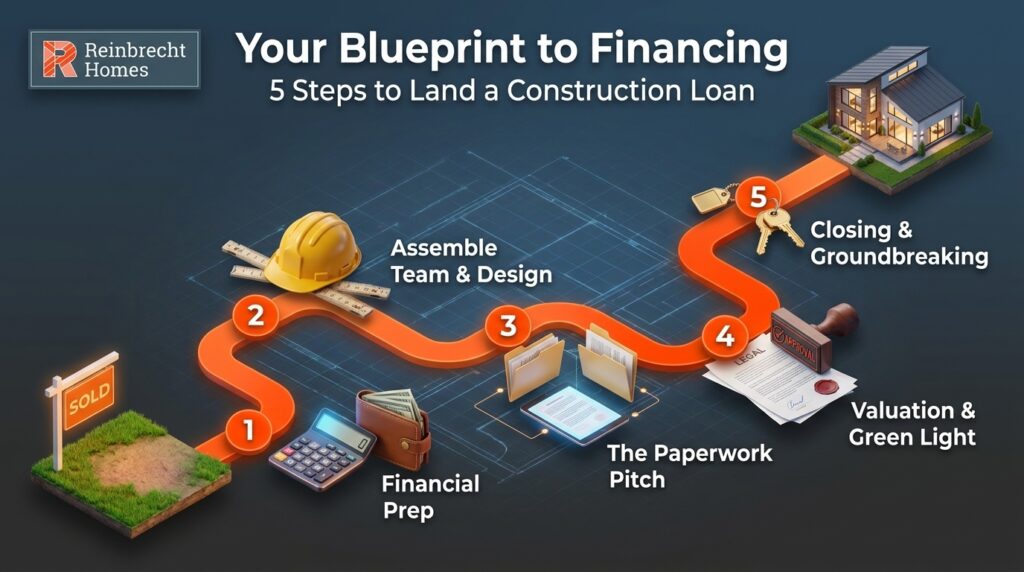
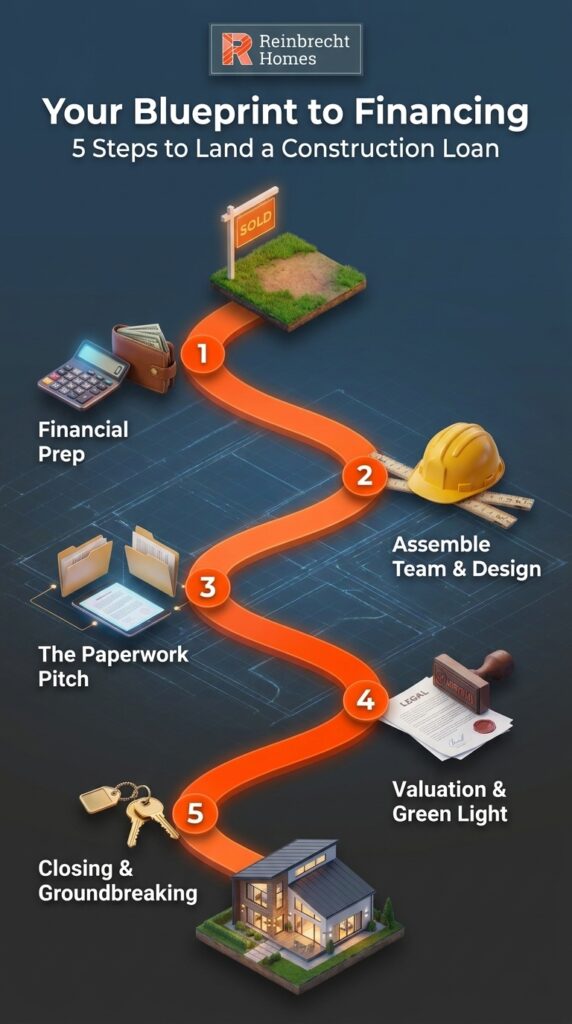
- Get your finances in order. Check your credit, gather income and asset documents, and set a realistic budget. If you’re planning ahead, our guide to preparing for home financing walks through a six-month credit timeline, a full document checklist, and how to build contingency into your budget.
- Choose your builder and plan. The lender needs a licensed builder and detailed construction plans before it can move forward.
- Submit your application and documents. This includes income verification, the build contract, your plans, and the budget.
- Appraisal and approval. The lender appraises the projected finished value and sets your draw schedule.
- Close and start building. You put your down payment in place, then funds release in draws as the work progresses.
Financing When You Build With Reinbrecht Homes
When you build with Reinbrecht, construction financing is handled as part of the process. Reinbrecht offers free construction financing up to $250,000 of the build price, with as little as $1,000 down to start and zero interest-only payments during the build.
That structure removes the two biggest pain points of a standard construction loan. You don’t make interest-only payments while the home is going up, and there are zero out-of-pocket costs from the time you put your down payment in place until closing. Free construction financing is available on standard, FHA, VA, and USDA loans through partner banks.
Here’s how that changes what actually comes out of your pocket while the home is being built:
- With a standard construction loan: a down payment often close to 20%, plus interest-only payments each month on the balance drawn so far, often while you’re still paying for your current home.
- Building with Reinbrecht: as little as $1,000 down to start, no interest-only payments during construction, and zero out-of-pocket costs from your down payment until closing.
That difference matters most for first-time builders, who often assume they need a large cash reserve just to carry the loan through construction. Keeping that money in your own accounts during the build, rather than sending it to interest payments, is the practical advantage of builder-included financing.
Reinbrecht also supplies the build-side documentation your lender will ask for. The requirements covered earlier, a licensed builder with detailed plans and a budget, are your builder’s responsibility to produce, not paperwork you assemble on your own. Reinbrecht provides:
- Builder’s contract
- Architectural plans
- Builder’s insurance
That leaves you responsible for the financial side of the application: your credit, income verification, and asset documentation.
You can build in one of Reinbrecht’s active neighborhoods or on your own land, with the same builder-guided approach. Buyers looking specifically at construction loans in the Evansville area get local guidance from a team that builds across Southern Indiana, Northwestern Kentucky, and Eastern Illinois.
Building on Land You Already Own
If you already own land, you can use it as part of your construction financing, and Reinbrecht can build a semi-custom or custom home on your lot. Some lots may need infrastructure like electricity, water, or sewage before construction begins, so it’s worth confirming what your site needs early.
Using land as collateral for a construction loan can reduce the cash you need up front, since the value of the lot can count toward your equity. If you want to build on your own lot, the Reinbrecht team can walk you through how your land fits into the financing.
Frequently Asked Questions About Construction Loans vs. Mortgages
Can a construction loan be converted to a mortgage?
Yes. A construction-to-permanent (single-close) loan converts automatically to a standard mortgage when the home is complete, so you only close once. A construction-only loan doesn’t convert; you pay it off or refinance into a separate mortgage at the end of the build.
Is a construction loan harder to get than a mortgage?
Generally, yes. It’s typically harder to qualify for a construction loan than a traditional mortgage, because there’s no finished home to serve as collateral. Expect a closer look at your credit, plus a requirement for a licensed builder and detailed plans.
Are construction loan rates higher than mortgage rates?
Usually. Construction-loan rates tend to run higher than traditional mortgage rates because the lender takes on more risk during the build. Rates change constantly, so confirm current numbers with your lender rather than relying on a fixed figure.
What is the downside of a construction loan?
The main downsides are a larger down payment, often close to 20%, a higher interest rate, and stricter qualifying than a standard mortgage. Building with a builder who includes construction financing can offset some of these costs, since the interest-only payments during the build are covered.
Do you need a down payment for a construction loan?
Yes, and it’s usually larger than a mortgage down payment, often close to 20% on a conventional construction loan versus as little as 3% on a conventional mortgage. When you build with Reinbrecht, you can start your build with as little as $1,000 down.

Start Planning Your New Home Build
Building a new home shouldn’t feel out of reach because of the financing. The Reinbrecht team can walk you through your options and show you exactly how construction financing works for your build, with no surprises along the way.
Ready to start? Contact the Reinbrecht team to schedule your first meeting, or explore Reinbrecht’s customizable floor plans to find the right fit for your family.
