
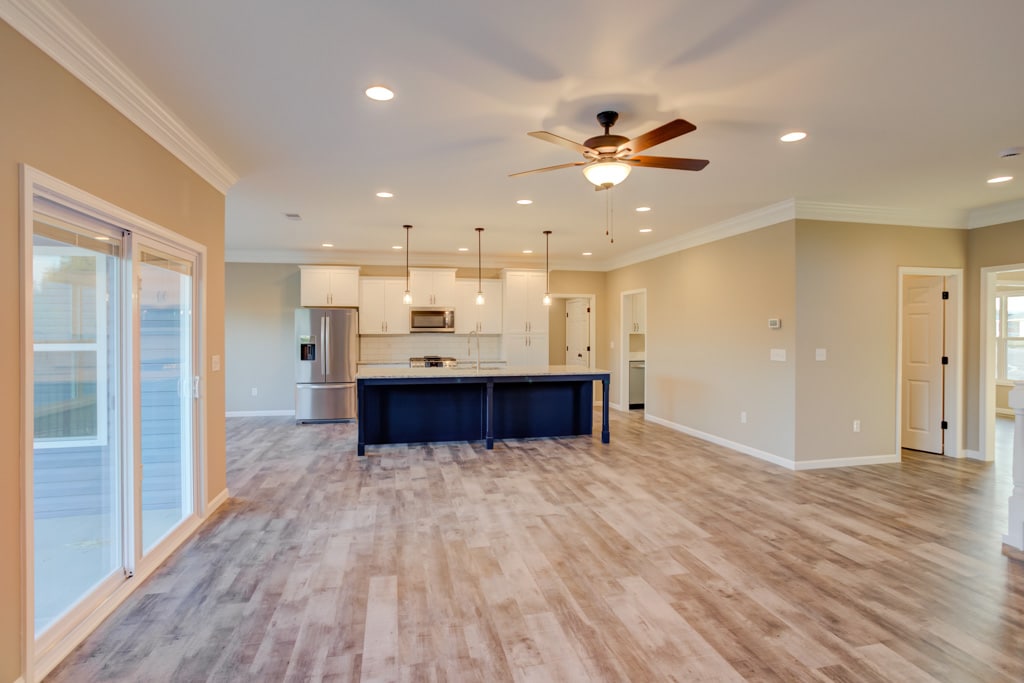
Picking flooring for a new home sounds simple until you start comparing options at the showroom. Hardwood vs. engineered hardwood vs. LVP is the comparison most buyers eventually land on, because all three deliver a wood look at very different prices, with very different long-term tradeoffs. This guide breaks down how a builder thinks about that decision, so you can match the right flooring to the right room before construction starts.
Key Takeaways
- Solid hardwood is one continuous piece of wood, engineered hardwood has a real wood veneer over a plywood core, and LVP (luxury vinyl plank) is a multi-layer vinyl product printed to look like wood.
- Flooring runs roughly 3.6% of total construction costs, about $15,388 in a typical new single-family home. It is a meaningful budget line, but rarely the biggest one.
- Solid hardwood holds the strongest long-term resale value and can be refinished multiple times, but it struggles in wet areas and basements.
- Engineered hardwood gives you the look and feel of real wood with better stability in humid or below-grade rooms, and it can typically be refinished once or twice depending on veneer thickness.
- LVP is the most water-resistant, most scratch-resistant, and lowest-cost of the three. It cannot be refinished, but it can be replaced plank by plank.
- Most new homes in Southern Indiana end up with more than one of these in the same home. The right answer is usually a mix, chosen room by room.
What Is Solid Hardwood, Engineered Hardwood, and LVP?
Each of these flooring types is built differently, and that construction explains almost every difference in how they perform. Understanding what each one actually is makes the rest of the comparison easier.
Solid Hardwood
Solid hardwood is exactly what it sounds like: a plank of real wood, typically 3/4 inch thick, milled from a single species like oak, hickory, maple, or walnut. Every part of the plank is wood, top to bottom.
Because there is no manufactured core, solid hardwood expands and contracts with humidity changes. That is why it performs best in stable, climate-controlled rooms on or above the main living level, and why builders rarely install it in basements, bathrooms, or directly over concrete slabs.
Engineered Hardwood
Engineered hardwood is a real wood veneer, usually 2mm to 6mm thick, bonded to a plywood or high-density fiberboard core. The top layer is genuine hardwood. You see oak grain because it is oak. The layers underneath are cross-laminated for stability.
That construction matters because the layered core handles humidity swings better than solid wood. Engineered hardwood can go in basements, over concrete, and in spaces where solid hardwood would warp or gap. The tradeoff is a thinner wear surface, so it can usually be refinished only once or twice, and sometimes not at all, depending on veneer thickness.
Luxury Vinyl Plank (LVP)
LVP is a multi-layer vinyl product. The visible wood look is a high-resolution printed image, protected by a clear wear layer on top and built on a rigid vinyl or stone-plastic composite (SPC) core underneath. There is no wood in it.
What LVP gives up in authenticity, it gains back in performance. Most LVP is waterproof or highly water-resistant, scratch-resistant, dent-resistant, and easy to clean. It is also the least expensive of the three by a meaningful margin in most product tiers.
Hardwood vs. Engineered Hardwood vs. LVP: Side-by-Side
The fastest way to weigh these three flooring types is to put them against the same criteria. The table below is a builder’s-eye view of the tradeoffs that actually show up over the life of a home.
| Criterion | Solid hardwood | Engineered hardwood | LVP |
| Material | Solid wood, top to bottom | Real wood veneer over plywood core | Vinyl with a printed wood-look layer |
| Water resistance | Low. Avoid wet rooms. | Moderate. Better than solid, not waterproof. | High. Most products are waterproof. |
| Scratch and dent resistance | Moderate. Soft species (pine) dent easily; hard species (hickory) hold up well. | Moderate. Same as solid, since the surface is real wood. | High. The wear layer is built to resist scratches and pet claws. |
| Can be refinished | Yes, multiple times over the life of the floor. | Sometimes. Depends on veneer thickness. | No. Replace damaged planks instead. |
| Works in basements | Not recommended. | Yes. | Yes. |
| Resale value | Strongest. Buyers consistently value real hardwood. | Strong. Reads as hardwood to most buyers. | Neutral. No longer a negative in most markets, but does not boost value the way wood does. |
| Relative cost (installed) | Highest | Middle | Lowest |
How to Choose Flooring by Room
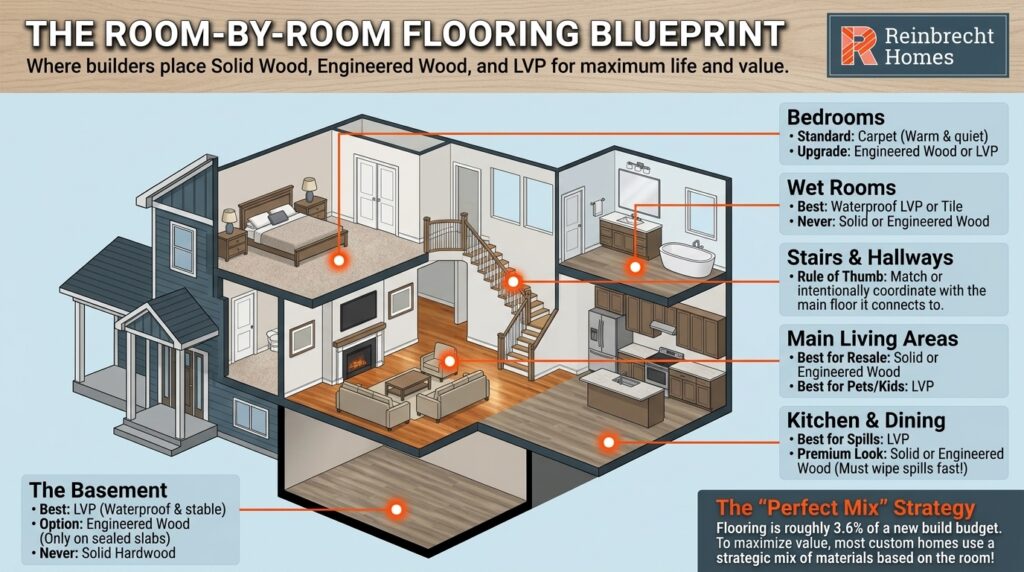
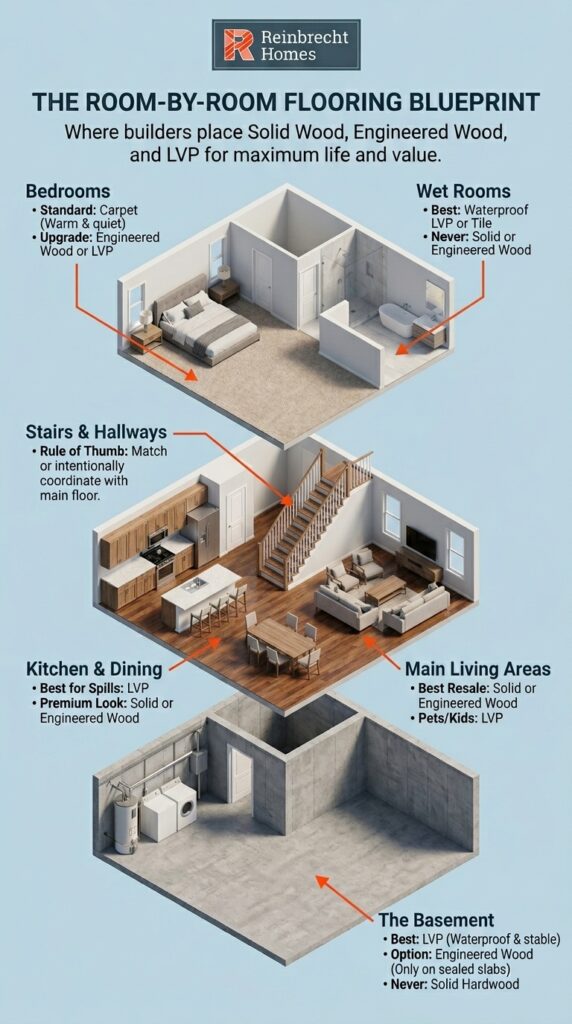
In most new builds, the right answer is not one flooring type throughout. It is a thoughtful mix, with each room getting the material that fits how it is used. Here is how a builder typically thinks about each space.
Main living areas (great room, kitchen, dining)
These rooms set the visual tone of the home and take the most foot traffic. LVP is the most common choice in new construction because it handles spills near the kitchen, holds up to pets and kids, and runs continuously through the main level for a clean look. Engineered hardwood is a strong upgrade when you want the warmth and authenticity of real wood throughout the main living level. Solid hardwood works here too, but think carefully about the kitchen, where hardwood and standing water are not friends.
Bedrooms
Carpet is still the most common bedroom flooring in new homes for comfort and sound. If you prefer a hard surface in bedrooms, engineered hardwood is a good fit because the warmth of real wood reads as a premium upgrade and humidity swings are mild in bedrooms. LVP works too, especially if pets sleep in the room.
Bathrooms and laundry rooms
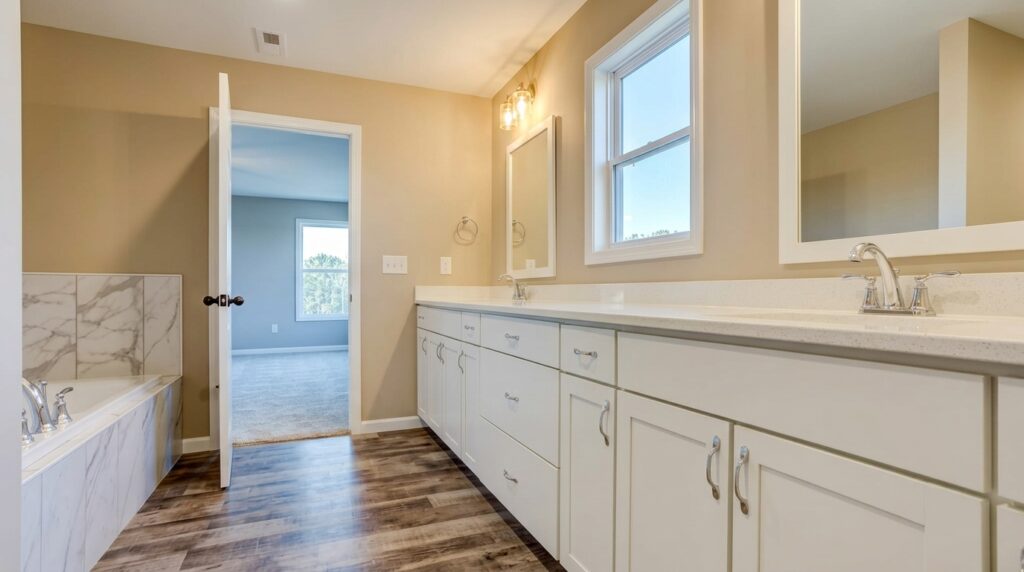
Tile is the traditional answer in wet rooms, but waterproof LVP has become a strong alternative because it is warmer underfoot than tile, faster to install, and easier to replace if a single plank ever gets damaged. Hardwood, solid or engineered, is not recommended in full bathrooms.
Basements
Basements have two enemies: moisture from below and temperature swings, and LVP handles both. Engineered hardwood can also work if the basement is fully conditioned and the slab is properly sealed. Solid hardwood should not go in a basement. The Reinbrecht home foundation types guide walks through how different foundation types affect moisture, which in turn shapes your flooring options.
Stairs and hallways
Stairs and hallways are high-traffic and high-visibility. They should match, or coordinate intentionally with, the flooring in the rooms they connect. Engineered hardwood stair treads are common in homes with hardwood on the main level. Carpeted stairs remain popular when the bedrooms upstairs are also carpeted.
How Flooring Fits Into a New Home Budget
Flooring sits inside the interior finishes category of a new build, which is the single largest construction stage in a typical home. Flooring itself averages roughly 3.6% of total construction costs, about $15,388 in an average new single-family home. That figure covers all the flooring across the whole home, not a single material.
Where your build lands in that range depends mostly on the mix:
- A home with LVP throughout the main level and carpet in the bedrooms lands at the lower end.
- A home with engineered hardwood across the main level, tile in the bathrooms, and carpet in the bedrooms lands higher.
- A home with solid hardwood on the main level, custom hardwood stair treads, and premium tile lands higher still.
Two other things shape the total. Regional cost differences are real: median custom home construction in the East North Central census division, which includes Indiana, ran $186 per square foot of floor space in 2024, behind only New England (above $190) and the Middle Atlantic ($188). These are broad regional medians, not a quote for any specific home. Your finish choices within each flooring type also matter, since a premium engineered hardwood with a thick veneer costs more than a budget engineered hardwood, even though both look like wood.
How Flooring Selection Works in a Reinbrecht Build
Reinbrecht does not price flooring by the square foot or hide it behind vague allowances. The company considers cost-per-square-foot pricing unreliable, so flooring is built into the fixed contract price before construction begins. The price you sign is the price you pay at closing, with no surprise allowance overruns at the end of the build.
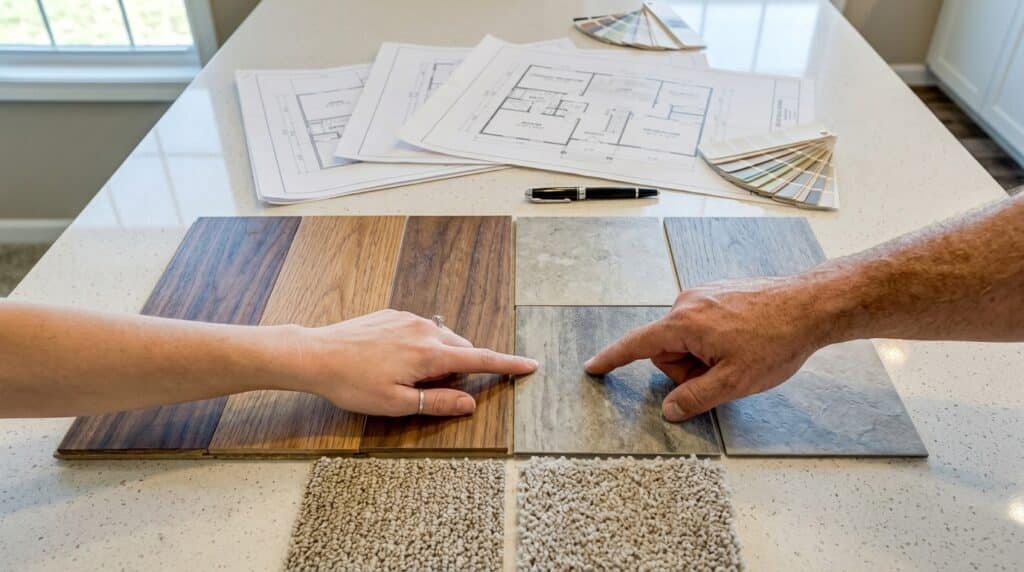
You make your flooring selections during the design phase, as part of personalizing your floor plan. With semi-custom homes, every component comes with a high-quality standard, and you can upgrade where it matters to you, including to premium materials like hardwood and engineered hardwood. The Reinbrecht team walks you through which combinations make sense for your floor plan, your lifestyle, and your budget. If you are building a fully custom home, every flooring decision is open from the start.
That kind of clarity is something Reinbrecht customers notice. One described the experience this way: “Our home started with a good plan, then moved on to a budget that included everything from concrete and fill rock to towel bars! Our builder helped us make decisions and even took us to the cabinet maker on an icy, winter day. The quotes were specific and based on what we said we wanted. Thanks to everyone who helped us!”
Most Reinbrecht builds use a mix of flooring types. The project gallery shows how those combinations come together in finished homes across Southern Indiana, Northwestern Kentucky, and Eastern Illinois.
Frequently Asked Questions About Choosing Flooring for a New Home
Is engineered hardwood as good as solid hardwood?
For most homeowners, engineered hardwood performs just as well as solid hardwood and offers a few practical advantages: better stability in humid conditions, lower cost per square foot, and the ability to install over concrete or in basements. Solid hardwood still wins on long-term resale value and the number of times the floor can be refinished, but those advantages matter most in homes where the flooring will stay in place for decades.
Does LVP look obviously fake?
It depends on the product tier. Entry-level LVP can look flat and uniform up close. Mid-tier and premium LVP uses high-resolution printing, embossed-in-register textures, and varied plank patterns that are difficult to tell apart from real wood at normal viewing distances. The biggest tell is usually underfoot, where LVP feels slightly softer and warmer than wood even when it looks identical.
Can I install hardwood and LVP in the same home?
Yes, and most new homes do. The trick is planning the transitions: matching colors so the rooms feel cohesive, using clean transition strips where one material meets another, and being intentional about which rooms get which floor. The Reinbrecht room-by-room flooring guide goes deeper on how to plan those transitions during the design phase.
Which flooring holds the best resale value in Southern Indiana?
Solid hardwood and engineered hardwood both signal quality to buyers and tend to support stronger resale value, especially on the main living level. LVP is no longer a negative in most markets, since it has become standard in new construction, but it does not lift value the way real wood does. If resale is a major concern, putting hardwood or engineered hardwood in the great room, dining room, and primary suite is a defensible choice.
Is LVP a good choice for families with pets and kids?
LVP is the most pet-friendly and kid-friendly of the three. The wear layer is built to resist scratches, the surface is waterproof, and damaged planks can be swapped out individually. Engineered hardwood is a reasonable second choice if you want the warmth of real wood. Solid hardwood is the least forgiving in a home with active pets, though it can still be a great choice if you are comfortable with some patina developing over time.
Build the Right Floor for the Right Room
Choosing the right flooring is easier when you can see and feel the options against your specific floor plan, your rooms, and your budget. Ready to start planning your new home? Contact the Reinbrecht team to schedule your first meeting, or explore Reinbrecht’s 30+ customizable floor plans to find the right fit for your family.
