
Building a new home is exciting. The financing can feel like the hard part, especially if you’re weighing an FHA construction loan for the first time. This guide explains how the loan works for a build in the Evansville area and across Southern Indiana, written from the builder’s side rather than the lender’s.
Key Takeaways
- One loan, one closing. The FHA One-Time Close is a construction-to-permanent loan: you close once, funds release in draws during the build, then the loan converts to a permanent FHA mortgage, governed by FHA Handbook 4000.1.
- Low down payment: you can put down as little as 3.5% with a credit score of 580 or higher.
- 2026 loan limit here: the FHA one-unit limit in the Evansville area is $541,287, the national floor.
- Mortgage insurance applies. Plan for a 1.75% upfront premium and a 0.55% annual premium on a typical 30-year, low-down-payment FHA loan.
- It’s a common builder path. About 35% of single-family builders used a one-time-close construction-to-permanent loan for some homes in early 2026.
- The build side matters too. Reinbrecht’s free construction financing can cover build-period costs, separate from the FHA loan that becomes your permanent mortgage through a partner bank.
FHA Construction Loan at a Glance for the Evansville Area (2026)
Here’s how the key FHA construction loan numbers land for a build in the Evansville area in 2026. Each figure ties to its primary source.
| Item | 2026 figure or rule | Source |
| Minimum down payment | 3.5% (credit 580 or higher); 10% (credit 500 to 579) | Handbook 4000.1 |
| Minimum credit score | 580 for 3.5% down; 500 to 579 needs 10% down; below 500 ineligible | Handbook 4000.1 |
| 2026 FHA loan limit, one unit (Evansville area) | $541,287 (national floor; confirm your exact county figure via the HUD lookup) | HUD No. 25-145 |
| Upfront mortgage insurance (UFMIP) | 1.75% of the base loan amount | HUD ML 2023-05 |
| Annual mortgage insurance (typical 30 year, 3.5% down) | 0.55% per year | HUD ML 2023-05 |
| Loan structure | One-Time Close (construction to permanent): one closing, draws during the build, then converts to a permanent FHA mortgage | Handbook 4000.1 |
| Property type | One-unit primary residence; FHA-approved lender; builder follows FHA property standards | Handbook 4000.1 |
| How it pairs locally | Reinbrecht’s free construction financing covers build-period costs; FHA is the buyer’s permanent loan through a partner bank | Reinbrecht Homes |
What Is an FHA Construction Loan?
An FHA construction loan is a government-backed loan that finances building a new home. The most common version, the FHA One-Time Close, is a construction-to-permanent loan: it covers the construction phase and then converts into a permanent FHA mortgage, using a single application and a single closing, as set out in FHA Handbook 4000.1.
FHA actually backs two different construction-related loans, and they solve different problems:
- FHA One-Time Close (construction to permanent): finances a brand-new build from the ground up, then rolls into your permanent mortgage. This is the loan most new-construction buyers mean when they say “FHA construction loan.”
- FHA 203(k) rehab loan: finances buying and renovating an existing home, not new construction from scratch. If you’re building new, this usually isn’t the one you want.
This is a mainstream way to finance a build, not a niche product: about 35% of single-family builders used it for some of their homes in early 2026.
How Does an FHA Construction Loan Work?
An FHA One-Time Close works in one continuous process: you get approved, close once (which locks your terms), and the lender releases money in stages called draws as the home gets built. When construction finishes, the loan converts to a permanent FHA mortgage with no second closing, per FHA’s construction-to-permanent rules.
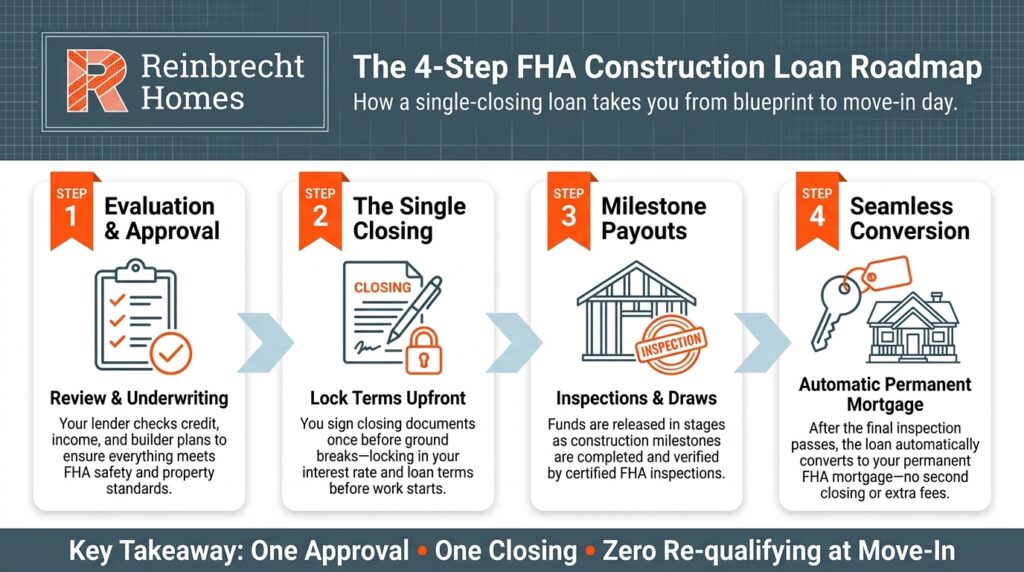
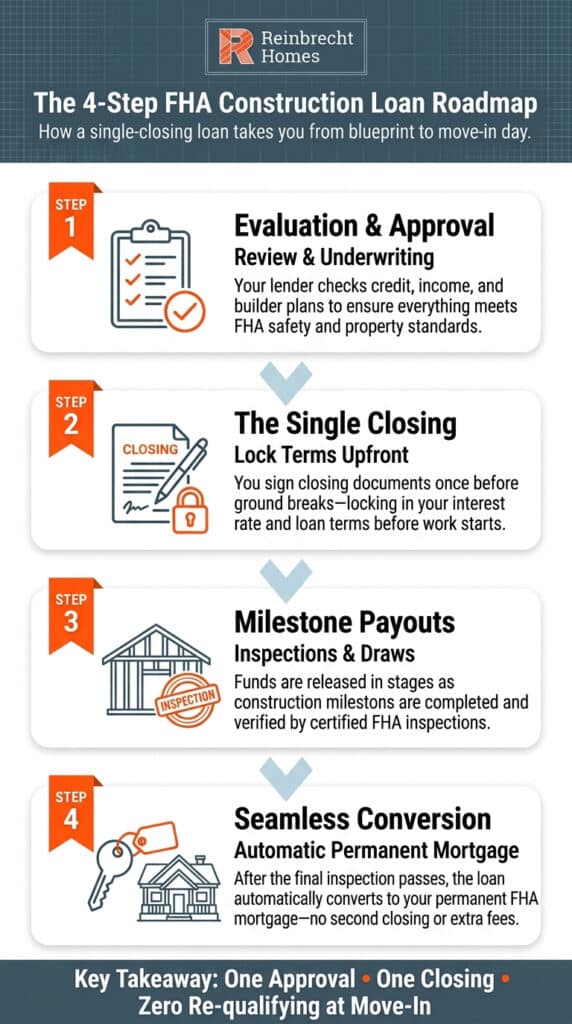
From approval to move-in, the process follows a clear order:
- Pre-approval and underwriting. The lender reviews your credit, income, and the build plans, and confirms the project meets FHA property standards.
- A single closing. You close once, before construction starts, which locks your loan terms up front.
- Construction draws. The lender releases funds in stages tied to build progress, with an inspection confirming each phase before the next draw.
- Conversion to a permanent mortgage. When the home is finished and passes final inspection, the loan converts to your permanent FHA mortgage automatically.
FHA Construction Loan Requirements in 2026: Credit, Down Payment, and Loan Limits
FHA construction loan requirements come down to three things: your credit score, your down payment, and your county’s FHA loan limit. The home must be a one-unit primary residence built by a licensed contractor, per Handbook 4000.1.
What credit score do you need for an FHA construction loan?
FHA sets tiered credit rules. A score of 580 or higher qualifies you for maximum financing at 3.5% down. A score of 500 to 579 is limited to 90% financing, which means 10% down, and scores below 500 aren’t eligible. Your FHA-approved lender confirms the exact requirements, since lenders can set their own standards on top of the FHA minimums.
How much is the down payment on an FHA construction loan?
The minimum down payment is 3.5% for borrowers with a credit score of 580 or higher, or 10% for scores of 500 to 579. That low entry point is a big reason FHA loans appeal to first-time buyers in the Evansville area.
What are the 2026 FHA loan limits in the Evansville area?
For 2026, the FHA one-unit loan limit in the Evansville area is $541,287, the national floor that applies to lower-cost counties like Vanderburgh, Warrick, Posey, and Gibson. Because local home prices sit well below the national ceiling, these counties use the floor. You can confirm the exact figure for your county through HUD’s FHA mortgage limits lookup tool.
Does an FHA construction loan require mortgage insurance?
Yes. FHA loans include mortgage insurance regardless of down payment. You’ll pay an upfront mortgage insurance premium of 1.75% of the base loan amount, plus an annual premium of about 0.55% on a typical 30-year loan with the minimum down payment. Mortgage insurance is part of what lets FHA offer low down payments and flexible credit requirements.
Can You Build on Your Own Land With an FHA Construction Loan?
Yes. An FHA One-Time Close can finance a home built on a lot you already own or one you buy as part of the loan. FHA’s Building on Own Land provisions cover this situation, and land you already hold can factor into your investment in the project. For rural buyers across Southern Indiana, that’s a practical way to build on family land or a small-community lot.
Our guide on using land as collateral for a construction loan covers that side of the deal in more detail.
A few FHA rules shape how build-on-your-land works:
- One-unit primary residence. The loan is for a single-family home you’ll live in, not an investment or vacation property, per FHA program rules.
- Licensed contractor required. You can’t act as your own builder or do the work for sweat equity. FHA construction loans call for a licensed, approved contractor.
- FHA-approved lender. The loan has to come from a lender approved to write FHA loans.
- Within the county FHA limit. The total loan has to stay within your area’s FHA loan limit, which is $541,287 for one unit in the Evansville area in 2026.
How long you’ve owned the lot can also affect how the loan is calculated. FHA looks at whether you acquired the land recently or some time ago, and your lender will confirm how your situation is treated under the current Handbook.
How an FHA Construction Loan Compares to Other Loan Paths
FHA isn’t the only way to finance a build. Here’s how it stacks up against the two comparisons buyers ask about most.
FHA One-Time Close vs a conventional construction loan
The biggest difference is the number of closings:
- FHA One-Time Close: one application, one closing, and an automatic conversion to your permanent mortgage. Your terms are locked before the build starts.
- A conventional two-close construction loan: a short-term construction loan first, then a separate closing to refinance into a permanent mortgage once the home is done. That’s two rounds of closing costs and, potentially, requalifying if your finances or rates change.
Conventional construction loans usually ask for a stronger credit profile and more cash up front than FHA’s 3.5% minimum. Our explainer on the differences between a construction loan and a mortgage breaks down the two-close structure.
FHA vs VA and USDA construction loans
If you qualify for a VA or USDA loan, those can be even more affordable than FHA for a new build:
- VA construction loans are for eligible veterans and service members and can require no down payment. See our guide to VA loans for new construction in Indiana.
- USDA construction loans support builds in eligible rural areas, which cover much of Southern Indiana, and can also require no money down. Our guide to USDA construction loans in Indiana covers eligibility.
FHA is the most widely available of the three, because it doesn’t require military service or a rural location. For many first-time buyers in the Evansville area, it’s the most accessible starting point.
How Reinbrecht’s Free Construction Financing Works With an FHA Loan
Reinbrecht’s free construction financing and an FHA loan do two different jobs. The free construction financing covers your costs during the build, while the FHA loan is your permanent mortgage through a partner bank. Together, they can make building more affordable than either piece alone.
With Reinbrecht’s free construction financing, you can finance up to $250,000 of the build with as little as $1,000 down, and you make no interest-only payments during construction. Reinbrecht partners with local banks and supports FHA financing alongside conventional, USDA, VA, and jumbo loans. A family-owned builder serving Southern Indiana since 1995, Reinbrecht has completed more than 500 homes across the region.
The two pieces stay distinct:
- Free construction financing: a builder-side program that covers your costs during the build period.
- The FHA loan: the permanent mortgage you carry after closing, arranged through a partner bank.
They’re not the same product and don’t replace each other. Whether a particular partner bank offers FHA specifically as a One-Time Close is worth asking your lender directly, since construction-to-permanent availability varies by lender.
Reinbrecht’s track record is part of why buyers trust the process. As one homeowner put it: “The Reinbrecht team and their sub contractors did a wonderful job bringing our dream home to reality. They delivered a home of exceptional quality on time and on budget. They were present for us every step of the way, delivering a personal and professional home building experience.”
Timing, Draws, and Appraisals: The Builder’s Side of an FHA Construction Loan
The paperwork side of an FHA construction loan is only half the picture. The other half is how the loan lines up with an actual build calendar, which is where a builder’s perspective helps. With Reinbrecht, a semi-custom build typically runs about one month of pre-construction and six to eight months of construction. Because the One-Time Close locks your terms at that single closing before the build begins, coordinating the closing with your start date matters: lock too early and you may hold a rate through a long pre-construction phase, but time it well and your rate lock lines up with the build.
Construction draws follow the build’s real milestones, releasing as work reaches stages like foundation, framing, and finishing, with an inspection before each release. A builder used to coordinating draw schedules with lenders can keep those inspections from slowing the job down.
One risk buyers don’t always plan for is the appraisal. A new build is valued against recent sales of comparable homes nearby, and in parts of Southern Indiana where new construction is less common, there may be fewer close comparables. You can reduce that risk in a few practical ways:
- Build in an established neighborhood with recent comparable sales, so the appraiser has strong local data to work from.
- Keep finishes in line with the local market rather than over-improving beyond what nearby homes support.
- Work with a builder who knows the area’s values, which helps set realistic expectations before the appraisal.
One family who had planned to remodel a farmhouse decided to build new after hearing from friends who had built with Reinbrecht. They met the team within a week, started construction within four months, and finished well within the projected timeline.

Frequently Asked Questions About FHA Construction Loans
What are the two types of FHA construction loans?
FHA backs two construction-related loans. The FHA One-Time Close is a construction-to-permanent loan for building new from the ground up, while the FHA 203(k) finances buying and renovating an existing home. For a new build, the One-Time Close is the relevant option.
What credit score do you need for an FHA construction loan?
You’ll generally need a credit score of at least 580 for the 3.5% minimum down payment. Scores from 500 to 579 require 10% down, below 500 aren’t eligible, and individual lenders may set higher minimums.
What are the 2026 FHA loan limits in the Evansville area?
The 2026 FHA loan limit for a one-unit home in the Evansville area is $541,287, the national floor for lower-cost counties. Your total FHA loan must stay within that limit, and you can confirm your county’s exact figure through HUD’s lookup.
Can you act as your own builder on an FHA construction loan?
No. FHA construction loans require a licensed, approved contractor, so you can’t do the work yourself for sweat equity. That requirement helps make sure the home meets FHA property standards.
Does an FHA construction loan require mortgage insurance?
Yes. FHA loans include an upfront premium of 1.75% of the base loan amount and an annual premium of about 0.55% on a typical low-down-payment loan. It’s part of what lets FHA offer low down payments and flexible credit.
Ready to Build in Southern Indiana?
Building with an FHA loan is very doable in the Evansville area, and the right builder makes the financing side simpler. If you’re ready to talk through your options, contact the Reinbrecht team to start the conversation, or explore Reinbrecht’s customizable floor plans to picture what’s possible. Whatever stage you’re at, it helps to have a builder who knows the local process.
