
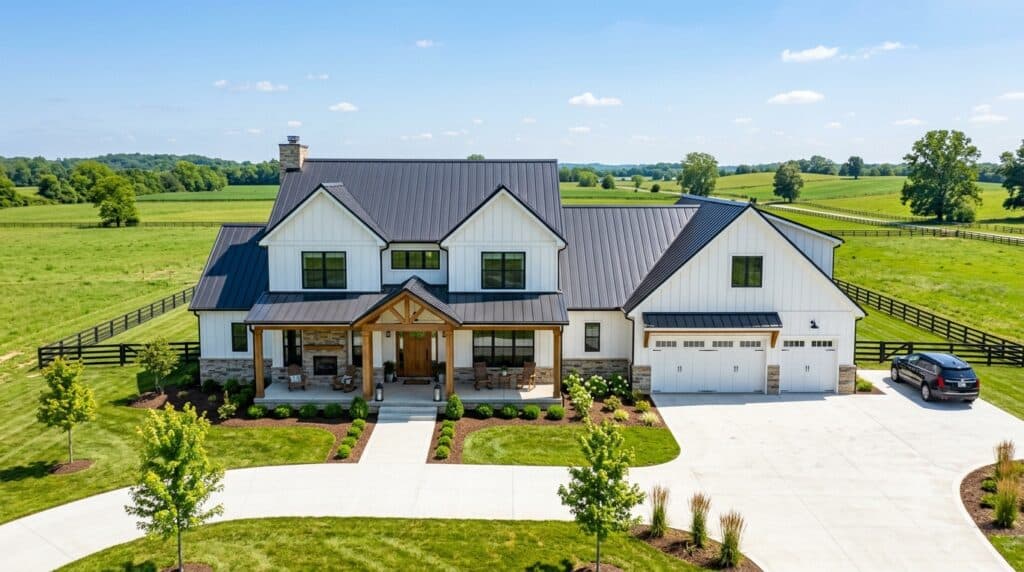
If you want to build a new home in a rural part of Southern Indiana, a USDA construction loan can be one of the most affordable paths available, and it is one a lot of buyers do not realize exists. This guide walks through how the loan works, who qualifies, which areas are eligible, and how to find a builder, all from the perspective of a local builder who works with this kind of financing every day. The aim is to bridge the gap between getting approved and actually breaking ground.
Key Takeaways
- A USDA construction loan is a single-close, construction-to-permanent loan: one closing covers the lot, the build, and the permanent mortgage, with no down payment for eligible buyers.
- The loan note guarantee is issued before construction begins, and your interest rate is fixed at that closing, so it does not move during the build.
- Eligibility comes down to three things: the property sits in an eligible rural area with a population up to 35,000, household income stays within 115% of the area median, and the finished home meets USDA property standards.
- You cannot be your own builder. Your USDA-approved lender reviews and approves the builder, and USDA itself keeps no contractor list and makes no referrals.
- Reinbrecht Homes already supports USDA financing and has built more than 500 homes across Southern Indiana, Northwestern Kentucky, and Eastern Illinois since 1995.
- The USDA loan and Reinbrecht’s in-house free construction financing are two separate things that can work together on the same build.
What Is a USDA Construction Loan?
A USDA construction loan is a government-backed mortgage that lets eligible buyers finance land, construction, and a permanent mortgage in a single loan with one closing, and with no down payment. It is officially called a single-close, or combination construction-to-permanent, loan, and it runs through USDA-approved lenders under the Rural Development Single Family Housing Guaranteed Loan Program.
Instead of juggling separate loans for the land, the build, and the mortgage, a USDA construction loan rolls all three into one. The single loan covers:
- The lot: the land purchase, or paying off the remaining balance on a land loan you already have.
- Construction: funds released to your builder in stages as the work reaches each milestone.
- The permanent mortgage: once the home is finished, the loan becomes a long-term, fixed-rate mortgage automatically, with no second closing.
Because the program is backed by the U.S. Department of Agriculture, it is built to support homeownership in smaller communities. That is why it can offer 100% financing to buyers who might not otherwise be able to put money down to build.
How Does a USDA Construction Loan Work?
A USDA construction loan works by closing once, before construction starts, and then converting to a permanent mortgage when the home is complete. At that single closing, your interest rate is locked, the loan note guarantee is issued, and construction funds are scheduled to release to your builder in draws as the build progresses.
That single-close structure is the main thing that sets it apart from the way most people finance a build. With a USDA loan, your rate is fixed at closing before construction begins, so you are not exposed to rate movement during the months it takes to build. The loan can also cover more than just the home itself.
USDA-eligible costs that the loan can fold in include:
- The lot purchase, plus reasonable construction and administrative costs.
- Contingency reserves and inspection fees.
- Landscaping and other authorized project costs.
Those eligible costs are spelled out in the USDA construction-to-permanent fact sheet. If you want a broader primer on how construction loans differ from a standard mortgage before going further, our guide to mortgage loans versus construction loans covers the fundamentals.
Here is how the single-close path compares with the traditional approach of taking out a construction loan and then a separate mortgage:
| Feature | Traditional two-loan path | USDA single-close loan |
| Closings | Two: a construction loan, then a separate mortgage. | One closing covers construction and the permanent mortgage. |
| Down payment | Often substantial, depending on the lender. | None for eligible buyers (100% financing). |
| Interest rate | Set later, when you refinance into the permanent loan. | Fixed at closing, before construction begins. |
| Conversion | A separate refinance after the build is done. | Automatic, with no second closing. |
| Where it applies | Most locations. | Eligible rural areas with a population up to 35,000. |
USDA Construction Loan Requirements
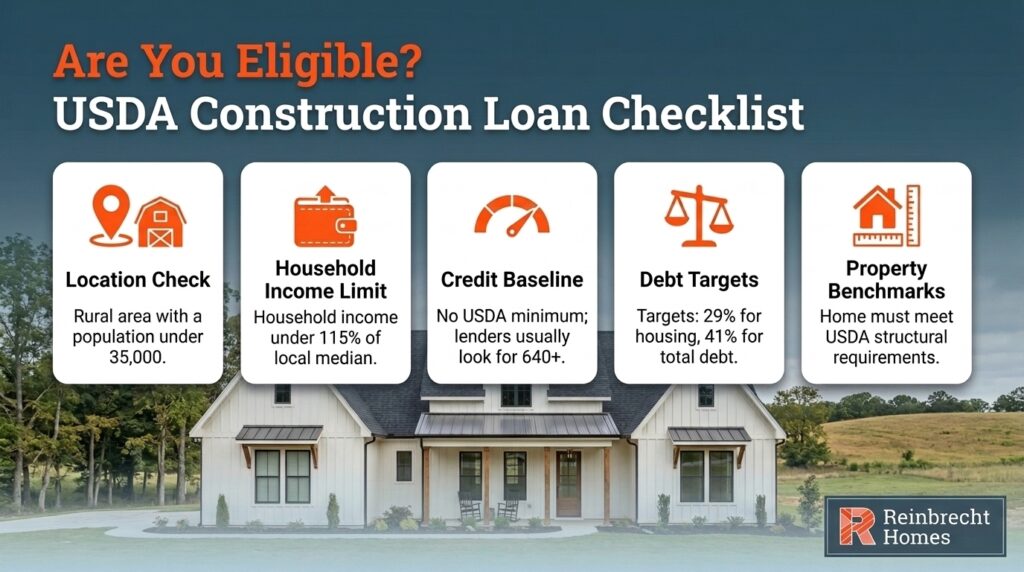
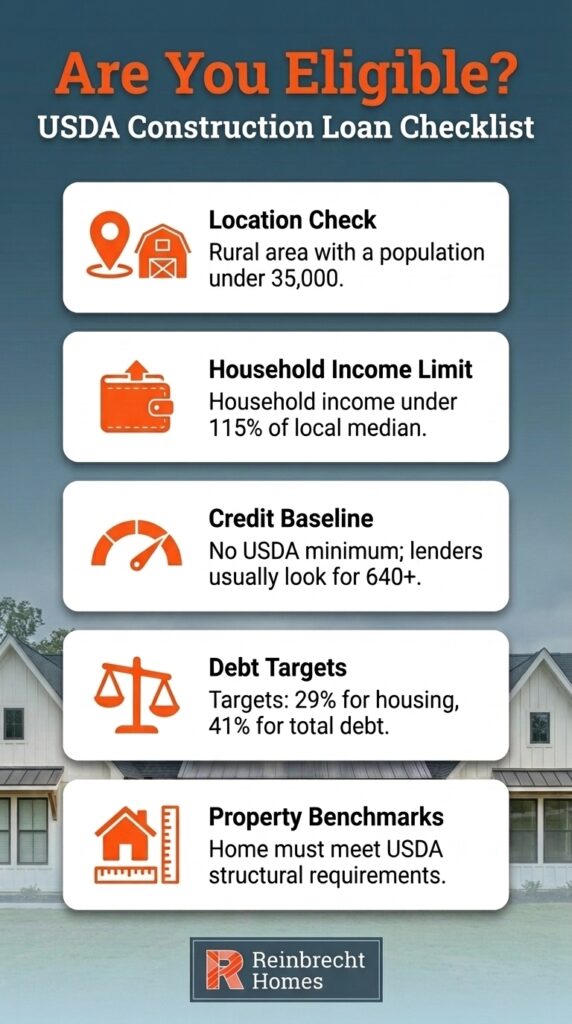
To qualify for a USDA construction loan, you need a property in an eligible rural area, a household income within 115% of the area median, and a credit and debt profile your lender is comfortable with. USDA sets no minimum credit score, though most lenders look for around 640.
The core requirements break down like this:
- Location: the home must be in a USDA-eligible rural area, defined by a population up to 35,000.
- Income: household income cannot exceed 115% of the area or county median household income.
- Credit: USDA itself sets no minimum score, but lenders commonly look for around 640.
- Debt ratios: lenders generally want housing costs near 29% of income and total debt near 41%, with some flexibility for strong applicants.
- Property standards: the finished home must meet USDA construction and property standards.
USDA loans do not carry private mortgage insurance. Instead, they include a guarantee fee that funds the program: 1% upfront and 0.35% annually. The upfront portion can usually be rolled into the loan rather than paid in cash at closing. These are typical expectations rather than hard cutoffs, and compensating factors can help borrowers who fall slightly outside a guideline.
Which Areas Qualify for a USDA Loan in Southern Indiana?
USDA loans are limited to eligible rural areas, which the program defines by population (up to 35,000). A good portion of Reinbrecht’s service area across Southern Indiana, Northwestern Kentucky, and Eastern Illinois sits outside the larger city centers, so a lot of it may qualify. Eligibility, though, is set by specific address, not by town name.
The reliable way to check is the USDA eligibility map. Enter a specific address and it will tell you whether that parcel is in an eligible area. We point buyers to the map rather than naming towns, because a single community can include both eligible and ineligible pockets. The map is the source of truth.
This is also where building on your own lot comes in. A USDA construction loan pairs naturally with a rural parcel you own or plan to buy, and already owning that land can work in your favor. It lifts your loan-to-value ratio, which one loan officer summed up in an industry guide this way: “you borrow less and often end up with a lower monthly payment”. To get a feel for payments at different loan amounts, you can try Reinbrecht’s mortgage calculator.
How to Find a Qualified Builder for Your USDA Construction Loan
You cannot build the home yourself with a USDA construction loan. The build has to be handled by a qualified builder, and it is your USDA-approved lender, not USDA, that reviews and approves the builder‘s license, insurance, experience, and references. USDA keeps no list of approved builders and makes no referrals.
This trips up a lot of buyers who search for a “USDA-approved builder.” In practice, USDA does not approve builders at all. The lender does. So the real task is finding an established builder whose credentials your lender will sign off on. Lenders typically want a builder who meets standards like these:
- Experience: at least two years building single-family homes.
- Insurance: at least $500,000 in commercial liability coverage.
- Background: a passed background check.
Those benchmarks come from current USDA construction loan guidance, and they are exactly the kind of bar a long-running local builder clears comfortably. Reinbrecht Homes has been building homes across Southern Indiana since 1995, with more than 500 completed homes and recognition that includes the 2024 Gold Winner, People’s Choice for Home Builder, in the Evansville Community’s Choice Awards. For a rural USDA build, that track record is what gives a lender confidence and gives you a partner who has guided hundreds of families through the process.
That experience shows up in how projects land. In the words of one homeowner: “The Reinbrecht team and their sub contractors did a wonderful job bringing our dream home to reality. They delivered a home of exceptional quality on time and on budget. They were present for us every step of the way, delivering a personal and professional home building experience.”
USDA Financing and Reinbrecht’s Free Construction Financing: How They Fit Together
These are two separate things, and it helps to keep them straight. The USDA single-close construction loan is your mortgage financing, arranged through a USDA-approved lender. Reinbrecht’s free construction financing is a separate, in-house offer designed to keep your out-of-pocket cost low while the home is being built.
On a USDA build, Reinbrecht’s role is the qualified builder. The USDA loan provides the no-down-payment structure and the permanent financing for eligible rural buyers. Reinbrecht’s program speaks to the build phase, with as little as $1,000 down to get started and no interest-only payments during construction. Because the exact way these pieces combine depends on your lender and your situation, the best move is to map it out with the Reinbrecht team and your USDA lender together, so everyone is working from the same plan.
Steps to Start a USDA Construction Loan Build
If a USDA construction loan looks like a fit, here is the general order of operations from first check to move-in:
- Check your eligibility. Confirm the address is in an eligible area on the USDA eligibility map, and compare your household income to the local limit.
- Get pre-qualified with a USDA-approved lender. The lender confirms your income, credit, and debt fit the program and tells you what you can borrow.
- Choose a qualified builder. Your lender reviews the builder’s credentials, so working with an established local builder keeps this step smooth.
- Finalize your plans and selections. Lock in your floor plan, finishes, and budget before closing so the build can move without surprises.
- Close once, then break ground. Your rate is fixed at this single closing before construction begins, and the loan note guarantee is in place.
- Build, then convert to your mortgage. Funds release to the builder in draws, and at completion the loan automatically becomes your long-term, fixed-rate mortgage.
On paper that is a lot of steps, but the process tends to move smoothly with a builder who has run it many times. One Mt. Carmel, Illinois family who built with Reinbrecht put it this way: “We originally planned to remodel a family farm house, but after talking with friends whose homes were built by Reinbrecht Homes, we decided we would be happier with new construction. The Reinbrecht team met with us within a week of our call, started construction within four months, and finished well within the projected completion date!”
Frequently Asked Questions About USDA Construction Loans
What credit score do you need for a USDA construction loan?
USDA itself sets no minimum credit score, but most lenders look for around 640. A higher score can make approval easier and may help with your rate, while applicants below the common threshold can sometimes qualify with strong compensating factors like steady income or low debt.
Can you build a house on land you’re still paying for?
Yes. You can roll the remaining balance of an existing land loan into a USDA construction loan, which can improve your loan-to-value and lower your monthly payment. One thing to know: USDA does not allow cash-out, so if you paid cash for the land, you cannot reimburse yourself through the loan.
Does the builder have to be USDA-approved?
No. USDA does not approve builders. Your USDA-approved lender reviews and approves the builder‘s qualifications instead. That is why the search term “USDA-approved builder” is a bit of a misnomer; what you actually need is a qualified builder your lender will accept.
What disqualifies a home from USDA financing?
The most common disqualifiers are location and income. A property outside an eligible rural area, a household income above the 115% median limit, or a home that does not meet USDA property standards will not qualify. Checking the eligibility map and your income early helps you avoid surprises.
How long does a USDA construction loan last?
The construction phase happens first, then the loan converts to a 30-year fixed-rate mortgage. Because it is a single-close loan, you do not refinance to reach that permanent term; the conversion is automatic once the home is complete.
Ready to Build in Rural Southern Indiana?
A USDA construction loan can open the door to a brand-new home in a rural community, and the right local builder makes the rest of the process feel manageable. If you’re weighing a build in Southern Indiana, Northwestern Kentucky, or Eastern Illinois, contact the Reinbrecht team to talk through your plans, or explore our floor plans to start picturing what’s possible on your own land.
