
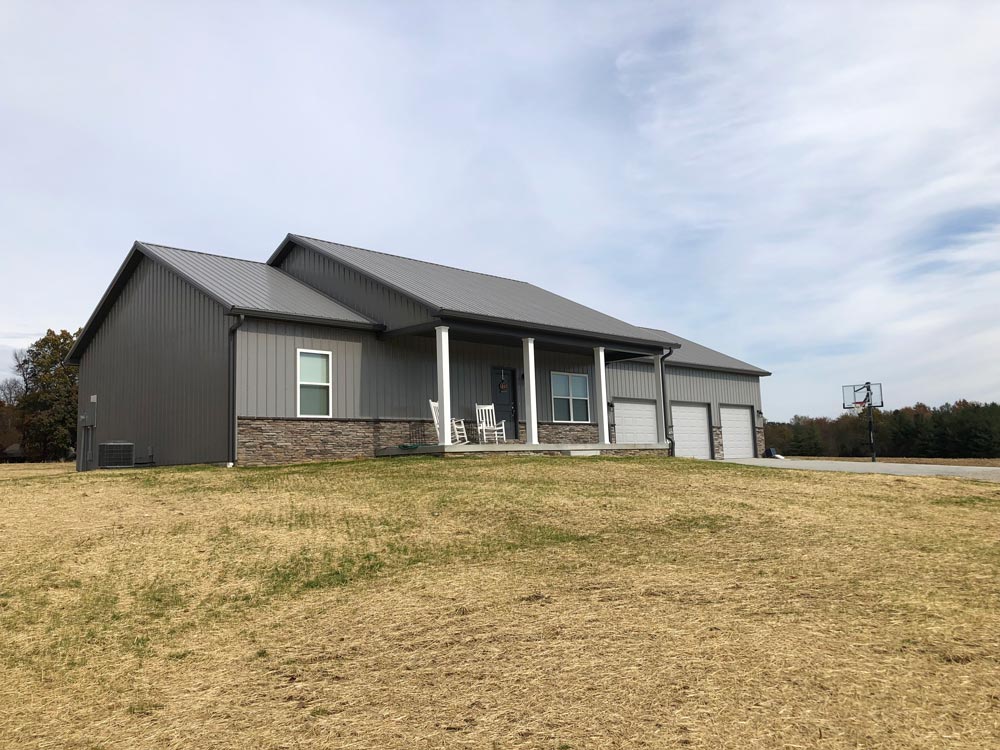
Pole barn homes have a lot going for them on paper: wide-open floor plans, a rugged metal exterior, and price tags that look lower than a traditional new home. But the number on a pole barn home ad rarely tells the full story. Once a pole barn home is built to the same standards as any other house in Indiana, most of that savings disappears. Here’s what pole barn homes actually cost, where the savings really come from, and how to get the look you want on a home that’s built, financed, and appraised like every other house on the road.
Key Takeaways
- Finished pole barn homes average $50 to $150 per square foot to build, but in Reinbrecht’s experience, most of the lower per-square-foot cost comes from building a large, simple space, not from the metal exterior.
- Indiana’s residential code requires foundation walls, piers, and other permanent supports to be protected from frost. In Reinbrecht’s experience, many low-cost pole barn builds skip the footings that protection takes, and Reinbrecht Homes won’t cut that corner.
- Reinbrecht builds the look instead: the same structure as every other Reinbrecht home, wrapped in metal siding and a metal roof.
- When Reinbrecht priced several of its own homes with metal siding and roofing versus standard siding and asphalt shingles, the cost difference was basically a wash.
- Fannie Mae and Freddie Mac both permit conventional loans on barndominiums, but thin appraisal comparables and lender overlays make financing a true pole barn home harder.
- Reinbrecht’s standard foundation is a slab, and a basement is an available upgrade. A basement also rules out true post-frame construction, because the posts have to sit on top of the basement wall instead of in the ground.
What Is a Pole Barn Home?
A pole barn home is a house built with post-frame construction. As Reinbrecht describes it, the posts are set several feet into the ground, and in a true post-frame build, the only foundation is typically the concrete at the posts.
What draws most buyers in is the look and the space: tall ceilings, big open rooms, a shop or garage under the same roof, and a durable metal exterior. Those are all reasonable things to want. The question is whether a true post-frame structure is the right way to get them.
Are Pole Barn Homes Code Compliant in Indiana?
They can be, but only when they’re built with the footings and frost protection the code requires, and that’s where many low-cost pole barn builds fall short. Indiana’s residential code requires foundation walls, piers, and other permanent supports to be protected from frost, for example, by extending below the frost line. In Reinbrecht’s experience, a pole barn home often sets its posts in the ground and pours a slab between them with no footing under the walls along its edges.
This is why Reinbrecht steers buyers away from pole barn homes. Indiana’s code doesn’t require continuous footings, so a post-frame home can be engineered to meet code, but by the time the required footings and frost protection are added, most of the savings that made it attractive are gone. In Reinbrecht’s view, the only real savings in a pole barn home come from skipping those requirements, which is why Reinbrecht won’t build one.
Footings aren’t a technicality. In Reinbrecht’s experience, without them a slab can move or heave around the edges in cold weather, which shifts interior walls and damages drywall and trim over time.
A professionally built, residentially classified home on a permanent, code-compliant foundation avoids this problem entirely. It’s also why every Reinbrecht home is backed by a 10-year structural warranty, 2-year systems coverage, and 1-year workmanship and materials coverage.
Are Pole Barn Homes Really Cheaper Than a Traditional Home?
Pole barn homes look cheaper mainly because of size and shortcuts, not because of the metal. A post-frame shell is inexpensive on its own, with a kit running $10 to $30 per square foot plus $5 to $10 per square foot to assemble. But site prep, foundation, utilities, and interior finishing cost about the same as a traditional build, and those stages make up most of a finished home’s price.
Reinbrecht tested the exterior question directly. The team priced out several of its own homes two ways: once with standard siding and asphalt shingles, and once with metal siding and a metal roof. The pricing was basically a wash. In other words, choosing the pole barn look doesn’t save you money on its own.
So where do the advertised savings come from? In Reinbrecht’s experience, mostly from sheer size. A large, simple, open building spreads its fixed costs across a lot of square footage, so its cost per square foot looks low. In Reinbrecht’s view, the remaining savings come from skipping the footings and frost protection that code requires, and that’s a corner Reinbrecht won’t cut. It’s also why Reinbrecht doesn’t price homes by cost per square foot at all: the metric hides finish level, mechanical systems, and site conditions. Reinbrecht provides upfront, straight-cost pricing with no hidden fees.
| Consideration | True Pole Barn / Post-Frame Home | Reinbrecht Home Wrapped in Metal |
|---|---|---|
| Structure | Posts set several feet into the ground; in Reinbrecht’s experience, many builds skip footings under the walls between posts. | The same framing and footings as every other Reinbrecht home. |
| Code compliance | Indiana doesn’t require continuous footings, so it can be engineered to meet code, but in Reinbrecht’s experience that adds the footings and frost protection many low-cost builds skip. | Built to code, like every Reinbrecht home. |
| Exterior look | Metal siding and metal roof. | Metal siding and metal roof, so the look is the same. |
| Cost | Inexpensive shell, but site prep, foundation, utilities, and finishing cost the same either way. | When Reinbrecht priced metal against standard siding and shingles, the difference was basically a wash. |
| Foundation | Typically, the only foundation is the concrete at the posts. In Reinbrecht’s view, adding a basement means setting the posts on top of a poured basement wall, which makes it essentially a standard build. | Slab is standard; a basement is an upgrade. |
| Financing | Conventional loans are eligible, but thin comps and lender overlays can stall approval. | Standard financing through Reinbrecht’s local bank partners. |
| Appraisal and resale | Comparable sales are often scarce, and unusual features widen the risk. | Appraises against the same pool of comparable sales as other homes nearby. |
| Insulation | In Reinbrecht’s experience, thicker post-frame walls need more insulation and can be harder to heat and cool. | Standard Spider Plus insulation in every exterior wall. |
For a fuller look at style, layout, and long-term ownership, see Reinbrecht’s comparison of barndominiums versus traditional homes in Southern Indiana.
How Much Does a Pole Barn Home Cost?
A finished pole barn home averages $50 to $150 per square foot, or roughly $120,000 to $360,000 for a 2,400 square foot home. Where a project lands in that range depends mostly on size and finish level. Breaking the total into stages shows where the money goes:
- Kit shell: $10 to $30 per square foot for post-frame materials and plans.
- Assembly labor: $5 to $10 per square foot to erect the shell on-site.
- Interior finishing: $35 to $110 per square foot for site prep, foundation, utilities, and a completed interior.
Notice that finishing is the biggest line item by far, and it’s the same work a traditional home needs. The shell is the only stage where a pole barn home is meaningfully cheaper, and the shell is exactly where code compliance and long-term durability are decided.
Can You Get a Mortgage for a Pole Barn Home?
Yes, but it’s harder than it should be. Fannie Mae and Freddie Mac both allow conventional loans on barndominiums. The real obstacles show up after the application:
- Thin appraisal comps: appraisers rely on recent sales of similar homes nearby. As one lender puts it, the loan can fall apart when “the appraiser has nothing to compare your home to.” A mortgage lending vice president who finances these builds says it plainly: “Everything is about comparable sales.”
- Lender overlays: most VA lenders decline to finance barndominiums as a blanket policy overlay, even when the property meets VA requirements.
A Reinbrecht home wrapped in metal sidesteps both problems, because structurally it’s the same home as the ones selling next door. Reinbrecht partners with local banks across conforming, FHA, USDA, VA, and jumbo loans, and offers free construction financing up to $250,000, with as little as $1,000 down and no interest-only payments during construction.
What About a Basement?
Reinbrecht’s standard foundation is a slab. A basement is available as an upgrade. A basement costs about the same no matter what sits on top of it. But in Reinbrecht’s view, adding one changes what a pole barn home is: the posts can’t go into the ground, so they have to be attached to the top of the poured basement wall. At that point, it’s essentially a standard build. For a closer look at the options, see Reinbrecht’s guide to home foundation types.
Other Trade-offs to Know Before You Build a Pole Barn Home
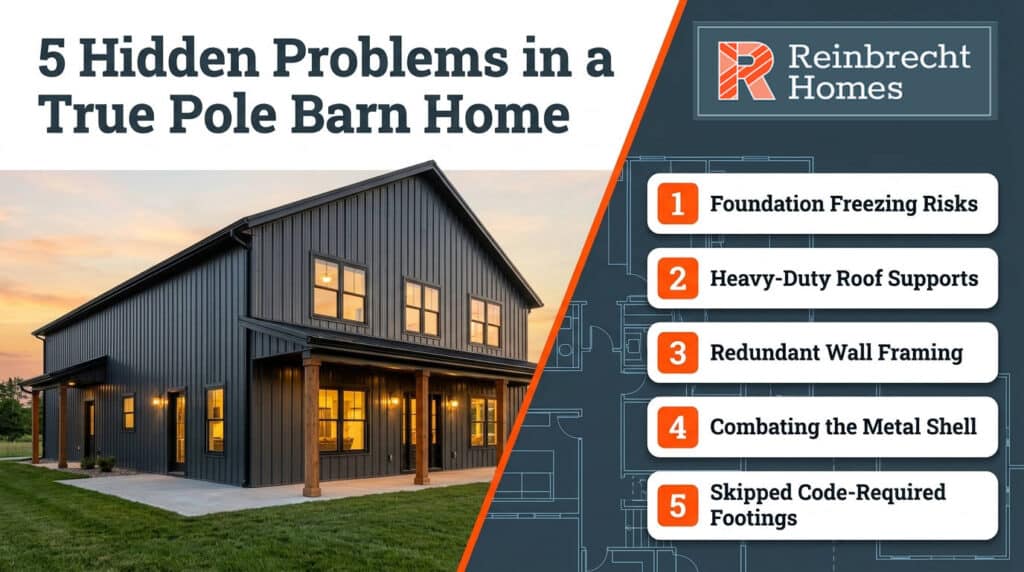
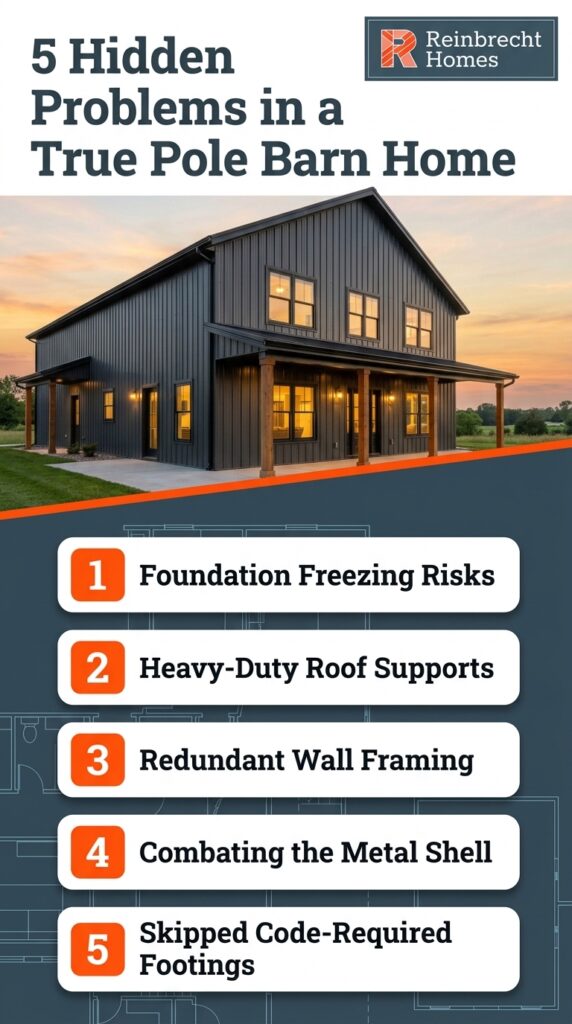
Beyond footings and code, Reinbrecht points to a few trade-offs that a true post-frame structure carries and a traditional home doesn’t:
- Larger roof truss spans: post frames have larger spans in the roof trusses, and those spans have to be filled in before drywall can go up.
- Extra wall framing: the walls between the posts have to be built after the post frame goes up, an added cost layered on top of the existing structure.
- Higher insulation demand: post-frame walls are thicker than standard two-by-four walls, so they need more insulation and can be harder to heat and cool. Reinbrecht homes use standard Spider Plus sprayed-in fiberglass insulation on every exterior wall, spray foam on band boards, and caulk sealant on the inside of all exterior walls.
How to Get the Pole Barn Look the Right Way

You don’t have to give up the look to get a home that’s built to code. Reinbrecht builds the same home it builds for every customer, with the same structure, footings, framing, and insulation, and then wraps it in metal siding and a metal roof. From the road, you get the clean, rugged pole barn aesthetic. Underneath, you get a home that finances, appraises, and resells like every other house in the area.
Start with one of Reinbrecht’s 30+ customizable semi-custom floor plans and personalize the layout, finishes, and exterior. Explore Reinbrecht’s semi-custom homes to see what’s possible, or build on your own lot anywhere in Southern Indiana, Northwestern Kentucky, or Eastern Illinois.
“We originally planned to remodel a family farm house, but after talking with friends whose homes were built by Reinbrecht Homes, we decided we would be happier with new construction. We were met with within a week of our call, started construction within four months, and finished well within the projected completion date!” (Reinbrecht Homes customer, Mt. Carmel, IL)
Frequently Asked Questions About Pole Barn Homes
Can Reinbrecht Homes Build a Pole Barn Home?
Reinbrecht doesn’t build true post-frame pole barn homes. Indiana’s code doesn’t require continuous footings, so a post-frame home can be engineered to meet code, but by the time the required footings and frost protection are added, the savings are largely gone. Instead, Reinbrecht builds a standard, code-compliant home and wraps it in metal siding and a metal roof, so you get the pole barn look without the structural shortcuts.
Is Metal Siding More Expensive Than Regular Siding?
Not by much. When Reinbrecht priced several of its homes with metal siding and a metal roof against standard siding and asphalt shingles, the difference was basically a wash. The exterior you choose has little effect on the total cost of the home.
Why Are Pole Barn Homes Cheaper Per Square Foot?
In Reinbrecht’s experience, mostly because of size. A big, simple, open building spreads its fixed costs over a lot of square footage, which lowers the cost per square foot. In Reinbrecht’s view, the rest of the savings comes from skipping the footings and frost protection that code requires.
Do Pole Barn Homes Hold Their Resale Value?
They can, but resale is less predictable. Comparable sales are scarce in many markets, which affects both the appraisal when you buy and the price when you sell. A code-compliant home with a metal exterior resells against the same familiar pool of comparable homes as any other house nearby.
Can You Build a Pole Barn Home With a Basement?
Not as a true pole barn home. In Reinbrecht’s view, once there’s a basement, the posts can’t go into the ground. They have to be attached to the top of the poured basement wall, which makes it essentially a standard build. The basement itself costs about the same no matter what sits on top of it. Reinbrecht’s standard foundation is a slab, and a basement is an available upgrade.
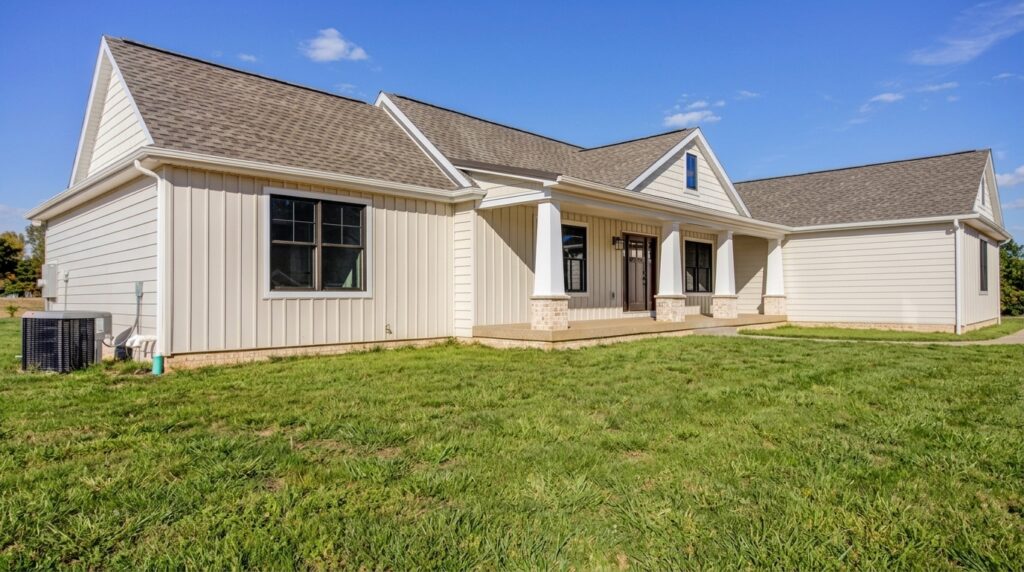
Get the Look You Want, Built the Right Way
If a pole barn home caught your eye for the open space and the metal exterior, Reinbrecht can give you both on a home that’s built to code and backed by a structural warranty. Contact Reinbrecht Homes to talk through floor plans, financing, and your lot.
