
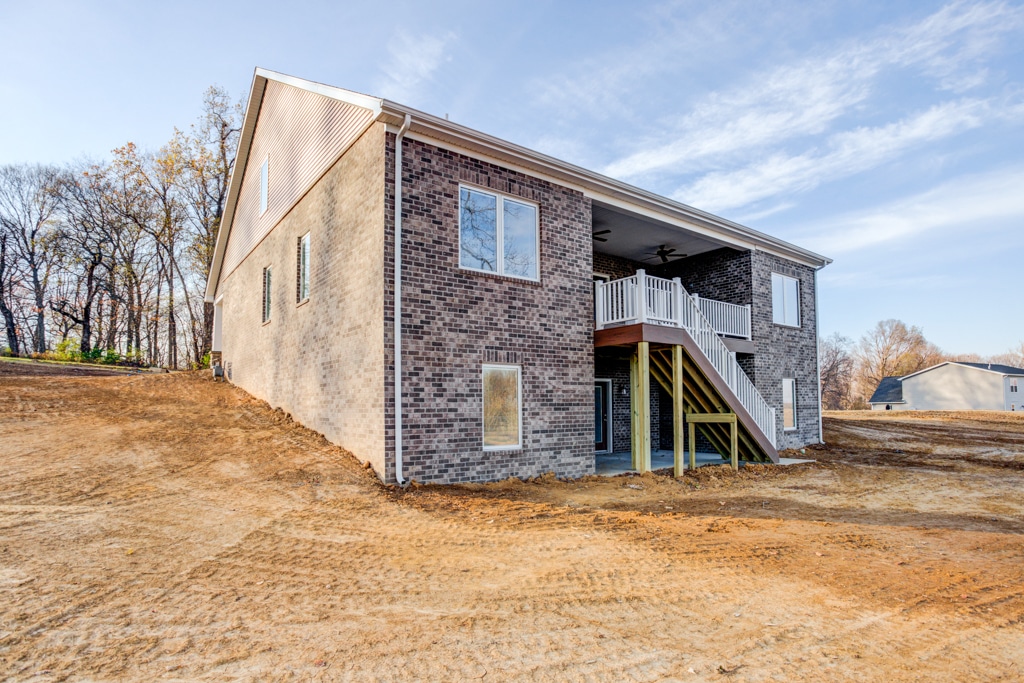
If you’re building a new home in Southern Indiana, Northwestern Kentucky, or Eastern Illinois, the basement decision shows up early and shapes a lot of what follows: floor plan, lot suitability, budget, even storm safety. Understanding which basement types fit your site makes the rest of the build easier.
Key Takeaways
- The four basement types that come up in new home construction are full, partial, walkout, and daylight. Each fits a different combination of lot conditions, budget, and intended use.
- Basements remain the majority foundation type for new homes in the East North Central region: 50.3% of new single-family homes here had a full or partial basement in 2024, compared to just 17% nationally.
- Lot conditions usually decide which basement types are even possible. Walkouts and daylight basements need grade change. Full basements need workable soil and a manageable water table.
- Reinbrecht Homes builds basement walls exclusively with poured concrete, never masonry block or precast panel. Poured walls have fewer joints, better water resistance, and stronger long-term performance.
- Storm safety, added square footage at a lower cost per finished foot than upper levels, and resale value are the three most consistent reasons buyers in this region build down.
- The 2025 Cost vs. Value Report puts the national basement remodel ROI at 71%, the highest among newly tracked projects in that report.
Why Basements Still Dominate New Construction Here
Basements are the majority foundation type in the East North Central census division (Indiana, Illinois, Ohio, Michigan, and Wisconsin), even as the rest of the country shifts toward slabs. In 2024, 50.3% of new single-family homes in the East North Central division were built with a full or partial basement, while only 17% of new homes nationally had one.
The reason is structural. In colder climates, building codes generally require foundations to extend below the frost line. Once you’re already digging that deep, adding the depth for a usable basement is a small marginal cost compared to the square footage you gain. South of here, where the frost line sits closer to the surface, slabs win on cost.
For your build, basements are normal, expected, and well understood by the trades that work in this region. Whether one is right for your project comes down to the lot, your budget, and what you plan to do with the space.
The 4 Basement Types for New Home Construction
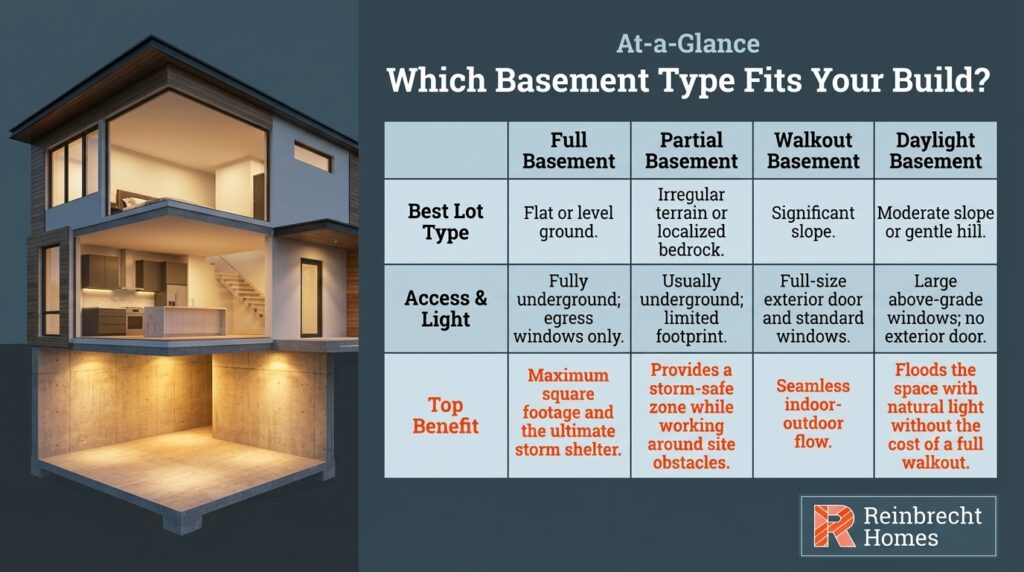
There are four basement types that come up in new home construction: full, partial, walkout, and daylight. Each has a clear use case tied to site conditions and intended use.
Full Basement
A full basement spans the entire footprint of the home’s main floor and sits fully below grade. Ceiling height is typically eight feet or more, high enough to walk around comfortably, finish out as living space, or use for storage and mechanicals.
Full basements work best when:
- The lot is relatively flat with workable soil and a manageable water table
- You want to maximize square footage at a lower cost per finished foot than building up or out
- Storm safety matters (a below-grade interior space is the most reliable shelter in severe weather)
- You’re planning to finish the space now or sometime later
A full basement gives you the most usable square footage of any basement type, the lowest cost per square foot of finished space, and a built-in storm shelter without having to add one separately. The trade-off is upfront cost. A full basement is the most expensive foundation type to build because of the excavation, concrete, and waterproofing involved. Lots with rocky ground, high water tables, or significant flooding risk may not be good candidates regardless of preference.
Partial Basement
A partial basement covers only part of the home’s footprint, with the remainder of the foundation built as a slab or crawlspace. Ceiling height usually matches a full basement, but the square footage is reduced.
Partial basements typically exist for one of two reasons:
- Site conditions force the issue. A lot with bedrock under part of the footprint, an irregular grade, or a high water table on one side may only allow a basement under a portion of the home.
- Budget priorities favor it. Some homeowners want a basement for storm shelter, mechanical access, and limited storage without paying for excavation under the entire home.
Partial basements aren’t a smaller version of a full basement by choice. They’re usually a function of what the lot will allow. If your lot supports a full basement and the budget works, a full basement almost always delivers more value per dollar.
Walkout Basement
A walkout basement is a full basement built into a slope so that one side is fully above grade with a standard exterior door. The other sides remain below grade. Walkouts are common on sloped lots where the natural grade change makes them practical.
What makes a walkout distinct:
- Direct exterior access at basement level: A real door, not a stairwell well or egress window.
- Natural light on the exposed side: Full-height windows are possible where the wall is above grade.
- Stronger resale value than a buried basement: Buyers tend to value walkouts as second-story living space rather than below-grade square footage.
Walkouts only make sense on lots with enough grade change to expose one full side. Trying to engineer a walkout on a flat lot is rarely worth the cost. If you’re building on a slope, a walkout is often the highest-value basement type. The considerations covered in building on sloped land go beyond just the foundation decision.
Daylight Basement
Daylight basements are frequently confused with walkouts, but they’re not the same. A daylight basement has above-grade windows on one or more sides (enough to bring in natural light) but no exterior door at basement level. The grade change on the lot is enough to expose part of the wall, but not enough for a full walkout.
The distinction matters:
- Walkout: exterior door at grade on one side. You can walk in and out at basement level.
- Daylight: above-grade windows but no exterior door at basement level. More natural light than a buried basement, but access is through the interior staircase.
Daylight basements are a good fit when the lot has modest grade change. You get most of the visual and lifestyle benefits of a walkout (natural light, a less “underground” feel, easier finished-space layouts) without needing the full grade change a walkout requires.
If a basement isn’t the right fit for your lot or budget, the next decision is between a slab and a crawlspace foundation. Our guide to home foundation types walks through that comparison. The short version: turning a crawlspace into a basement after the fact is rarely worth the cost, so decide which foundation type you want during planning, not after.
Wall Materials: Why Reinbrecht Builds With Poured Concrete
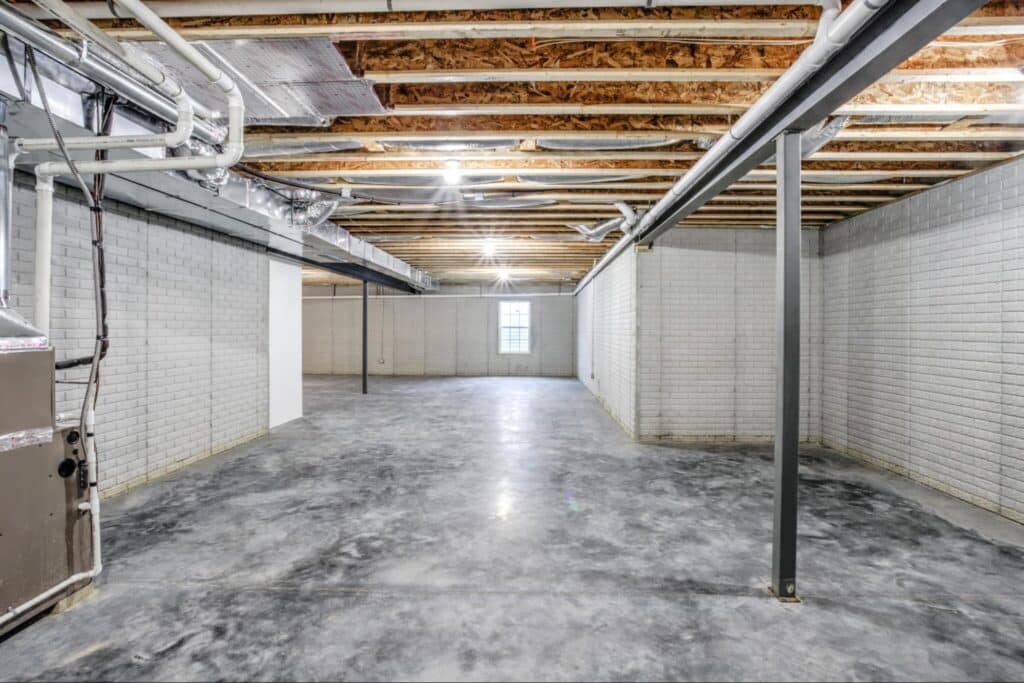
Basement walls can be built three ways: masonry block, precast panel, or poured concrete. The wall material affects long-term performance more than most homeowners realize, especially in a region with humid summers and a high water table near the Ohio River valley.
| Material | How it’s built | Performance considerations |
| Masonry block | Concrete blocks stacked and bonded with mortar | Many mortar joints. Reinforcement and waterproofing are essential. |
| Precast panel | Panels manufactured off-site, lifted into place with a crane | Faster to install. Joints between panels can be a moisture path. |
| Poured concrete | Concrete poured into forms on site to create monolithic walls | Few or no joints. Strongest water resistance and structural performance. |
Reinbrecht builds basement walls exclusively with poured concrete. A poured wall has no mortar joints and no panel seams, which removes the most common moisture entry points and produces a stronger structural wall. In this region’s climate, the long-term durability difference is real, not theoretical.
Benefits of a Full Basement
A full basement does more than add storage. For families building in this region, it consistently delivers value across several dimensions:
- More usable square footage without expanding the footprint: a 2,000-square-foot main floor over a full basement can deliver close to 4,000 square feet of conditioned space on the same lot. That’s useful in neighborhoods with lot-size restrictions or for homeowners who want a larger home without giving up yard space.
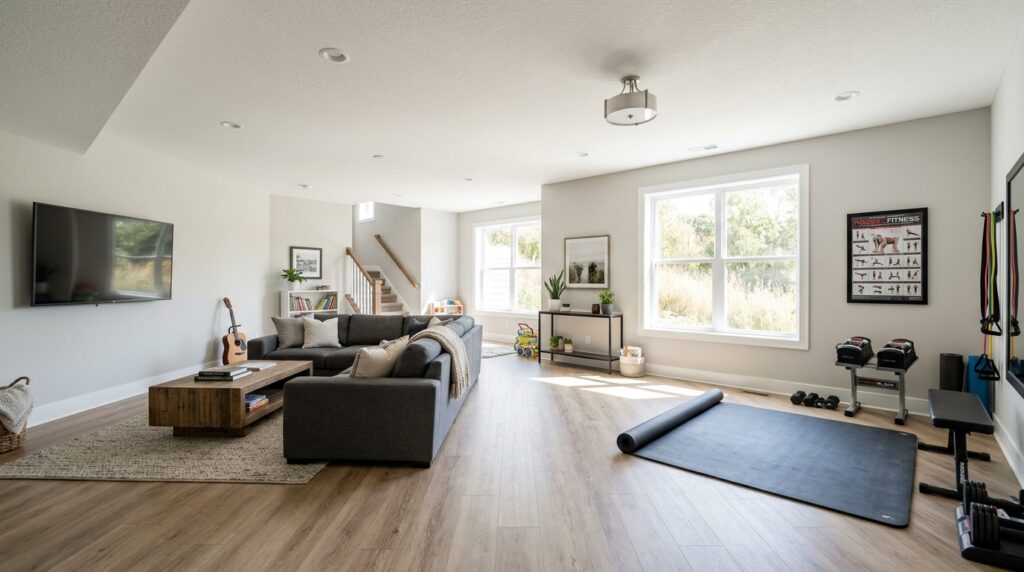
- Versatility for changing needs: a basement that’s a playroom and home gym today can become an in-law suite, home office, or rental unit ten years from now (where local zoning permits). The structure doesn’t change. The use case does.
- Storage that doesn’t cost extra: even an unfinished full basement provides room for seasonal items, sports equipment, and the things that otherwise crowd a garage.
- Energy efficiency from natural insulation: below-grade space stays cooler in summer and warmer in winter than above-grade rooms because the surrounding earth moderates temperature. Combined with Reinbrecht’s standard energy-efficient construction, a full basement contributes to lower utility bills over the life of the home.
- Storm shelter built into the home: in a region where severe thunderstorms and tornado watches are part of the calendar, a below-grade interior space is the safest shelter most families have access to. Always available, no running across the yard.
- Resale value: homes with full basements stand out in this market because buyers expect them. The basement remodel ranked highest among newly tracked projects in the 2025 Cost vs. Value Report, at a 71% national ROI, a stronger return than most major interior remodels.
Common Basement Misconceptions
A few persistent worries come up in almost every basement conversation. Most are based on outdated assumptions or confusion about what a basement actually is:
- “A basement is just adding another story to my home.” Not really. A basement is a structural foundation that doubles as conditioned interior space. It anchors the home below the frost line, distributes load across a larger footprint, and provides a moisture and vapor barrier between the soil and your living space. The construction methods and engineering are different from an above-grade story.
- “Basements always have water and moisture problems.” Older basements built with masonry block walls, limited exterior waterproofing, and minimal drainage often had problems. New basements built with poured concrete walls, modern waterproofing membranes, perimeter drainage, and properly graded lots don’t behave the same way. In areas with high water tables or flood risk, site selection matters more than ever. The floodplain considerations for Ohio River area builds are worth understanding before lot selection.
- “Basements are dark and dreary.” A buried basement with a couple of small windows can feel that way. A walkout, daylight, or full basement with planned egress windows feels nothing like that. Window size and placement should be part of the design conversation, not an afterthought.
- “A basement decreases resale value.” The opposite is true in this region. Buyers in the East North Central market expect basements in new construction. A home without one stands out for the wrong reason.
- “Basements raise property taxes and cost too much to build.” Property tax treatment varies by jurisdiction. Confirm with your local assessor. As for construction cost, a basement does cost more upfront than a slab, but it also delivers more square footage and resale value than the same dollars spent on above-grade additions.
What Does a Basement Cost?
Basement cost is project-specific. It depends on the size of the home, soil conditions, water table, whether you’re finishing the space, and several other factors that don’t translate to a single number. For a clear breakdown of the cost components, the cost and value of building a basement covers it in depth.
Reinbrecht doesn’t quote basements (or anything else) on a cost-per-square-foot basis because that number is unreliable and misleading. Every quote is based on the actual specifications of your build, with transparent pricing and no hidden fees.
Should You Finish Your Basement?
Whether to finish your basement now, finish it later, or leave it unfinished is a separate decision from which basement type to build. The basement type and wall materials don’t change either way. What changes is the interior buildout. For a full breakdown, the comparison of finished basements vs. unfinished options walks through both paths.
If you know how you’ll use the space and the budget supports it, finishing during initial construction is usually more efficient than finishing later. If the use case is unclear, finishing in phases keeps your options open without losing structural value.
Frequently Asked Questions About Basement Types
What is the difference between a full basement and a partial basement?
A full basement spans the entire footprint of the home’s main floor. A partial basement covers only a portion, with the rest of the foundation built as a slab or crawlspace. Partial basements usually exist because of lot conditions (rock, high water table, irregular grade) or budget constraints, not as a smaller version of a full basement by preference.
What is the difference between a walkout and a daylight basement?
A walkout basement has a full exterior door at grade on one side, allowing direct entry and exit at basement level. A daylight basement has above-grade windows that bring in natural light but no exterior door at basement level. Walkouts require more grade change on the lot than daylight basements.
Are basements common in Indiana?
Yes. In 2024, 50.3% of new single-family homes in the East North Central census division, which includes Indiana, Illinois, Ohio, Michigan, and Wisconsin, were built with a full or partial basement. That’s nearly three times the 17% national rate. Basements remain the majority foundation type for new construction across this region.
Does a partial basement count as square footage?
It depends on whether the basement is finished and how the local market and appraiser handle below-grade space. Finished basement square footage is generally reported separately from above-grade square footage on listings and appraisals, even if the total interior conditioned space is the same. This applies to both full and partial basements.
Can you convert a partial basement to a full basement later?
Technically possible, but rarely worth the cost. Excavating under an existing home, extending the foundation, and tying new walls into the original structure is significantly more expensive than building a full basement from the start. If you want the option of a full basement, build one during initial construction.
Build the Right Basement for Your New Home
The right basement type comes down to the lot, your budget, and how you plan to live in the home over the next ten to twenty years. We’d be glad to walk through the options with you, look at what your lot supports, and help you understand which basement type makes the most sense for your project.
Explore Reinbrecht’s customizable floor plans to see what’s possible, or contact the Reinbrecht team to schedule a first meeting.
