
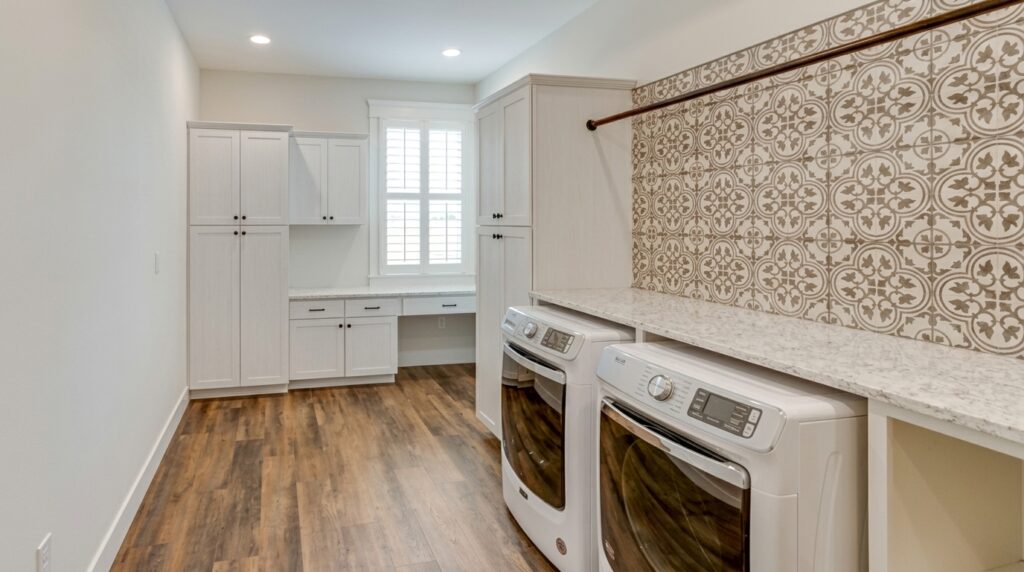
Where the laundry room goes is one of the most underestimated decisions in a new home. You’ll use it constantly, and a layout that doesn’t fit how you live makes a routine chore harder than it needs to be. Here’s how the Reinbrecht Homes team walks buyers through the right laundry room layout for their floor plan.
Key Takeaways
- Around 86% of homebuyers rate a laundry room as essential or desirable, and most prefer it on the first floor (NAHB, What Home Buyers Really Want 2024).
- In 2024, 70% of new single-family homes had laundry connections on the first floor; 28% on the second floor; only 2% in the basement.
- Two-story floor plans with all bedrooms upstairs make the strongest case for second-floor laundry, but plan leak protection in during framing, not after.
- A mudroom-laundry combo handles muddy boots, work clothes, and pet cleanup, which is a regular reality across Southern Indiana, Northwestern Kentucky, and Eastern Illinois.
- Most usable laundry rooms run from 7′ x 10′ (standard) to 9′ x 12′ or larger, depending on whether you want a folding counter, a sink, and full storage.
- Main-level laundry pairs naturally with aging-in-place planning and ranch-style plans where stairs aren’t part of the daily routine.
The Short Answer: Where Should the Laundry Room Go?
For most new homes built in Southern Indiana, the laundry room belongs on the first floor, usually off the mudroom or near the kitchen. Two-story plans with all bedrooms upstairs are the main exception. In those cases, second-floor laundry near the bedrooms usually wins on convenience.
National data backs the first-floor preference. About 86% of buyers want a dedicated laundry room and prefer it on the main level, per NAHB’s What Home Buyers Really Want 2024 study. Builders are following suit. In 2024, 70% of new single-family homes were built with first-floor laundry connections, 28% had second-floor laundry, and only 2% had basement laundry.
That majority view is the right starting point, but it isn’t the answer for every household. The right placement depends on your floor plan, the people in your home, and how the laundry actually moves through the day.


First-Floor Laundry: When It Works and Where to Put It
First-floor laundry is the most common placement in new homes and the most popular with buyers. It works because laundry is a daily chore. Keeping it close to where you spend the day, whether that’s the kitchen, mudroom, or back entry, keeps it from becoming a separate trip across the house.
There are three first-floor placements that show up most often in our floor plans:
- Off the mudroom or back entry: Best for families with kids, pets, or active outdoor seasons. Dirty clothes go from the door to the washer in one move. This is the layout we recommend most often, and it’s the basis for the mudroom-laundry combo discussed below.
- Off the kitchen: Best for smaller homes, ranch-style plans, or households where the kitchen is the central hub. Loads can run while you’re cooking, and the noise stays in the working part of the house.
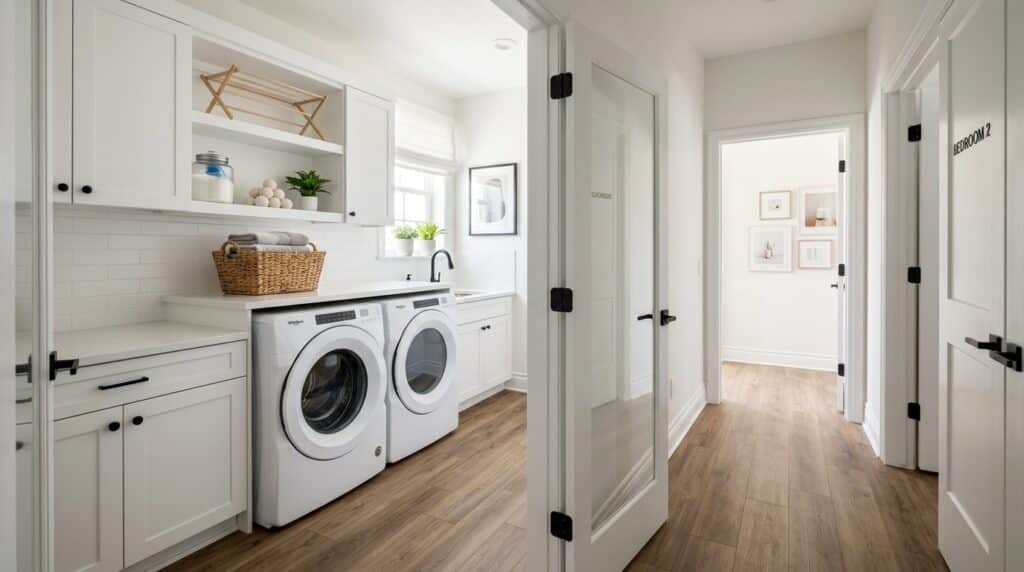
- Hall closet or compact closet style: Best for smaller plans where a dedicated room isn’t practical. A washer and dryer behind bifold doors uses about 36 inches of wall, but you give up folding and storage space.
First-floor laundry pairs especially well with a main-level master suite and with aging-in-place planning, where stair-free access to the most-used spaces matters.
Second-Floor Laundry: When It Works and How to Manage Water Risk
Second-floor laundry makes the most sense when all the bedrooms are upstairs. The case is simple: most laundry is generated where the bedrooms and bathrooms are, so putting the washer and dryer near the source eliminates the daily haul up and down the stairs. It pairs naturally with planning master suite layout and dimensions at the same time, since the laundry sits right next door.
There’s a real trade-off, though. A leak on the second floor doesn’t just damage the laundry room. It can soak the bedrooms and ceilings below. Roughly 1 in 67 insured homes files a property damage claim caused by water damage or freezing each year, per the Insurance Information Institute. Most of those losses come from preventable failures: a worn supply hose, a backed-up drain, an overflow nobody catches in time.
The good news is every one of those failure modes can be planned for during framing. We recommend the following for any second-floor laundry:
- Drain pan with a dedicated drain line: A pan under the washer routed to the home’s plumbing catches small leaks before they reach the subfloor.
- Auto-shutoff valves on the supply lines: These shut off water if a hose fails. Some integrate with smart home systems to send phone alerts, which is worth wiring in during framing. (See our guide to smart home features that should be planned before drywall goes up.)
- Waterproof flooring: Tile or sealed luxury vinyl plank with watertight seams under and around the laundry footprint, extending into the doorway.
- Stainless braided supply hoses: More durable than rubber hoses, which can degrade and burst over time.
- Vibration isolation under the machines: Anti-vibration pads keep spin-cycle noise from carrying through the floor into the bedrooms below.
Done right, second-floor laundry can be both convenient and safe. Done without these planning steps, it’s a leak waiting to happen.
Basement Laundry: When It Still Makes Sense in Southern Indiana
Basement laundry is uncommon in new construction here. Only about 2% of new single-family homes built in 2024 had a basement laundry. Most homes in Southern Indiana, Northwestern Kentucky, and Eastern Illinois are built on slabs or crawlspaces rather than full basements. For many buyers in our market, basement laundry simply isn’t on the table.
When a home does have a full or walkout basement, basement laundry has real advantages:
- More space for folding, hanging, and drying than most main-floor layouts.
- Noise isolation from the rest of the house.
- Plumbing simplicity if the basement already has a floor drain or a rough-in for utilities.
The trade-off is the trip. Two flights from upstairs bedrooms to a basement laundry is a lot of stair time. It’s the layout that gets the most “we’d do it differently next time” feedback. If your floor plan includes a finished basement and you’re already spending time there, basement laundry can be a fine fit. Otherwise, the main floor or second floor is usually the better answer.
The Mudroom-Laundry Combo: Reinbrecht’s View
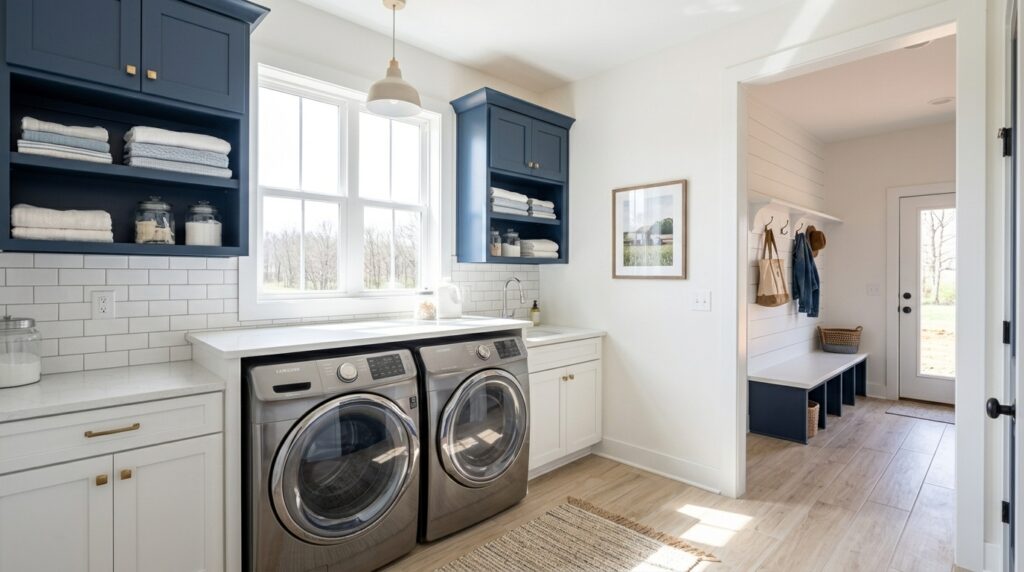
A combined mudroom and laundry is one of the most practical layouts we build, especially for the way Southern Indiana families actually live. Muddy fields in spring, snowy boots in winter, and dogs that don’t wipe their paws all hit the same room. When that room is also the laundry, dirty clothes go straight in the washer instead of getting carried across the house first.
A few things to plan for:
- Flooring that handles water and mud: Tile or sealed LVP, ideally sloped toward a floor drain when the floor plan allows.
- Bench seating with cubbies above and shoe storage below: This keeps the entry functional even when a load is mid-cycle.
- A utility sink: For hand-washing, soaking stained clothes, rinsing tools, or cleaning up pet messes.
- Upper cabinets and a folding counter: Make the room a true working laundry, not just a dumping ground.
- A door from the garage and another into the main living area: This separates drop-zone traffic from the rest of the house.
For a deeper look at the mudroom side of this equation, read our mudroom ideas for new Indiana homes. It covers built-in storage, layout configurations, and the case for treating the mudroom as the home’s central organizing space.
Laundry Room Size and Dimensions
Laundry rooms in new homes generally fall into three size ranges. The right size depends on whether the room is purely utility (machines only) or also a folding, sorting, and storage space.
Here are the size brackets we use when planning a laundry room layout:
- Compact (5′ x 6′ to 6′ x 8′): Side-by-side or stacked machines and minimal counter space. Common in smaller floor plans or as a hall-closet laundry. No real room for sorting or hanging.
- Standard (7′ x 10′ to 8′ x 10′): Side-by-side machines with a folding counter above or beside, upper cabinets for storage, and room for a basket or two. This is the size most semi-custom plans default to and what most buyers find comfortable.
- Large (9′ x 12′ or larger): Side-by-side machines, full folding counter, utility sink, base and upper cabinets, and space for hanging racks or a dedicated drying area. Some larger plans add a built-in pet wash, second refrigerator, or ironing station.
A few sizing details worth knowing as you plan:
- Machine footprint: Standard side-by-side washer and dryer units need about 60 inches of width with clearance on either side. Stacked units cut that in half but require ceiling height for the dryer door to swing:
- Counter depth: 24 to 25 inches is standard for a folding counter, matching base cabinetry. Anything shallower won’t hold a folded sheet flat.
- Door swing: Plan the laundry room door to swing out, not into the room, where it could block the path to the machines. Make sure the dryer door has at least 90 degrees of clearance to open.
If you’re working from a Reinbrecht semi-custom floor plan, the laundry room can typically be resized or relocated during the planning phase, before construction starts. You start with a base plan, then personalize the parts that matter to you. Fully custom plans can build the room around the layout you describe from the beginning.
Frequently Asked Questions About Laundry Room Layout
Is it better to have the laundry room on the first or second floor?
For most homes, the first floor is more popular and more practical, and 70% of new single-family homes built in 2024 had first-floor laundry. Second-floor laundry makes the most sense when all the bedrooms are upstairs and you want to eliminate trips up and down the stairs. The trade-off is leak risk, which can be planned around with the right framing decisions.
What is the best layout for a small laundry room?
A compact 5′ x 6′ or 6′ x 8′ laundry room can hold side-by-side or stacked machines with shelving above, but not much else. The best layout maximizes vertical space (upper cabinets to the ceiling), uses stacked units if you need floor space for anything else, and skips features like a sink or large folding counter. For a true working laundry with sorting and folding space, plan for at least 7′ x 10′.
What size should a laundry room be in a new home?
The most common size in new homes is 7′ x 10′ to 8′ x 10′, which fits side-by-side machines, a folding counter, and upper cabinets. A large laundry with a sink, full counter, and hanging space typically runs 9′ x 12′ or larger. Compact closet-style laundries can fit in as little as 36 inches of wall.
What are the disadvantages of upstairs laundry?
The biggest disadvantage is water damage risk. A leak above living space can be far more expensive to repair than a leak in a basement or first-floor laundry. Water damage and freezing claims affect roughly 1 in 67 insured homes per year. Other concerns include vibration noise traveling through the floor and the difficulty of moving large machines up the stairs. All of these can be planned around during construction.
Should the laundry room be near the kitchen?
In smaller homes or single-story plans, near the kitchen is a reasonable choice. It puts the laundry close to the working part of the house and lets you run loads while doing other tasks. In larger homes, mudroom-adjacent placement usually beats kitchen-adjacent because dirty clothes don’t have to cross the cooking and eating space to reach the washer.
Planning Your New Home’s Laundry Room with Reinbrecht Homes
Where the laundry room goes is a decision that doesn’t seem urgent until you’ve lived in a layout that doesn’t work. Reinbrecht Homes has been building new homes across Southern Indiana, Northwestern Kentucky, and Eastern Illinois since 1995, and we walk every buyer through these decisions before anything is poured. Explore our customizable floor plans or contact the Reinbrecht team to start the conversation.
As one Reinbrecht homeowner described it: “The Reinbrecht team and their sub contractors did a wonderful job bringing our dream home to reality. They delivered a home of exceptional quality on time and on budget. They were present for us every step of the way, delivering a personal and professional home building experience.”
