
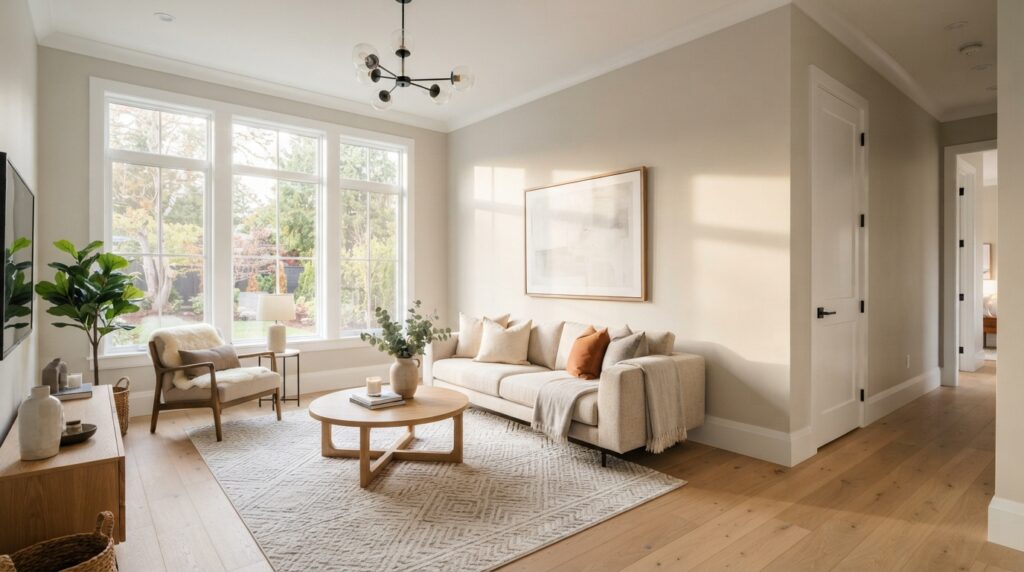
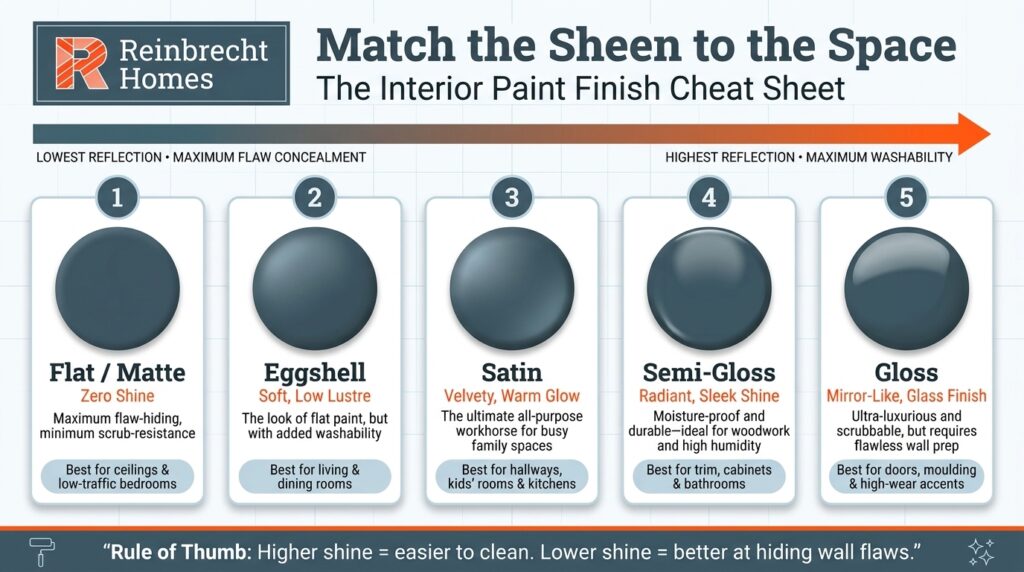
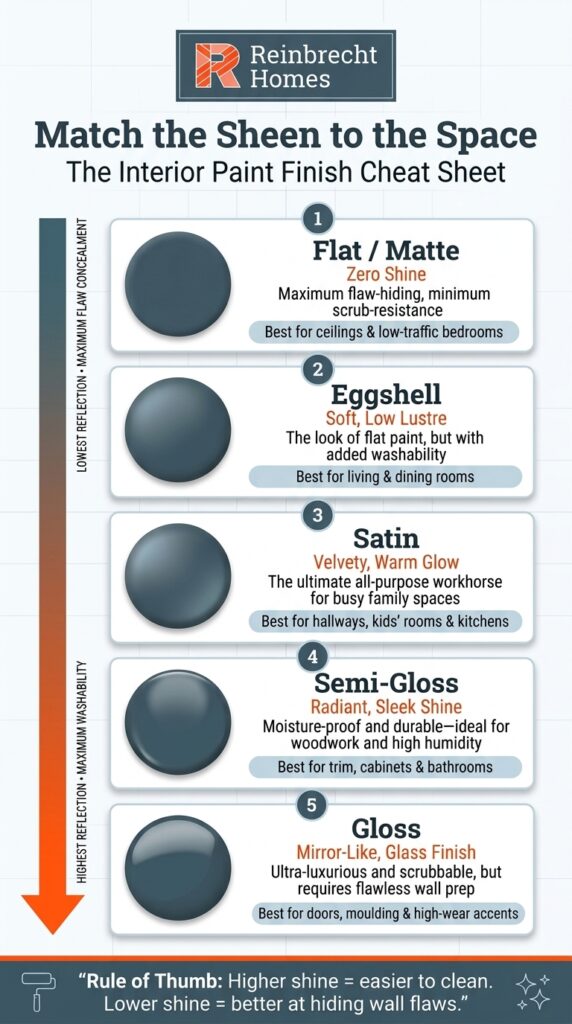
Choosing a paint finish is a bigger decision than it looks, especially when you’re picking finishes for every room of a new home at once. There are five main types of paint finishes for interior walls, and their sheen (how much light the finish reflects) runs from least to most shine: flat (matte), eggshell, satin, semi-gloss, and gloss. Flat or eggshell finishes are best for hiding imperfections, while satin offers better stain resistance and durability than lower sheens, including eggshell.
Key Takeaways
- Durability versus flaws: Satin offers better stain resistance and durability than lower sheens, including eggshell, but gloss can accentuate blemishes on walls that aren’t completely smooth.
- Flat for ceilings and quiet rooms: Flat touches up well and hides minor surface imperfections, but stains are harder to remove from low-sheen paint.
- Eggshell for living spaces: It’s more washable than flat but more difficult to touch up than satin.
- Satin or semi-gloss for baths and trim: Satin or semi-gloss can withstand moisture, and semi-gloss is great for trim and moldings.
- Sheen and drywall finish: Under the Gypsum Association’s GA-214 standard, Level 4 drywall finish is typically specified for flat paint and Level 5 for non-flat or deep-tone paint, so pick sheen during selections.
Types of Paint Finishes
Whether you’re choosing paint for a new home or touching up walls that have lost their luster, there are lots of finishes to choose from.
Interior paints come in different levels of sheen: gloss, semi-gloss, satin, eggshell, and flat. When choosing the right paint, you’ll need to decide on the look you want and how durable you want the finish to be.
When you’re choosing a paint finish, ask yourself these questions:
- Room size: How large is the room?
- Traffic: How much traffic will the room receive?
- Light: How much light comes into the room?
- Wall condition: Are the walls smooth, or do they have imperfections you want to hide?
- Cleaning: Will you need to scrub any surfaces?
- Touch-ups: How often are you willing to touch up your paint?
- Look: What look do you want to achieve?
- Other finishes: What other finishes, such as trim, will share the room?
Here is a brief rundown on each finish to help you make the perfect paint choices for your home.
Gloss
Gloss paint is a shiny finish that creates a luxurious look, and a gloss finish reflects light.
High gloss is easy to clean and stain-resistant, which is why it shows up in guidance for doors, trim, and high-traffic kitchens, along with cabinets and moulding. It’s nice to be able to scrub your cabinets, door frames, and other surfaces that get touched a lot without worrying about damaging the paint, especially if you have children or pets.
The drawback: gloss can accentuate blemishes, so avoid it on surfaces that aren’t completely smooth.
Semi-Gloss
Semi-gloss adds a subtle shine and is easy to clean, which makes it great for trim, moldings, kitchens, bathrooms, utility areas, and closet doors. It also holds up on cabinets, high-traffic areas, and high-moisture areas.
You might also choose semi-gloss for woodwork; Benjamin Moore uses it to create dimension on millwork, trim, and doors.
If you’re painting kitchen cabinets, our guide to cabinet colors for dark wood floors explains why satin or semi-gloss is the common cabinet choice and how finish changes the way a color reads.
Satin
Satin paint has a velvety finish and is ideal for high-traffic rooms.
Satin is also a smart choice for:
- Bathrooms: A satin or semi-gloss sheen is ideal, as it can withstand moisture.
- Kitchens and laundry rooms: Satin is recommended for kitchens, laundry rooms, playrooms, and home offices.
- Hallways and kids’ rooms: Satin suits busy spaces like hallways and children’s bedrooms.
Satin paint gives an elegant look to any room.
Eggshell
Eggshell is between satin and flat on the sheen scale. It has a low sheen with little luster, much like that of an egg, and while it looks close to flat or matte, it provides an easy-to-clean, nearly shine-free finish.
Eggshell is a great option if you want walls that are more washable than flat and resist stains and scuffs without sacrificing light in your rooms.
One trade-off: eggshell is considered more difficult to touch up than satin paint.
Flat
Flat paint gives a less reflective, more matte look to your walls and ceilings. It’s perfect for rooms where you want a softer or muted feel. Because flat paint doesn’t reflect light, it’s more forgiving of flaws and creates a uniform surface. Home Depot groups flat and matte as one finish, since flat or matte paints absorb more light than they reflect, so they have no sheen.
Flat paint works best in two places:
- Ceilings: Flat is ideal for ceilings. “The ceiling is usually in shadows and has imperfections that flat paint camouflages well,” Baton Rouge designer Arianne Bellizaire told Business of Home.
- New drywall and low-traffic rooms: Flat is perfect for new construction, drywall, and low-traffic areas like adult bedrooms.
The trade-off is cleaning. Flat hides surface flaws, not dirt, and stains are harder to remove from low-sheen paint. The upside is that flat paint touches up well. Pairing flat wall paint with a gloss finish will really make the trim and mouldings pop.
Which Paint Finish Goes Where in a New Home
In a new home, use flat on ceilings, flat or eggshell in bedrooms, eggshell in living areas, satin in busy hallways, satin or semi-gloss in kitchens and baths, and semi-gloss or gloss on trim, doors, and cabinets. This map combines four manufacturer and retailer guides and adds a drywall note for each space.
| Room or surface | Finish the sources point to | Why | Touch-up behavior | Drywall finish note |
|---|---|---|---|---|
| Ceilings | Flat | No sheen, hides flaws, uniform surface (Benjamin Moore); ideal for ceilings (Benjamin Moore, Behr, Home Depot) | Touches up well (Behr, Home Depot) | Flat on smooth walls: Level 4 typical (GA-214) |
| Bedrooms | Flat, matte, or eggshell | Low traffic; flat for adult bedrooms (Home Depot); eggshell or satin for a soft feel (Sherwin-Williams) | Flat and matte touch up well (Behr) | Level 4 if flat; Level 5 if non-flat (GA-214) |
| Living, family, and dining rooms | Eggshell (or matte) | Eggshell suits most areas, including family rooms (Benjamin Moore); low to mid traffic (Home Depot); matte for living and dining rooms (Sherwin-Williams) | Eggshell is harder to touch up than satin (Home Depot) | Non-flat on smooth walls: Level 5 typical (GA-214) |
| Hallways, kids’ rooms, home offices | Satin (or eggshell) | High traffic, nicks, and scuffs (Sherwin-Williams, Home Depot) | Easier to touch up than eggshell (Home Depot) | Level 5 typical (GA-214) |
| Kitchens, bathrooms, laundry | Satin or semi-gloss | Withstand moisture (Sherwin-Williams); humidity (Home Depot); high-moisture areas (Behr) | Not addressed by sources | Level 5 typical (GA-214) |
| Trim, doors, cabinets | Semi-gloss or high gloss | Trim and moldings (Sherwin-Williams); millwork, trim, doors, cabinets (Benjamin Moore); cabinets and trim (Behr) | Not addressed by sources | n/a (wood surfaces); gloss needs a smooth surface (Benjamin Moore) |
Sources for the map: Sherwin-Williams, Benjamin Moore, Behr, The Home Depot, and National Gypsum’s summary of GA-214 for the drywall column.
Why Your Paint Sheen Matters Before the Drywall Is Finished
Your sheen affects how smooth your walls need to be, so choose it before the drywall is finished. The Gypsum Association’s GA-214 standard defines drywall finish levels and ties them to the paint going on the wall:
- Level 4: Typically specified for smooth walls with flat paints. Non-flat or dark and deep tone paints are not recommended at this level (GA-214).
- Level 5: Typically specified for smooth walls with non-flat (sheen or gloss) paints, dark or deep tones, or critical lighting conditions (GA-214).
In plain terms, shinier or darker walls point to a higher finish level. With semi-custom homes, you’ll customize selections like paint, cabinets, floors, and siding, so sheen fits naturally there. Our custom home selections guide covers planning those decisions, and our look at how builder allowances work explains why locking in selections early matters.
Questions to ask your builder:
- Finish level: Which drywall finish level is included, and does it change with a non-flat sheen or deep color?
- Standard sheens: Which sheens are standard for walls, ceilings, and trim?
- Timing: When are paint selections due?
Specific selections and quotes keep these choices from becoming surprises.
How Paint Color and Wall Condition Affect Your Sheen Choice
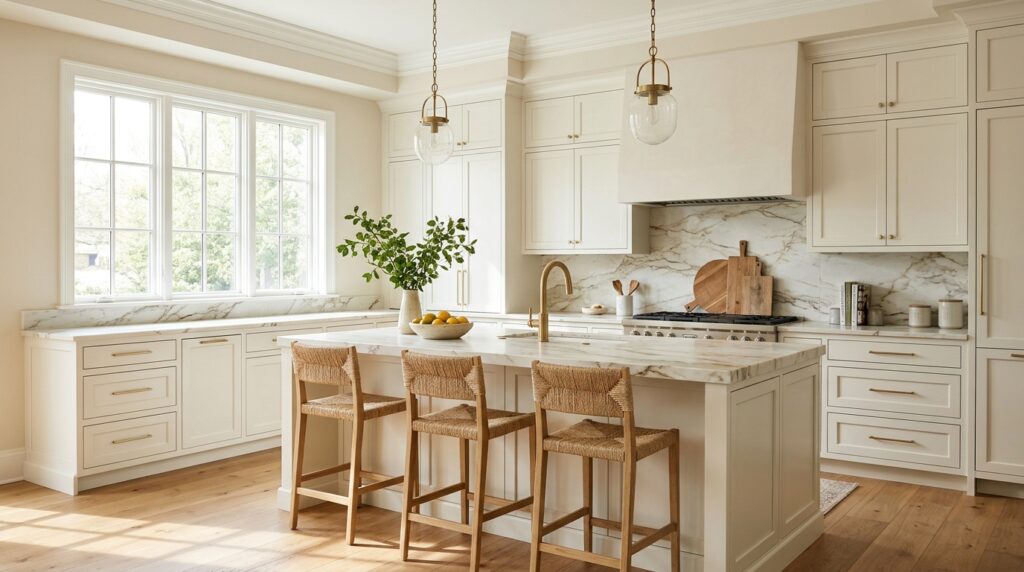
Choose a lower sheen for walls with imperfections, and plan for a smoother wall if you pick deep colors. Flat or eggshell finishes are best for hiding imperfections, while gloss can accentuate blemishes.
If you’ve chosen deep, rich colors, plan for a smoother wall: GA-214 points dark/deep tone paints to a Level 5 finish. If you’re still narrowing down a palette, our roundup of warm neutral paint colors for 2026 is a good place to start.
Why Touch-Ups Show on Higher-Sheen Paint
Touch-ups show when the patched spot doesn’t match the sheen of the paint around it. A touch-up adds a new layer of paint, and excessive film build can make a touch-up more noticeable, which is why Dunn-Edwards recommends thinning waterbased non-flat touch-up paint on smooth walls with about 5 to 10% clean water to help minimize the sheen difference from the original application. Paints with a sheen are harder to touch up, while flat and matte paints are easier to touch up than satin or semi-gloss finishes.
The uneven look is called flashing: an uneven appearance of a paint coating’s gloss, sheen or luster. It isn’t a simple ladder, either, since eggshell is considered more difficult to touch up than satin. When a touch-up won’t blend, larger areas or mismatched finishes may need more extensive prep or a full repaint, and if a wall needs too many touch-ups, it may be best to repaint the entire wall from corner to corner. Touching up paint is one of the low-risk jobs in our guide to new home repairs you can DIY.
Different Types of Paint: Latex vs. Oil-Based, Cost, and Care
Latex and oil-based paints differ in base and cleanup. Latex paints are water-based, and they dry quickly and clean up easily with soap and water, while oil-based (alkyd) paints need mineral spirits or paint thinner for cleanup.
A few more things to keep in mind:
- The type of paint you choose could impact your labor and materials costs beyond the cost of the paint itself. Touch-ups on satin or glossy paint may require sanding the edges, and mismatched finishes may need more extensive prep or a full repaint, which adds labor.
- Glossier paints need a smooth surface, since gloss can accentuate blemishes.
- Matte paints, on the other hand, require fewer coats than higher gloss paints, which can save you money on labor and materials.
- Matte paints touch up well.
- Oil-based paints offer good adhesion, excellent durability, and stain resistance, which makes them a strong choice for trim in high-traffic rooms such as kitchens and bathrooms.
- Oil-based paints contain solvents that don’t mix with water and are flammable. Paints, varnishes, and wax all contain organic solvents, and indoor levels of several organics average 2 to 5 times higher than outdoors, so increase ventilation by opening a window while you paint.
- Save labeled leftover paint for future touch-ups, and note the room and sheen on each can.
Frequently Asked Questions About Paint Finishes
What is the difference between eggshell and satin paint?
Satin has more sheen than eggshell, which sits closer to flat. Eggshell is more washable than flat but harder to touch up than satin. Satin suits kids’ rooms, kitchens, and bathrooms, while eggshell suits most areas, including family rooms.
What paint finish is best for walls in a new home?
It depends on the room. Flat or eggshell hides imperfections best, satin suits hallways and kids’ rooms, and satin or semi-gloss withstands bathroom moisture. In a new build, also ask how your sheen affects the drywall finish level.
Is flat paint too hard to clean for walls, or should I use satin?
Flat works on walls where hiding flaws matters more than scrubbing. It hides minor surface imperfections and touches up well, but stains are harder to remove from low-sheen paint. For walls that need regular cleaning, such as playrooms and kitchens, choose satin.
Does my paint sheen affect the drywall finish?
Yes. Under the Gypsum Association’s GA-214 standard, Level 4 drywall finish is typically specified for flat paint, and Level 5 for non-flat sheens, deep tones, or critical lighting. Ask your builder which level is included before finalizing sheen.
Why do paint touch-ups show on some walls?
A visible touch-up looks like a patch of uneven shine, called flashing. Flat paint touches up well, while eggshell is harder to touch up than satin. Paints with a sheen (non-flats) are harder to touch up, and if a wall needs too many touch-ups, it may be best to repaint the entire wall from corner to corner.
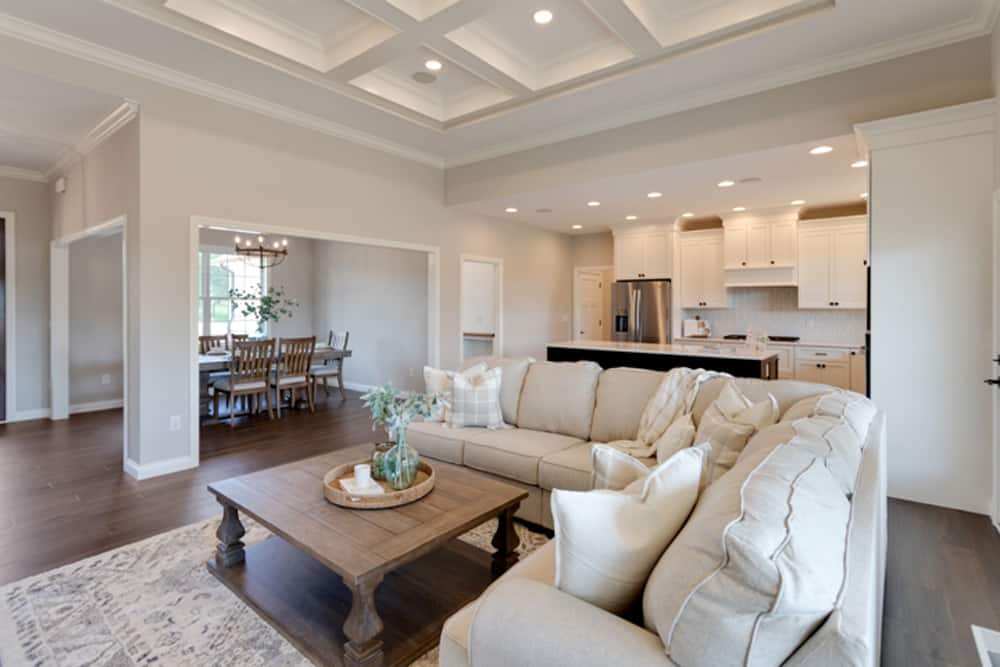
Choosing the Right Paint Finish for Your New Home
When choosing paints for your home, there’s more to consider than just color. Paint finishes and formulas will impact the look, feel, and durability of your paint job. Choosing the right amount of sheen for your project is key to achieving the right look and feel.
With more than 30 years of experience and over 500 homes built, Reinbrecht Homes has the experience to guide you through paint selections and all the other decisions that come with building a home. As one homeowner put it:
“The Reinbrecht team and their sub contractors did a wonderful job bringing our dream home to reality. They delivered a home of exceptional quality on time and on budget. They were present for us every step of the way, delivering a personal and professional home building experience.”
Ready to start planning your new home? Contact the Reinbrecht team to schedule your first meeting.
