
If your older home feels drafty in January and costly to cool through a humid Southern Indiana summer, you have probably wondered whether making an older home energy efficient is worth the investment, or whether you would be better off building new. It is a fair question, and the honest answer is that it depends on your house. This guide covers what actually makes an older home inefficient, what you can realistically fix, how far a retrofit can take you, and when building a new, energy efficient home is the smarter move.
Key Takeaways
- Whether it is worth it comes down to the house itself. If the home is structurally sound and the layout works, targeted upgrades close much of the gap; if the envelope, framing, or floor plan is the problem, building new usually wins.
- Air sealing and adding insulation can save an average of about 15% on heating and cooling costs, around 11% on total energy, for a typical existing home (EPA).
- Heating and cooling is the largest energy expense in a home, about 43% of a typical utility bill (DOE), so the building envelope is where an older home leaks the most money.
- A retrofit narrows the gap but rarely matches new construction, because some limits (the band boards, the framing, the floor plan) cannot be fixed without tearing the house apart.
- Moving up does not have to mean two mortgages. The No Stress Trade Up Program lists and, if needed, buys your current home so it sells before your new one is finished, and free construction financing covers up to $250,000 of the build with as little as $1,000 down.
- Buyers often look for energy efficiency and lower operating costs, so both upgrades and new-build performance tend to help at resale.
Retrofit or Build New: A Side-by-Side Decision Matrix
For a quick read on your situation, weigh the two paths across the factors that actually drive the decision. Upgrading wins on upfront cost and speed to start; building new wins on achievable efficiency, comfort, warranty, and long-term certainty. The table lays out both honestly, because for some homes upgrading really is the right call.
| Factor | Upgrade the older home | Build new (Reinbrecht) |
|---|---|---|
| Upfront cost | Lower to enter. Targeted fixes can be modest, but deep retrofits add up and can surprise you once the walls are open. | Higher headline cost, but the price is transparent and known before you sign, with no cost-per-square-foot guesswork. |
| Disruption and time | You live in a construction zone, and the timeline varies with the scope of work. | For a semi-custom build, pre-construction runs about one month and construction about six to eight months (typical, not guaranteed). You move once, at the end. |
| Achievable efficiency | Real gains from air sealing, insulation, and HVAC work, but a retrofit rarely reaches new-construction performance. | Energy efficiency is standard practice on every build (house wrap, sprayed-in wall insulation, insulated headers, spray-foamed band boards), so the home starts efficient by design rather than being retrofitted toward it. |
| Comfort and humidity | Improves with sealing and insulation, but envelope and floor-plan limits remain. | A whole-home envelope built for even temperatures and humidity control from day one. |
| Warranty | None beyond individual component or product warranties. | Home Buyers Warranty: 10 years structural, 2 years on systems, 1 year on workmanship. |
| Resale value | Efficiency upgrades help, and buyers often look for lower operating costs. | New-construction efficiency and a fresh, sealed envelope are a selling point buyers value. |
| Best when | The home is structurally sound, the floor plan works, and a few fixes close the gap. | Envelope, framing, or floor-plan problems are the issue, or you want new-construction performance and a fresh start. |
When the matrix tips toward building, the natural next question is how a new home reaches that performance. Rather than repeat it here, you can see exactly how Reinbrecht builds energy efficient homes into every standard build, from the sealed envelope down to the band boards.
What Makes an Older Home So Energy Inefficient?
Older homes lose energy mainly through the building envelope: the walls, attic, windows, and the seams where they meet. Air leaks, thin or settled insulation, single-pane or failing windows, aging HVAC equipment, and leaky ductwork all let conditioned air escape. Because roughly 43% of a home’s utility bill goes to heating and cooling (DOE), those losses land directly on what you pay each month.
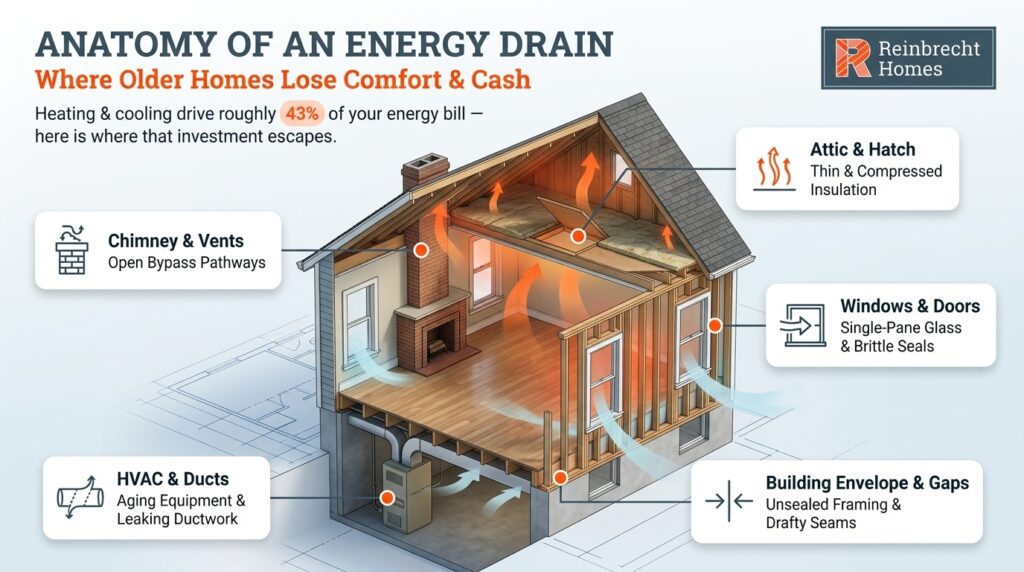
In most older homes, the biggest offenders are:
- Air leaks and gaps: unsealed joints around windows, doors, ducts, the attic hatch, and the fireplace let outside air pour in year-round.
- Thin or settled insulation: insulation that was minimal to begin with, or has compressed over the decades, no longer slows heat transfer well.
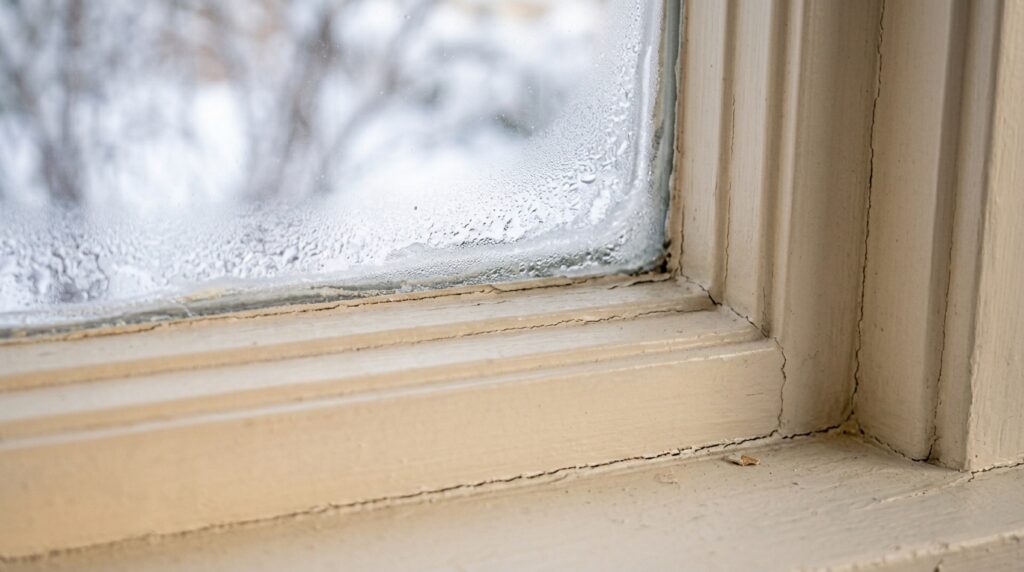
- Single-pane or failing windows: older glass and worn seals give up heat in winter and let it back in during summer.
- Aging HVAC and leaky ducts: an older furnace or air conditioner works harder for less, and leaky ducts waste the air you paid to condition.
- An envelope never sealed tight: many homes built decades ago simply were not built to today’s air-sealing standards.
The waste adds up. The U.S. Department of Energy estimates that of the roughly $2,000 the average household spends on energy each year, $200 to $400 could be going to waste from drafts, air leaks, and outdated heating and cooling systems (DOE). In a climate with cold snaps and humid summers, an inefficient envelope is expensive in both seasons.
If you have lived in your home for years, you already know its true operating cost better than anyone, which makes the upgrade-or-build question a practical one rather than a hypothetical.
What Can You Realistically Fix in an Older Home?
The good news: the most affordable fixes are also among the most effective. Adding insulation is one of the fastest and most cost-effective ways to reduce energy waste (DOE). Air sealing and insulating together save an average of about 15% on heating and cooling costs, around 11% on total energy, for a typical existing home (EPA). Combined with HVAC work and thermostat settings, envelope improvements can cut heating and cooling use 20% to 50% (DOE). Start with the basics before spending on anything fancy.
Start with air sealing and attic insulation
These two give you the most comfort and savings per dollar. Reseal the gaps where air escapes, around windows and exterior doors, at the attic hatch, around duct penetrations, and near the fireplace, then bring attic insulation up to a proper level. It matters more than most homeowners expect, and in many older homes insulation is the single biggest opportunity.
Maintain and upgrade the heating and cooling system
Because heating and cooling are the largest share of your energy use, keeping that system healthy pays off. Change filters on schedule, get an annual tune-up, and seal or repair leaky ducts. When an aging furnace or air conditioner nears the end of its life, a modern, higher-efficiency replacement noticeably lowers operating costs.
How Energy Efficient Can an Older Home Actually Get?
A good retrofit makes an older home noticeably more comfortable and cheaper to run, but it rarely reaches new-construction performance. Sealing and insulating can meaningfully cut an older home’s energy use, but only so far, because some of the biggest weak points are built into the structure itself.
Some things cannot be fixed without tearing the house apart, which is where a retrofit hits its ceiling:
- Band boards: the framing between the floors of a home is a leading source of air leakage, and in new construction it is sealed with spray foam because there is no wall cavity to insulate.
- Framing and wall cavities: you cannot easily re-engineer how an existing home was framed, or add sealing techniques that belong in new construction.
- The floor plan: if the layout no longer fits your life, no amount of insulation will change that.
New construction closes those gaps by design. If your home’s real problems are in the envelope, framing, or layout, and you want full performance rather than a partial improvement, building new is likely the better path.
Is It Cheaper to Renovate or Build New?
It depends on how deep the work goes. Targeted upgrades to a sound home usually cost less to enter than building. But deep retrofits, the kind that chase new-construction performance, add up quickly and often uncover hidden problems once the walls are open. Building new carries a higher headline cost, but the price is transparent and known before you sign.
The real comparison is not a single price tag, it is the whole picture:
- Predictability: renovation budgets can move as contractors find issues behind the walls. Reinbrecht prices a build up front, with no hidden fees, so you know the full cost before you commit.
- Disruption: a major renovation means living in a construction zone for weeks or months; with a new build, you stay put and move once, at the end.
- What the money buys: retrofit dollars improve an existing structure only so far. New-construction dollars buy a complete, sealed envelope and current systems from day one.
One caveat on comparing costs: Reinbrecht avoids cost-per-square-foot pricing, which it considers unreliable, so the honest comparison stays on these decision factors rather than a misleading per-foot number.
When Upgrading Makes Sense, and When Building New Wins
Use one simple test: is the house itself worth investing in? If the structure is sound and the layout still fits your life, upgrades are often the smart, lower-cost path, closing most of the comfort and cost gap without the disruption of moving. If the problems are baked into the envelope, framing, or floor plan, or you want the comfort, warranty, and certainty of a new home, building new tends to win.
Reinbrecht’s semi-custom homes are a popular middle ground when you build: you personalize a proven floor plan instead of designing from scratch, which is simpler and faster than a full custom build while still making the home your own. There is a middle ground on efficiency, too: a partial retrofit now, a deeper one over time, or a move-in-ready new home that delivers new-construction efficiency without the build timeline. Still weighing it? Reinbrecht’s home purchasing guide walks through the cost factors, and you can read more about building new with Reinbrecht.
How Reinbrecht Makes Moving Up Simple
Two worries stop most people from building: selling the current home and affording the build. Reinbrecht is set up to solve both, so moving up does not have to mean carrying two mortgages or draining your savings.
It is a decision plenty of local families have faced. One couple from Mt. Carmel, Illinois described why they chose to build new rather than remodel their family farmhouse: “We originally planned to remodel a family farm house, but after talking with friends whose homes were built by Reinbrecht Homes, we decided we would be happier with new construction. The Reinbrecht team met with us within a week of our call, started construction within four months, and finished well within the projected completion date!”
The No Stress Trade Up Program
If you build with Reinbrecht, the No Stress Trade Up Program lists your existing home while the new one is under construction, and if it has not sold by the time the build is complete, Reinbrecht buys it. That removes the classic move-up problem of trying to sell and build at the same time.
Free construction financing
Reinbrecht also offers free construction financing on up to $250,000 of the build price, with as little as $1,000 down. There are zero interest-only payments and zero out-of-pocket costs from your down payment until closing, and it is available on standard, FHA, VA, and USDA loans. Your money stays in your own accounts during the build instead of going toward construction-loan interest.
Quality and warranty you can count on
Every Reinbrecht home is backed by the Home Buyers Warranty: 10 years of structural coverage, 2 years on systems like electrical and plumbing, and 1 year on workmanship and materials. It is one reason homeowners across Southern Indiana choose Reinbrecht for a build that is done right the first time.
Frequently Asked Questions About Making an Older Home Energy Efficient
Is it worth making an old house energy efficient?
Often, yes, if the home is structurally sound and the layout works. Air sealing, added insulation, and HVAC improvements can meaningfully cut energy use and improve comfort, saving an average of about 15% on heating and cooling for a typical existing home (EPA). The upgrades will not turn a decades-old house into a new build, but for the right home they are money well spent.
What are the best energy-efficient upgrades for an older home?
Start with air sealing and attic insulation, which give strong returns per dollar, then address the heating and cooling system. Adding insulation is one of the fastest and most cost-effective ways to reduce energy waste (DOE), so it is often the single biggest opportunity. Windows and appliances matter too, but the envelope comes first.
Can I build a new home before selling my current one?
Yes. Reinbrecht’s No Stress Trade Up Program is built for exactly this. It lists your current home while the new one is under construction, and if it has not sold by completion, Reinbrecht buys it, so you can commit to building without timing a sale perfectly.
How much can I save by air sealing and adding insulation?
On average, about 15% on heating and cooling costs, or roughly 11% on total energy, for a typical existing home (EPA). Combined with HVAC upgrades, maintenance, and thermostat settings, sealing and insulating can cut heating and cooling use 20% to 50% (DOE). Actual savings depend on your home’s current condition and climate.
Do energy-efficient homes sell for more?
Efficiency is a real selling point. Buyers often look for lower operating costs and everyday comfort, so a more efficient home tends to stand out. Whether you upgrade your current home or build a new, well-sealed one, efficiency generally helps at resale.
Deciding Between Upgrading and Building in Southern Indiana
There is no single right answer. Some older homes are well worth improving, and some families are better served by building new. If you would like help thinking it through for your situation, contact the Reinbrecht team to talk it over, or explore Reinbrecht’s floor plans to picture what a new, energy efficient home could look like for you.
