
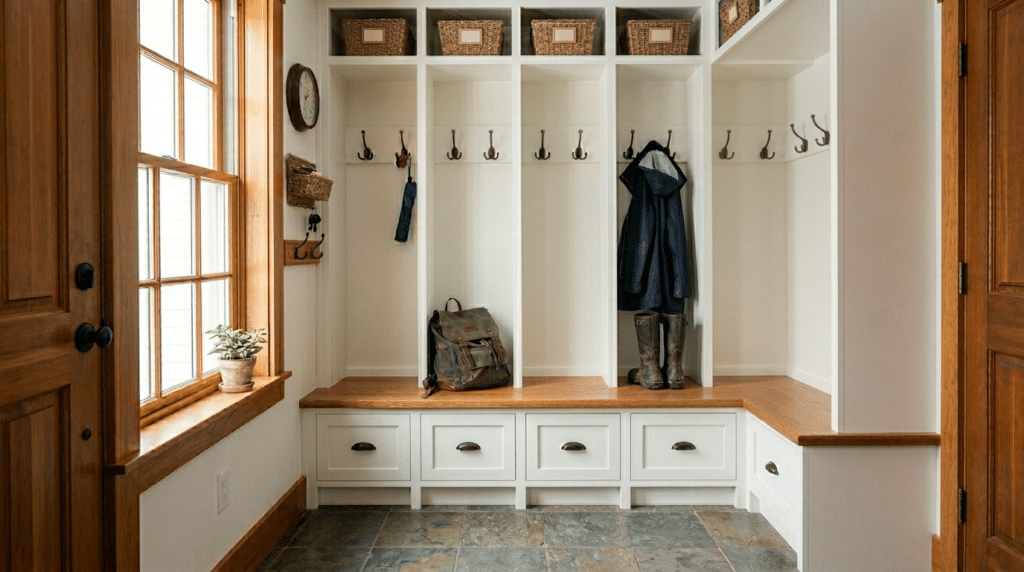
If you’re building a new home in Southern Indiana, a mudroom probably isn’t at the top of your wishlist — but it should be. Talk to any family who’s lived through a Midwest winter without one, and you’ll hear the same thing: mudroom ideas for new homes are easy to dismiss until you’re managing wet boots, farm jackets, and sports gear piling up at the back door every single day.
Key Takeaways
- A mudroom is a practical necessity in Southern Indiana, where mud season, snow, school-year chaos, and outdoor life create year-round demand for a dedicated drop zone.
- Core mudroom features include built-in cubbies or lockers, a bench, durable flooring (tile or LVP), hooks, and adequate lighting — with a utility sink and laundry integration as valuable upgrades.
- Adding a mudroom after construction costs $8,000–$30,000 depending on scope, according to U.S. News & World Report. Planning for one during the build costs a fraction of that and avoids structural constraints entirely.
- A mudroom/laundry room combination is a space-efficient solution that captures the function of both rooms without requiring significant square footage.
- Reinbrecht Homes’ semi-custom homes let buyers personalize mudroom layouts, storage configurations, and finishes as part of the selection process — before the first shovel hits the ground.
Why Southern Indiana Life Demands a Mudroom
Generic home advice will tell you a mudroom is a nice luxury. Midwest homebuilders will tell you something different.
Southern Indiana has a genuine mud season. From early March through May, fields turn saturated, unpaved driveways become soft, and anything that comes through the back door brings the outdoors with it. Add snow boots from December through February, school backpacks and sports gear stacking up several days a week, and the farm and outdoor lifestyle that defines much of this region — and you’ve got the case for a mudroom made for you, without any design magazine needed.
Without a dedicated entry space, all of that lands in your kitchen, your hallway, or your garage. A mudroom is the room that absorbs the transition between outside life and home life. It’s where boots get pulled off before they track across hardwood. Where the soccer bag lives during the week. Where the dog shakes off before hitting the couch.
You can retrofit a mudroom into an existing home. But it costs significantly more, involves structural constraints that limit your options, and means years of living without it first. Building it in from the start is the smarter move — and the less expensive one.
What a Well-Designed Mudroom Should Include
Not all mudrooms are created equal. A bench and a hook rail can get you started, but a mudroom built for real Indiana family life needs a few non-negotiables. Here’s what makes the difference between a mudroom that works and one that becomes a dumping ground.
Built-In Storage: Hooks, Cubbies, and Lockers
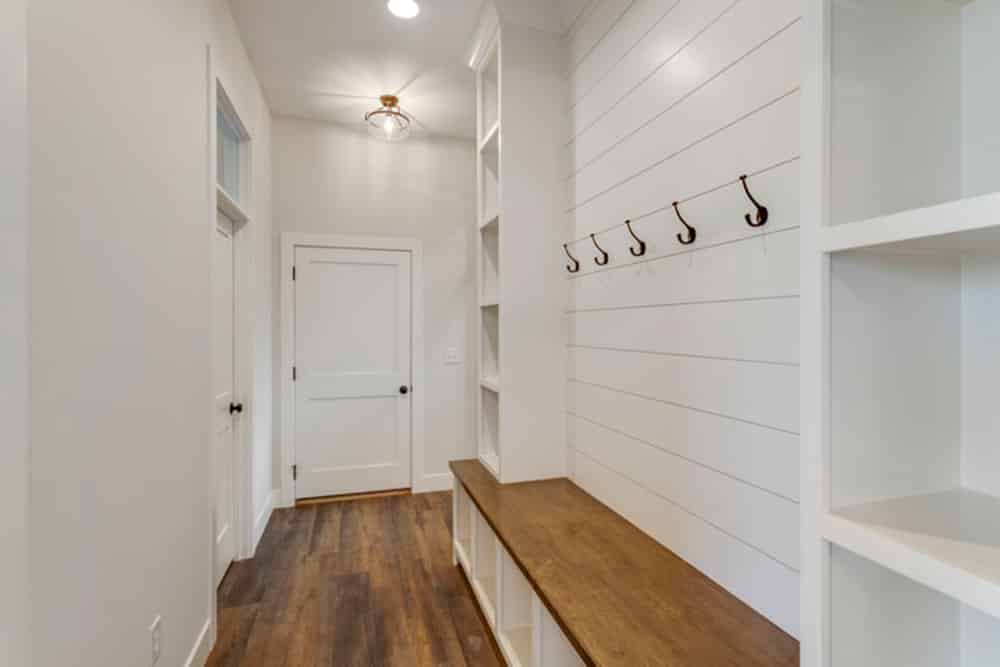
Built-in mudroom storage is what separates a functional mudroom from a narrow hallway with a coat rack. Individual cubbies or locker-style units give each family member their own zone — backpacks, jackets, shoes, and sports gear all have a home. Hooks at multiple heights accommodate both kids and adults. Closed storage options (cabinets or locker doors) keep the visual clutter down even when the space is busy.
The key is planning the storage for how your household actually lives, not for a showroom photo. If you have three kids in school activities, each one needs their own cubby. If you’re a hunting or farming household, you need wider cubbies and possibly enclosed cabinet space for gear that shouldn’t be sitting out.
A Bench for Sitting and Stowing
A mudroom bench does two things. It gives you a place to sit while pulling on boots — which sounds trivial until you’ve tried to put on hunting boots while standing in a narrow space. And it often integrates hidden storage beneath the seat, putting an otherwise underused spot to work for shoe storage, seasonal gear, or extra equipment.
Built-in benches with lift-top storage or pull-out drawers are worth including in your new construction plans. They’re significantly more expensive to add later than to plan for from the start.
Durable Flooring That Can Handle What Indiana Throws at It
Mudroom flooring takes the brunt of every wet boot, muddy paw, and dripping umbrella that comes through the door. The best choices are waterproof and built for heavy traffic. Competing sources and Reinbrecht’s own blog consistently point to the same short list of options:
- Porcelain or ceramic tile: The most durable option, completely waterproof, and easy to mop clean. The grout lines require periodic maintenance, but the material itself holds up to decades of use.
- Luxury vinyl plank (LVP): Fully waterproof, softer underfoot than tile, and available in a wide range of styles that can carry through from the mudroom into adjacent spaces. The 3 most popular types of home flooring — including LVP — are covered in more detail in a separate post on the Reinbrecht Homes blog.
- Slate: A traditional and attractive option, though more expensive and requiring sealing to prevent staining.
Whatever you choose, plan for it during construction. Matching or transitioning flooring from the mudroom to adjacent rooms is far easier when you’re making one unified decision rather than trying to marry a retrofit to existing flooring.
A Utility Sink
A utility sink in the mudroom is optional, but it earns its footprint for households where people come in genuinely dirty. Farm families, hunters, gardeners, kids coming in from outdoor play — a deep utility sink means you’re not trying to rinse muddy hands or boots in your laundry room or kitchen. If the plumbing is already being planned, adding a utility sink connection during construction is a straightforward upgrade.
Mudroom and Laundry Room: A Natural Combination
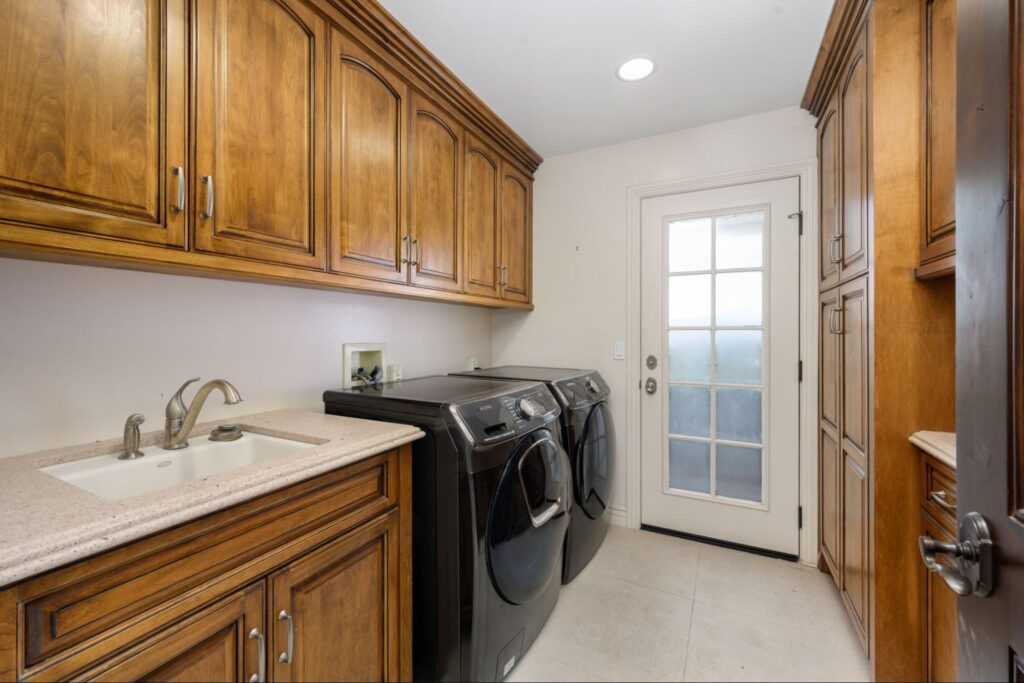
One of the most common buyer questions is whether a mudroom and laundry room can share the same space. They can — and for many Southern Indiana families, this combination makes excellent practical sense.
A mudroom/laundry room combination captures the efficiency of both functions: you strip off dirty clothes and put them directly in the wash, then grab clean ones from the dryer before heading in. The NAHB’s 2024 “What Home Buyers Really Want” study found that a laundry room is the single most-desired feature for home buyers — rated essential or desirable by 86% of respondents. A combined mudroom/laundry room addresses both of the top needs in one well-planned space.
The combination works best when both functions are planned together from the start. Trying to add a laundry room function to an existing mudroom, or vice versa, typically means compromising on both. Build it right from the beginning.
The Real Cost of Waiting: Build It In vs. Adding It Later
This is the argument that matters most for buyers planning a new home. Adding a mudroom to an existing home is expensive. U.S. News & World Report puts the range at $2,500 for a basic porch conversion up to $8,000–$16,000 for a built-in mudroom and $17,000–$30,000 for a bump-out addition that requires a new foundation.
Building a mudroom into new construction costs a fraction of any of those numbers — and it avoids every structural constraint that makes retrofits expensive. When the framing is going up, adding or expanding the mudroom footprint is a planning decision. After the home is finished, it’s a renovation project.
This is exactly why Reinbrecht Homes’ new home construction process is built around making these decisions early. The buyers who sit down to choose mudroom layout, storage, and finishes before the build starts are the ones who end up with the space they actually want — without the retrofit price tag later.
Planning Your Mudroom With Reinbrecht Homes
Reinbrecht Homes builds semi-custom homes from 30+ customizable floor plans across Southern Indiana, Northwestern Kentucky, and Eastern Illinois. The semi-custom process means buyers aren’t starting from scratch — they’re selecting a plan that already works and then personalizing the layout, finishes, and features to fit how they live.
Mudroom planning happens as part of that selection process. Buyers can work through layout options, built-in storage configurations, flooring choices, and whether to combine the mudroom with laundry — all before construction begins. The result is a mudroom designed for a specific household and a specific lifestyle, not a generic entry space tacked onto the back of the floor plan.
The Semi-Custom Standards Guide walks through the standard features and available upgrades, including what’s included at the base level and what buyers can add or modify. The project gallery shows what completed Reinbrecht Homes mudrooms actually look like in finished homes.
As one Southern Indiana homeowner shared after their build: “Our home started with a good plan, then moved on to a budget that included everything from concrete and fill rock to towel bars! Matt Reinbrecht helped us make decisions and even took us to the cabinet maker on an icy, winter day. The quotes were specific and based on what we said we wanted.”
That level of specificity during planning is exactly what produces a mudroom that works — not a box checked off a feature list, but a space designed around real family life in Indiana.
Frequently Asked Questions About Mudrooms in New Construction
What should a mudroom include?
A functional mudroom needs hooks for coats and bags, built-in cubbies or lockers for individual storage, a bench (ideally with storage beneath), durable waterproof flooring, and adequate lighting. A utility sink and laundry room integration are valuable additions if the space and plumbing allow for them. In Southern Indiana, plan for heavier-duty storage and flooring than a warmer-climate home might need — mud season and winter gear put real demands on the space.
Is a mudroom worth adding in new construction?
For Indiana families, yes — clearly. The cost to add a mudroom during new construction is a fraction of what a retrofit costs ($8,000–$30,000 according to U.S. News & World Report), and you avoid the structural constraints that limit your options in an existing home. You also get to design it for your household from the start, rather than working around what’s already there.
What is the difference between a mudroom and a laundry room?
A mudroom is an entry transition space designed to hold coats, shoes, bags, and gear as you come in from outside. A laundry room is a utility space for washing and drying clothes. They’re different functions, but they combine naturally — and a mudroom/laundry room combination is one of the most popular options for new construction buyers because it consolidates two high-utility spaces efficiently.
How big does a mudroom need to be?
A dedicated mudroom can work in as little as 6×8 feet for a smaller household. For families with multiple kids, sports equipment, or farm gear, 8×10 or larger gives you room for individual lockers, a bench, and a utility sink. Planning the size during new construction means you can build what your household actually needs rather than fitting a retrofit into whatever space is available.
What flooring is best for a mudroom?
Porcelain tile, ceramic tile, and luxury vinyl plank (LVP) are the most common and most practical choices. All three are waterproof and handle the traffic and moisture that mudroom floors experience daily. Tile is the most durable but harder underfoot. LVP is warmer and softer, and available in styles that blend well with the rest of the home. Avoid carpet or hardwood — neither holds up to the moisture and heavy use a mudroom floor will see in a Midwest home.
Ready to Plan Your New Home?
A well-designed mudroom is one of those features that you’ll use every single day — and one of those features you’ll wish you’d planned for if you didn’t. The right time to plan for one it is before the foundation is poured.
Explore Reinbrecht Homes’ floor plans to find a layout that fits your household, or contact the Reinbrecht Homes team to start the conversation about building your new home in Southern Indiana.
