
If you already own a few acres in Gibson, Vanderburgh, Posey, Warrick, or a neighboring county, you’ve probably gone looking for answers about building on family land and hit a wall of forum threads and legal sites. Most treat it as a debate (“should you do this at all?”) instead of a practical question (“you’ve decided; what does a builder actually need from you first?”). This post is the second answer: a checklist of the six items the Reinbrecht Homes team confirms on a parcel before quoting a build, written for people who own the land and want to move forward.
Key Takeaways
- Custom homes built on the owner’s land made up 17.5% of new single-family starts in 2024, a category with its own financing, pricing, and timeline logic.
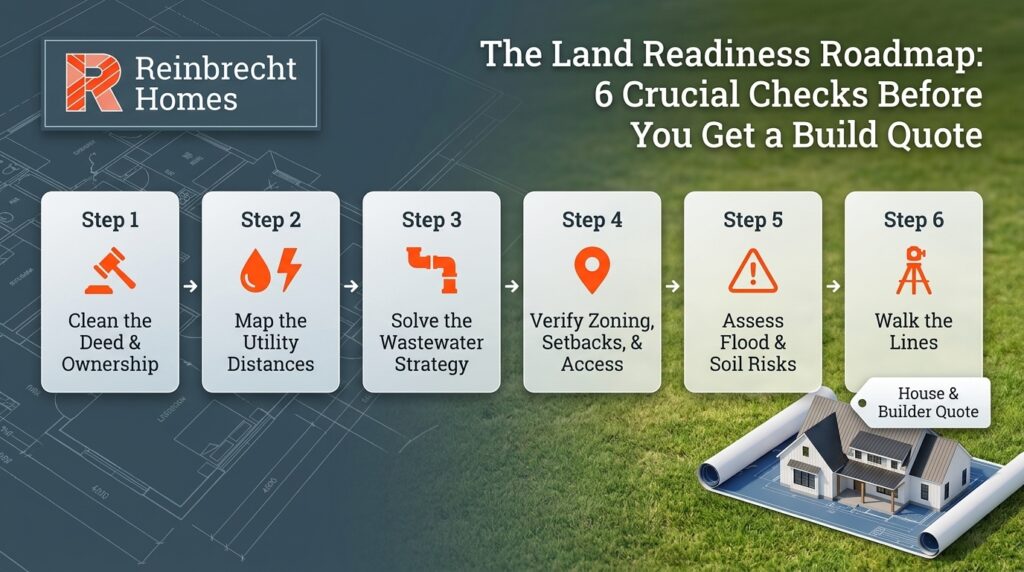
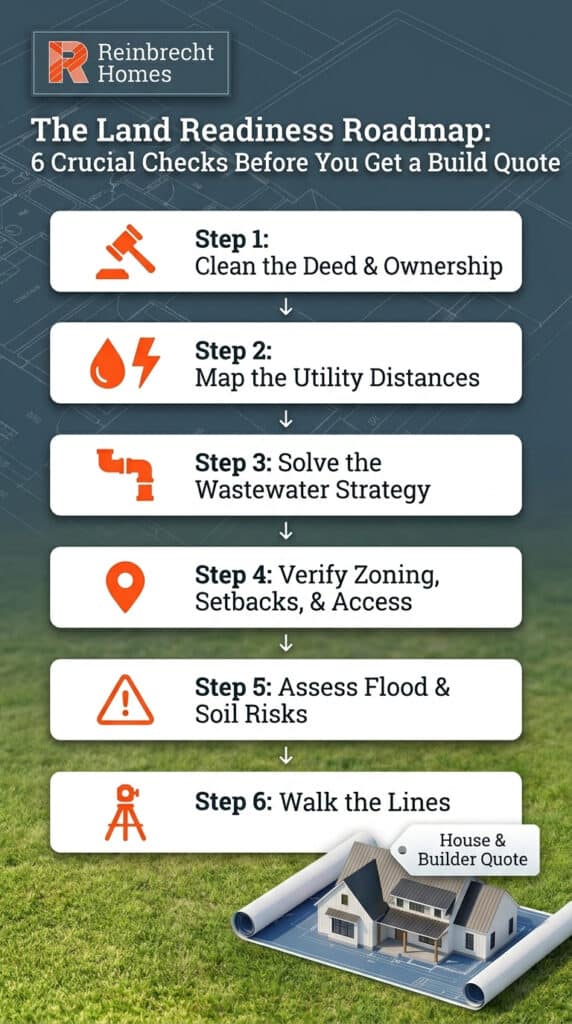
- Six pre-build checks should happen before any builder gives you a real quote: title and ownership, utilities, wastewater, zoning and access, floodplain and soil, and survey/site evaluation.
- Indiana septic systems are governed by Rule 410 IAC 6-8.3, which requires a soil profile analysis by a registered soil scientist and sizes systems at 150 gallons per day per bedroom.
- New residential construction in Indiana follows the 2020 Indiana Residential Code, with local jurisdictions sometimes adding amendments.
- When you already own the land, the parcel can sometimes serve as collateral, and Reinbrecht offers free construction financing on up to $250,000 of the build price across all loan types it supports.
- A semi-custom build typically runs about a month of pre-construction and six to eight months of construction; a fully custom build typically runs two to three months of pre-construction and eight to ten months of construction.
Why Building on Family Land Is a Different Process Than Buying a Lot in a Subdivision
Custom-on-your-land is its own category in the housing data, not a niche of the new-home market. Three points shape how this category works:
- It’s a meaningful market segment. In 2024, 17.5% of all new single-family homes started were custom homes built for owner occupancy on the owner’s land. That share has trended down from 20.4% in 2022, but 176,932 custom home starts in 2024 is still a substantial slice of new construction.
- The financing logic is different. NAHB economists note that the custom segment is less sensitive to interest rate cycles than spec home building and more sensitive to household wealth and stock prices. People who already own land aren’t shopping the same market as people choosing between two finished homes.
- Published prices exclude the lot. NAHB’s square-foot prices for custom homes do not include the value of the lot because these homes are built on the owner’s land. The 2024 median custom contract price in the East North Central division (Indiana included) was $186 per square foot. Reinbrecht doesn’t use cost-per-square-foot as a quoting tool because it tends to mislead more than clarify, but the regional benchmark is a useful order-of-magnitude check.
The Six Pre-Build Checks Before a Builder Can Quote Your Project
Every parcel is different. The six checks below are the questions a builder needs answered, in roughly this order, before quoting an honest build price. On most family lots, four come back clean and two need attention. The point of running them up front is to know which two before you sign anything.
1. Title and Ownership
Before anyone breaks ground, the deed has to be clean and everyone on it has to agree. On family land, this is rarely as simple as one name on one parcel. Often the land was inherited and split among siblings, deeded to one heir but still farmed by another, or sits inside a larger parcel that needs to be subdivided.
Three questions usually come up:
- Is the title clear? Pull the deed and confirm there are no liens, easements, or unresolved claims that would prevent construction or block financing.
- Are all owners on the same page? If the parcel is held jointly or by multiple heirs, every legal owner has to agree to the build and (often) sign onto the financing.
- Does the parcel need to be subdivided? Building one home on a 40-acre family farm is rarely a problem. Carving out a 2-acre homesite from a larger tract almost always involves county approval and a recorded subdivision.
A real estate attorney or title company answers these questions. A builder won’t quote against a parcel until the answers are yes across the board.
2. Utilities and Tap Fees
The cost difference between a lot 50 feet from existing utilities and one 1,000 feet away is the single biggest variable on most rural family parcels. Four utility questions matter:
- Electric: How far is the nearest service line, and what does the utility quote to extend it? Most utilities cover a standard distance and charge per foot beyond that.
- Water: Is there a municipal or rural water district line at the road, or will the home need a private well?
- Gas: Is natural gas available, or will the home use propane (LP)? Propane works well on rural Southern Indiana parcels, but it changes appliance and tank specifications.
- Telecom: Worth confirming early. Fiber availability varies sharply by county.
Tap fees, meter sets, and connection charges add up quickly. The Reinbrecht guide to tap fees and utility connections covers costs in more depth, and the raw land development cost guide walks through the full pre-build budget.
3. Wastewater: Septic vs. Sewer
Most family parcels in Southern Indiana sit outside municipal sewer service, which means the home will be on a septic system. Indiana septic systems are governed by Rule 410 IAC 6-8.3, administered through county health departments. Two requirements drive most of the timeline:
- Soil profile analysis by a registered soil scientist: Before a permit is issued, the soil has to be evaluated by an individual on the Indiana Registry of Soil Scientists. The analysis confirms whether the soil can absorb the design daily flow and what type of system the lot will support. Vanderburgh County requires a minimum of three soil profile evaluations on a residential lot, a useful benchmark for the Evansville-area audience.
- System sizing based on bedroom count: Indiana sizes residential systems using a design daily flow of 150 gallons per day per bedroom. A four-bedroom home requires a system designed for 600 gallons per day, regardless of how many people actually live there.
The tradeoffs between septic and municipal sewer (when sewer is even an option) are covered in detail in the septic vs. sewer guide for Southern Indiana homeowners. Read it before the soil evaluation, not after.
4. Zoning, Setbacks, and Road Access
Zoning on family land in Southern Indiana is usually agricultural or rural residential. Either is generally fine for a single-family home, but the details matter:
- Use is permitted, but with conditions. Most rural agricultural zones allow one residence per parcel by right. Adding a second home, an accessory dwelling, or a non-residential structure usually requires a variance.
- Setbacks restrict where on the parcel you can build. Front, side, and rear setbacks vary by county. A 10-acre parcel sounds large until a 200-foot front setback rules out the spot with the view.
- Road access has to be legal and adequate. A driveway permit from the county or state is required wherever the driveway meets a public road. If access to the parcel runs across another property, an easement has to be recorded.
- Local amendments to the state code matter. Construction follows the 2020 Indiana Residential Code, and counties or cities can layer their own amendments on top.
5. Floodplain and Soil Conditions
Parcels close to the Ohio River or its tributaries often touch a floodplain at some corner of the property, even when the building site itself is high and dry. The check is simple but has to be documented. The FEMA flood map for the parcel determines whether the home can be built where you want, what elevation it has to be built at, and what flood insurance will cost. The FEMA Flood Map Service Center is the official source for finding the effective flood map for any address.
Soil conditions matter beyond the septic evaluation. The foundation type a builder recommends depends on what’s under the topsoil: clay, sand, rock, or fill all behave differently. A site that pools after heavy rain needs grading work before construction starts, and serious slope can rule out certain foundation types or push toward a walkout basement.
6. Survey and Site Evaluation
Most family parcels haven’t been surveyed in decades. The deed description may reference a fence line that no longer exists, a tree that’s been gone for thirty years, or “the old county road” that was rerouted. A current boundary survey confirms the legal lot lines, locates any easements, and establishes the building envelope.
A builder’s site visit covers different ground than a survey. The Reinbrecht team walks the parcel to look at access, topography, the proposed home site, utility run routes, the septic field location, drainage, clearing needs, and where construction equipment can stage. Most of the questions a real quote depends on get answered on that visit.

Financing When You Already Own the Land
The financing changes when you bring the lot to the deal. You’re not financing land plus build; you’re financing the build, with the land sometimes serving as part of the equity. This often means a smaller down payment, faster underwriting, and more flexibility on loan structure.
Reinbrecht offers free construction financing built for buyers bringing land:
- Free construction financing up to $250,000 of the build price.
- As little as $1,000 down to start the build.
- Zero interest-only payments and zero out-of-pocket costs from the down payment until closing.
- All loan types supported: conforming, FHA, USDA, VA, jumbo, and Single Loan Close Construction Program.
When the land is owned outright, it can sometimes serve as collateral for the construction loan, reducing cash needed at closing. The land-as-collateral guide walks through how that works and where it doesn’t. The right structure depends on the loan type, the lender, and the value of the parcel relative to the build cost.
What the Build Process Looks Like
Once the six checks come back clean and financing is in place, the timeline becomes predictable. Reinbrecht offers two paths on family land:
- Semi-custom homes start from one of 30+ customizable floor plans, with personalization on layouts, finishes, fixtures, and upgrades. Pre-construction typically takes about a month, and construction typically takes six to eight months.
- Fully custom homes are designed from scratch, with maximum flexibility on layout, exterior style, and every interior detail. Pre-construction typically takes two to three months, and construction typically takes eight to ten months. The custom home process page walks through how a custom design goes from first conversation to a real quote.
Past customers describe the experience in their own words. One wrote: “The Reinbrecht team and their sub contractors did a wonderful job bringing our dream home to reality. They delivered a home of exceptional quality on time and on budget. They were present for us every step of the way, delivering a personal and professional home building experience.” Another, who originally planned a remodel of a family farm house, wrote: “We were met with within a week of our call, started construction within four months, and finished well within the projected completion date!”
If you’re still in the builder-selection phase, the guide to choosing a build-on-your-land builder covers what to look for. For a broader overview, Building A New Home on Your Own Land: What You Need to Know is the companion post to this one.
Frequently Asked Questions About Building on Family Land
How do I get a soil evaluation for my land?
Contact a registered professional soil scientist on the Indiana Registry of Soil Scientists, or ask the local county health department for a list of soil scientists who work in your county. The evaluation usually takes a few hours on site, plus a written report. The county will not issue a septic permit without it.
Can I get a construction loan on land I already own?
Yes, and the structure usually changes when you own the land outright. The parcel can sometimes serve as part of the equity in the deal, reducing the cash needed at closing. The right loan type (conforming, FHA, USDA, VA, jumbo, or Single Loan Close Construction) depends on the build cost, location, and your financial profile.
What happens if part of my land is in a floodplain?
A FEMA flood map determines what’s possible. Some parcels have a floodplain edge that doesn’t touch the buildable area. Others require the home built at or above a specific flood elevation, affecting foundation type and cost, and a few parcels have floodplain coverage that rules out building entirely. The flood map is the first place to look.
How long does the whole process take, from first call to move-in?
For a semi-custom home on family land where the six pre-build checks come back clean, expect about seven to nine months total: roughly a month of pre-construction plus six to eight months of construction. A fully custom home typically runs ten to thirteen months total. Lots that need long utility runs, road access improvements, or septic installation add time to the front end, not the build itself.
What are the typical hidden costs of building on raw land?
The most commonly underestimated costs are utility extensions, septic system installation, driveway construction, and site grading. These aren’t hidden in the sense of being unknown; they’re hidden in the sense that buyers used to subdivision pricing don’t always think to ask about them. A real Reinbrecht quote includes all of them, so there are no hidden fees once the contract is signed.
Ready to Build on Your Family Land?
If you own land in Southern Indiana, Northwestern Kentucky, or Eastern Illinois and want to know what it would take to build on it, the next step is a conversation with the Reinbrecht team. Send a message through the contact page with the parcel location and a rough sense of the home you’re imagining. The team will walk you through the six pre-build checks for your specific lot.
