The Semi-Custom Home Building Process: A Step-by-Step Guide
Share:
Building a semi-custom home means you get more than a floor plan to point at. You get a guided process that takes you from your first conversation with a builder to the day you get your keys. Understanding the semi-custom home building process upfront makes the experience less stressful and a lot more rewarding.
Key Takeaways
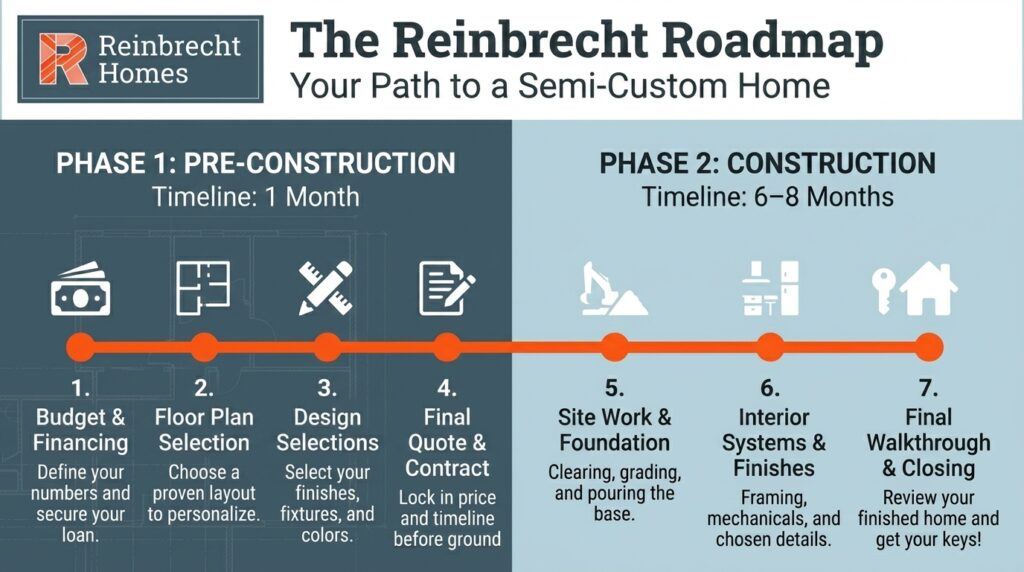
The semi-custom home building process has two phases: pre-construction (approximately 1 month) and construction (typically 6–8 months).
Settling your budget and financing before choosing a floor plan keeps every decision that follows grounded in what you can actually afford.
Reinbrecht offers free construction financing up to $250,000 of the build price, with as little as $1,000 down and zero interest-only payments during construction.
Nationally, the average time to complete a single-family home is 10.1 months. Reinbrecht’s semi-custom timeline is typically faster.
Design change orders after construction starts add cost and time, which is why the pre-construction selection phase is one of the most important parts of the process.
Every Reinbrecht home is backed by a 10-year structural warranty, 2-year systems coverage, and 1-year workmanship and materials coverage after closing.
Two Phases, One Streamlined Process
The semi-custom home building process breaks into two distinct phases: pre-construction and construction. Understanding both helps you make confident decisions rather than scrambling when choices come up.
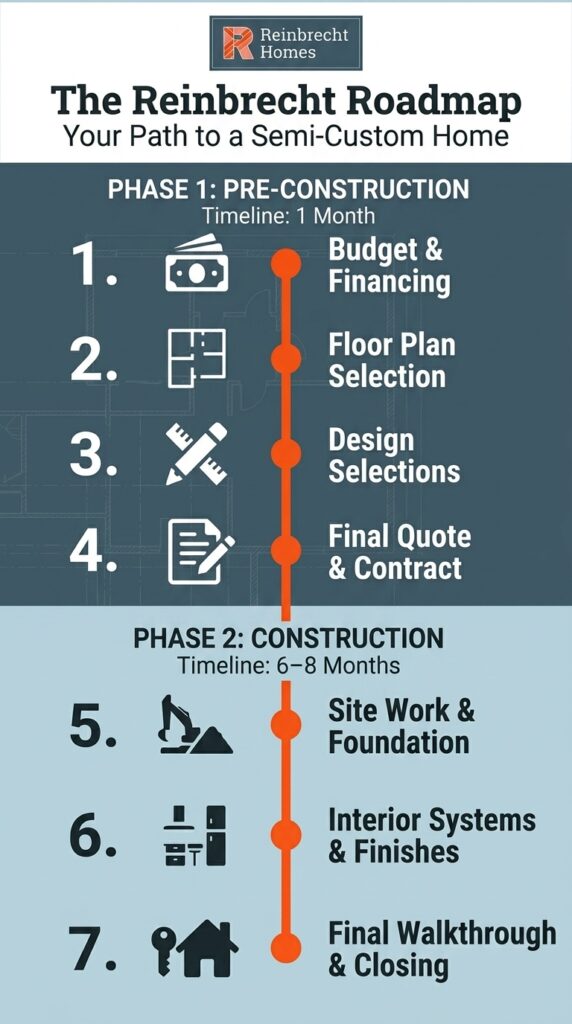
Pre-construction typically takes about 1 month and covers everything before a shovel hits the ground: establishing your budget, choosing a floor plan, making your design selections, and signing your contract. Construction typically takes 6–8 months, from breaking ground through your final walkthrough. If you’re still weighing semi-custom against other home types, What Is a Semi-Custom Home? covers those comparisons in detail.
Pre-construction is where the semi-custom home building timeline actually begins, even before anyone touches the lot. The decisions you make here set the course for the entire build.
Step 1: Set Your Budget and Secure Financing
Before you look at a single floor plan, you need a clear picture of what you can spend. Knowing your budget first keeps the entire process grounded: every decision that follows, from floor plan to finishes, is one you can actually afford. Reinbrecht uses transparent, upfront pricing with no hidden fees. You know the exact cost before signing anything. They do not use cost-per-square-foot pricing, which the team considers an unreliable way to represent what a home actually costs.
Reinbrecht offers free construction financing up to $250,000 of the build price, with as little as $1,000 down and zero interest-only payments during construction. They work with local banks and support conforming, FHA, USDA, VA, Jumbo, and Single Loan Close Construction loans. Addressing financing before your first meeting with the team means you arrive ready to make decisions, not gather information.
One mistake buyers make at this stage: confusing the base build price with the full budget. The build price covers your home from driveway to roof. Your total out-of-pocket picture also needs to account for:
Landscaping: Grading, seeding, and plantings after construction are typically not included in the build price.
Window treatments and furnishings: Many buyers are surprised by how much it costs to finish a new home once they have the keys. Blinds, curtains, and furnishings are not included in the build price.
Lot infrastructure: If you’re building on your own land, electricity, water, and sewage connections may require additional investment depending on the lot.
With your budget in hand, you’re ready to select a layout. Reinbrecht offers 30+ customizable floor plans across a range of sizes and styles. From there, you can personalize room configurations, ceiling heights, and other structural elements that would be difficult or expensive to change after construction begins.
One thing to understand going in: semi-custom means modifying an existing, proven plan, not designing from scratch. That structure is a feature, not a limitation. It keeps the process faster, more predictable, and more cost-controlled than full custom construction. If you want a completely blank-slate design, custom home construction is the better fit.
Step 3: Make Your Design Selections
Once your floor plan is chosen, you move into the selections phase: choosing interior and exterior finishes, fixtures, cabinetry, flooring, and other features that define how your home looks and feels. Most buyers are surprised by how many decisions this involves.
Reinbrecht’s Semi-Custom Standards Guide documents what comes standard in every home, so you can build on top of a known baseline rather than starting every conversation from zero.
The volume of decisions is exactly why this phase matters. Buyers who rush through selections often end up with change orders once construction is already underway, and those changes cost more and take longer than decisions made upfront. Treat this phase as your opportunity to get things right before they’re built.
Step 4: Review Your Price Quote and Sign Your Contract
Once your floor plan and selections are finalized, Reinbrecht prepares a detailed price quote. Because every feature and finish was chosen upfront, the estimate is precise, not a ballpark. You know exactly what you’re agreeing to before you sign anything.
The contract covers the full scope of the build: what’s being constructed, the total cost, the payment schedule, and the projected timeline. Both parties agree on expectations before work begins, which is what makes the process predictable. After signing, your build is scheduled and you’ll receive a production timeline for each phase of construction.
Phase 2: Construction (Typically 6–8 Months)
Construction begins with site preparation and runs through every stage of the build. Throughout this phase, Reinbrecht uses Buildertrend to keep buyers connected in real time, with progress photos, a shared calendar, and electronic sign-off on any change orders, all in one place.
Step 5: Site Work and Foundation
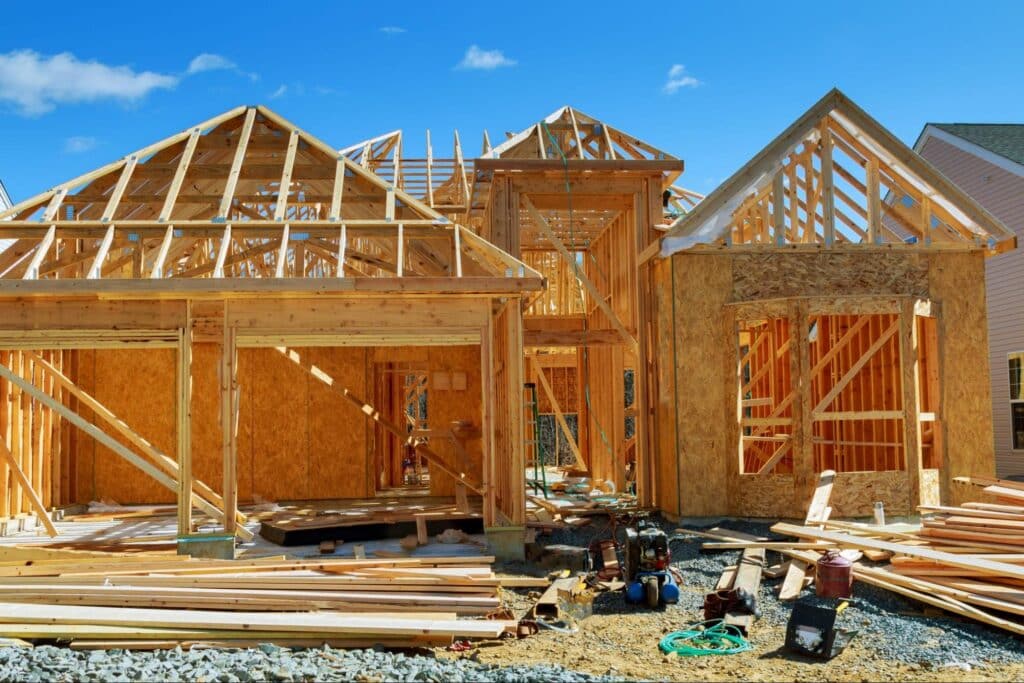
The build opens with site preparation: clearing, grading, and utility connections, followed by pouring and inspecting the foundation. Once the foundation passes inspection, framing begins. This is typically one of the most exciting milestones for buyers to visit in person. You’ll see the home start to take shape in a way that no floor plan drawing fully captures.
Step 6: Interior Systems and Finishes
After framing, the focus shifts to mechanical systems (electrical, plumbing, and HVAC), followed by insulation, drywall, trim, cabinetry, and all the finish work selected during pre-construction. Every Reinbrecht home includes Spider Plus sprayed-in fiberglass insulation on all exterior walls and spray foam insulation on band boards as standard.
Reinbrecht homes are built to be 35% more energy efficient than the industry standard, with HERS Index scoring and ENERGY STAR certification options available. Buildertrend keeps you in the loop throughout: if questions come up or approvals are needed, the platform handles communication and documentation without phone tag.
Step 7: Final Walkthrough and Closing
As construction wraps up, you’ll do a final walkthrough with the Reinbrecht team to review the finished home and document any remaining items. Once those are addressed, you close on the home and get your keys.
Common Pitfalls to Avoid in the Semi-Custom Process
Even with a smooth process, a few predictable mistakes can add cost, time, or frustration to a build. These come up often enough that they’re worth knowing about before you start:
Choosing the wrong floor plan: A layout that looked right on paper can feel wrong once construction is underway. Take time to walk completed Reinbrecht homes or visit active neighborhoods before committing to a plan. It’s far easier to choose a different layout before the contract is signed than to change it after.
Making frequent changes after construction starts: Change orders are possible, but they add real cost and can push your closing date. Lock in your selections during pre-construction and treat them as final.
Not vetting your builder: Not all semi-custom builders deliver the same quality or experience. Reinbrecht has been building homes in Southern Indiana since 1995, with more than 30 years and 500+ completed homes behind them, and earned the 2024 Gold Winner recognition from the Evansville Community’s Choice Awards for Home Builder.
Underestimating lot requirements: If you’re building on your own land, some lots require infrastructure investment for electricity, water, and sewage hookups. Know what your lot needs before finalizing a budget. Reinbrecht also has lots available in their active neighborhoods if you haven’t found land yet.
After Closing: Your Warranty and What’s Covered
Closing isn’t the end of the relationship. It’s the start of homeownership, and Reinbrecht backs every home with a comprehensive Home Buyers Warranty. Coverage includes:
10 years of structural defect coverage (foundation, framing, and load-bearing components)
2 years of systems coverage (electrical, plumbing, and mechanical)
1 year of workmanship and materials coverage
Frequently Asked Questions About the Semi-Custom Home Building Process
How long does the semi-custom home building process take?
From first meeting to closing, most Reinbrecht buyers complete the process in approximately 7–9 months. Pre-construction typically takes about 1 month, and construction typically takes 6–8 months. These are typical ranges and not guarantees. Your timeline can vary based on selections, lot conditions, and build scope.
How is the semi-custom process different from building a custom home?
In a semi-custom build, you start with an existing floor plan and personalize it. In a fully custom build, the home is designed from scratch with maximum flexibility and a longer timeline. Reinbrecht’s custom home pre-construction phase takes 2–3 months, with construction running 8–10 months, compared to approximately 1 month pre-construction and 6–8 months of construction for semi-custom.
Can you make changes after construction starts on a semi-custom home?
Changes after construction begins are called change orders, and they add both cost and time to your build. It’s possible, but not advisable. The design selection phase during pre-construction is specifically designed to give you the space to make all your decisions before work starts. Taking that phase seriously is the single most effective way to avoid costly surprises later.
What decisions do you make during the semi-custom selection process?
Selections typically include interior finishes (flooring, cabinetry, countertops, fixtures, paint, and trim), exterior choices (siding, roofing, and garage doors), and any structural modifications to your chosen floor plan. Reinbrecht’s Semi-Custom Standards Guide documents what comes with every home as a standard inclusion, so you know exactly what you’re starting with before you add upgrades.
How does Reinbrecht financing work during construction?
Reinbrecht offers free construction financing up to $250,000 of the build price. You can start with as little as $1,000 down, with zero interest-only payments and zero out-of-pocket costs from your down payment until closing. They work with local banks and support a range of loan types, including FHA, USDA, VA, Jumbo, and the Single Loan Close Construction Program.
Ready to Start Your Build?
A semi-custom home isn’t just a faster path to a new home. It’s a long-term investment built to your specifications, with modern systems, energy-efficient construction, and a warranty that protects you for years after you move in. Buying an existing home means inheriting someone else’s decisions, maintenance history, and aging systems. Building new means starting with everything right.
The semi-custom home building process is more manageable than most buyers expect, especially with a builder who has guided more than 500 families through it over the past 30 years. Reinbrecht’s team walks you through every step, from your first floor plan conversation through the day you get your keys.
“Our home started with a good plan, then moved on to a budget that included everything from concrete and fill rock to towel bars! Matt Reinbrecht helped us make decisions and even took us to the cabinet maker on an icy, winter day. The quotes were specific and based on what we said we wanted. Thanks to everyone who helped us!”